
Right Education is essential for unlocking human potential, fostering a fair society and driving national progress. Ensuring universal access to quality education is vital for Bharat’s growth and its global leadership in economic prosperity, social justice, scientific progress and cultural preservation. High-quality education is the most effective way to utilize the nation’s resources and talents for the benefit of individuals and society as a whole. With today’s rapidly evolving job market, it’s crucial for children to not only acquire knowledge but also learn how to learn. Educational approaches should prioritize critical thinking, problem-solving, creativity and adaptability.
Thus, pedagogy needs to transform to be more experiential, integrated, inquiry-driven and enjoyable. The curriculum should encompass not just science and math, but also the arts, humanities, sports, languages and cultural values to nurture well-rounded individuals and foster personal as well as national character. Reforms must be instituted to enhance the quality and equity of the education system at all levels, addressing current learning outcome deficits.
According to Pandit Deendayal Upadhyay, “Right Education” is an investment poised to drive positive societal change in the future. The education model imposed by Macaulay aimed to enslave Bharatiyas to British ideologies while disdaining Bharatiya culture and values. An educational framework should focus on building life skills and a strong national identity, rooted in our ancient Gurukul system that harmonized cultural and spiritual learning with scientific and technological insights.
Some of these Gurukuls gradually evolved into what we now call universities. The reasons could range from the dissemination of their popularity far and wide to students coming to these well-known locales, resulting in the establishment of universities. These served as advanced learning centers or institutions. The Vedic culture, particularly the early Vedic society, was highly liberal and egalitarian in nature. Sages imparted knowledge in Gurukuls and both boys and girls received education there. The academic matter and content of education were determined by an individual’s Varna status. Historical evidence suggests that women such as Apala and Lopamudra produced Vedic hymns.
Women who studied their entire lives were known as brahmavadini. There are few more names knowledgeable women in the later Vedic period, such as Gargi and Maitri. Yes, women went to gurukuls and few trained at home during the Vedic period. Girls were trained in battle and all Vedas, just like boys, but not every girl. It was based on individual merit and interest. For example, Kaikeyi, King Dashrath’s wife, and Chitrangada, Arjun’s wife received martial training and were skilled fighters. Kaikeyi also learned charioteering. Satyabhama received martial training and accompanied Krishna in his war against Narakasura.
Draupadi was in charge of the empire’s treasury and finances. she states in Vanaparva that she was taught in Drupad’s palace before her marriage. Look up the walls of ancient temples like the Khajuraho Temple; there are Gurukul scenes where a Rishi is teaching children, and girls are sitting and standing among them with bags and slates, writing. As the era of artificial intelligence unfolds, it’s imperative to ensure ethical applications of technology to prevent harm to humanity. The spiritual aspects of the New Education Policy aim to imbue students with ethical practices, preparing them to lead responsibly in the world of AI.
A nation suffers when its people are disconnected from their roots or ashamed of their heritage, leading to its decline. Forgetting one’s identity in favor of emulating others only paves the path to self-destruction. To prevent our nation from weakening, it is crucial to liberate our educational system from Macaulay’s influences and cultivate a genuine understanding of our enduring beliefs, passing them on for further exploration by future generations with increasing pride and nobility.
Macaulayism represents a systematic effort to erase indigenous culture through the promotion of a foreign ideology via education. His policies aimed to create a generation of Bharatiyas educated in a colonial mindset, breeding a class of individuals who were Bharatiya in identity but English in culture and morality. This approach not only demonstrated a disregard for local identities and languages but also fostered cultural strife and undermined the rich indigenous intellectual legacy. Unfortunately, this cultural erosion has led to a decline in interest in Bharatiya arts, history, and sciences, ultimately failing to honor the nation’s profound heritage.
Rethinking IQ: A comprehensive perspective
For the past century, we have revered the Intelligence Quotient (IQ), leading us to believe that a single number—based on a student’s ability to solve logic problems and memorize facts—determines their value and future success. This singular focus on IQ has resulted in an imbalanced view of human potential.
When we emphasize only the intellectual “blade,” we overlook the essential “handle” that supports it. A brilliant intellect devoid of emotional stability can become self-destructive, while a sharp mind lacking ethical guidance poses a threat to society. The current educational framework measures a student’s capacity to absorb information but neglects crucial aspects like their ability to remain composed (Regulation), discern truth amidst overwhelming information (Discernment), and understand the purpose behind their efforts (Purpose). We must harmonize intellect, mind, and soul—an essential factor we have forgotten—leading to a great deal of confusion and moral decline among students.
Mental Health Crisis: A generation in distress
The current statistics indicate a true crisis. Rates of anxiety, depression, and burnout among students below eighteen are at unprecedented levels. This is a direct consequence of the pressures of a hyper-competitive education system. When education turns into a cut throat contest for a limited number of opportunities, it forces students into a constant state of stress.
In the modern educational landscape, we have committed a grave error: we have confused “Information Processing” with “Mental Power.” We assume that because a student can navigate a smartphone or solve a complex equation, they possess a strong mind. But the reality in 2026 tells a different story. We are seeing a generation with high IQ but dangerously low MQ (Mental Quotient).
If the mind is a ship, IQ is the engine that determines how fast it can go. But MQ is the anchor. Without an anchor, even the fastest ship is at the mercy of the storm.
Cognitive Vulnerability: The current system penalizes failure rather than using it as a learning opportunity, rendering students “fragile” and lacking the mental resilience to cope with setbacks.
We must train students to “close the gates” of the mind. This isn’t about running away from technology; it’s about Sovereignty. A student with high MQ chooses when to engage with the digital world and when to retreat into the “Sanctuary of the Self.
Digital Disruption: The attention of today’s students is manipulated by algorithms, leading to a fragmented focus due to the incessant barrage of notifications.
The Search for Meaning: Many students are increasingly questioning the purpose of their education. They are trained to achieve “success” by societal standards but often feel an emptiness, as their education lacks connections to their heritage or any deeper significance.
A Holistic Approach: The six-fold awakening
To break free from this cycle, we must shift our focus from merely “fixing” the current educational system to creating a more nurturing environment. Instead of primarily asking, “How intelligent is this child?” we should inquire, “How holistic is this individual?”
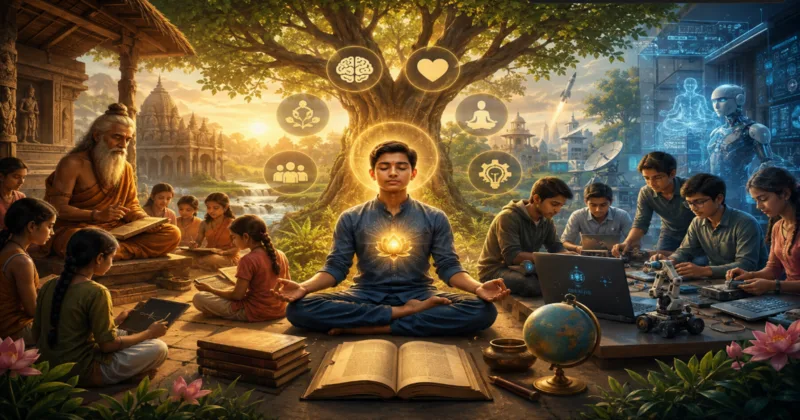
The quest for a Sovereign Mind starts with recognizing that a student is more than just an intellectual asset; they are a complex being that requires emotional stability (MQ), sharp discernment (IQ), a sense of purpose (SQ), and a connection to their community (NQ). Blending the enduring wisdom of the ancient Gurukul system with modern technologies could provide a comprehensive educational framework.
The National Quotient (NQ) emphasizes our interconnectedness—not as isolated entities but as integral parts of a larger societal organism. The Dharma-Artha Quotient (DAQ) evaluates a student’s ability to generate value and prosper ethically. This hybrid approach aims for holistic growth instead of mere rote learning.
While contemporary education aims to cultivate “Global Citizens,” it often leads to “Nowhere Citizens”—individuals equipped with advanced skills yet lacking roots, historical awareness, and a sense of responsibility toward their communities.
Awakening the purna citizens
The journey through the Six Quotients represents more than an educational overhaul; it signifies a cultural reconnection. We began by critiquing the Industrial Trap, which viewed the human mind as just another component of a global machine. We conclude with the vision of the “Sovereign Mind,” portraying a student as a “light” to be inspired by, rather than merely a “resource” to be utilized.
When we integrate Mental, Intellectual, Spiritual, Research and Innovation, Dharma and Artha, and National Quotients, we foster the condition of Purnata (wholeness) in students. They acquire the mental equilibrium to stay calm amid chaos, the intellectual capability to innovate and discern truth, a spiritual purpose that turns work into a calling, and a national identity that aligns their achievements with contributions to society.
By cultivating research and innovation skills along with ethical awareness, and a commitment to sustainability, we prepare students to elevate nation across all aspects of life. Focusing on these six quotients is essential to enacting meaningful reform within the educational system.
The “Sovereign Mind” isn’t a distant utopia; it’s a decision we make each day. We choose to take a moment before reacting, to question rather than accept blindly, and to prioritize service over self-interest. The age of the “Industrial Student” is ending, giving way to the era of the Purna Citizen, and the future classroom is prepared.
In the industrial education model, the teacher is a “content deliverer”—a biological search engine tasked with transmitting a fixed syllabus to a passive audience. But in the age of Artificial Intelligence, where information is a commodity, the role of the “Lecturer” is dead. To cultivate the six Quotients, we must revive the ancient concept of the Acharya: one who teaches not just by their words, but by their Achar (conduct). The Modern Guru is not a “Sage on the Stage,” but a Sutradhar—the holder of the thread—who guides the student through the labyrinth of information toward the sanctuary of wisdom.
The West offers a model of high-tech individualism that often leads to burnout and isolation. Other models offer collective discipline at the cost of personal freedom. The Bharatiya Model—the path for the sovereign mind—offers a synthesis: Individual excellence for collective well-being. By producing citizens who are technically elite yet ethically anchored, Bharat does not just compete with the world; it leads the world.