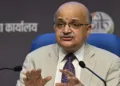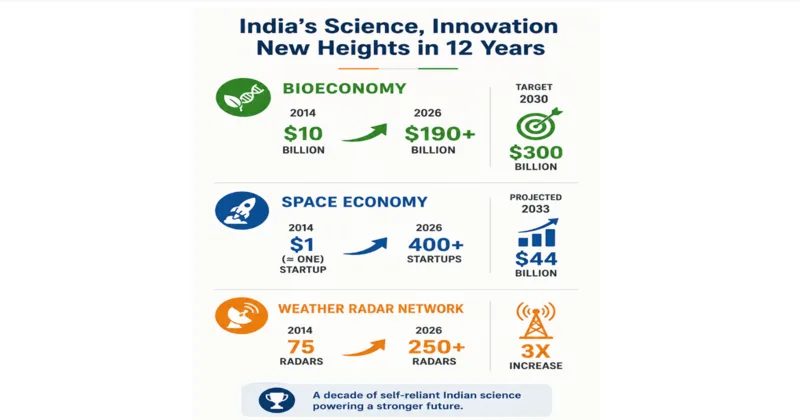
The Union Minister of State (Independent Charge) for Science & Technology and Earth Sciences Dr Jitendra Singh stood before the press at the CSIR headquarters in New Delhi on June 15 and offered a detailed number on bioeconomy, it has expanded from roughly $10 billion in 2014 to more than $190 billion today in 2026, with a stated target of $300 billion by 2030. 12 Years of Transformative Growth in Science, Technology and Innovation argues that Indian science has moved out of the laboratory, into the everyday economy, governance and the lives of ordinary citizens.
The claim deserves both celebration and scrutiny. The trajectory is real, the policy implemented behind it, is documented and the comparison with where India sat a decade ago is on the negative seat. But the precise figures carry a subtlety during last 12 years is applaudable.
Journey From $190 Billion with $165.7 Billion
The official benchmark report for this sector is the India Bioeconomy Report, published by the Department of Biotechnology through BIRAC. Its most recent edition pegged the bioeconomy at $165.7 billion in 2024, a sixteen-fold rise from $10 billion in 2014, contributing of 4.25 per cent of GDP and growing at a compound annual rate of 17.9 per cent over the preceding four years. The same report charts the road to $300 billion by 2030 and a $1 trillion vision by 2047 and it notes the sector nearly doubled in just five years from about $86 billion in 2020.
The June figure of over $190 billion should hold as the Minister current statement and the $165.7 billion as the last audited report. Both points in the same direction, only the decimal precision is in motion.
Inside the Biotech Engine: Pharma, Fuels and the High-Skill Layer
By the 2024 accounting, the industrial segment of biofuels, bioplastics and allied manufacturing has generated nearly half the total value around $78 billion. Pharmaceuticals, led by vaccines, accounted for roughly 35 per cent. The fastest-growing slice was research and IT in the field of bioinformatics, clinical trials and biotech software, the high-skill layer that signals a maturing rather than merely an extractive economy. Indian firms already supply about 40 per cent of the world generic medicines, a figure that anchors the country claim to being indispensable to global public health.
Policy and Startups: The BioE3 Scaffolding
Underpinning the numbers is the BioE3 policy of Biotechnology for Economy, Environment and Employment approved by the Union Cabinet on 24 August 2024 to push high-performance biomanufacturing. The startup base has thickened in parallel from 5,365 bioeconomy companies in 2021 to 10,075 by 2024, with BIRAC network of bio-incubation centres providing the plug and play laboratory space that early-stage founders rarely command. The Minister pointed to indigenous, affordable CAR-T cell therapy, next generation antibiotics, genomics and precision medicine as the kind of frontier work India is now doing for itself rather than importing.
The honest counterweight, recorded in the same official report, is concentration and under-investment. Five states such as Maharashtra, Karnataka, Telangana, Gujarat and Andhra Pradesh, account for more than two-thirds of bioeconomy value, while the entire eastern and northeastern belt contributes under 6 per cent. India spends roughly 0.8 per cent of GDP on research and development, well below the United States and China. And while a 4.2 per cent bioeconomy share of GDP matches those two giants, it trails European economies such as Spain and Italy, which draw over 20 per cent of GDP from bio-based activity. The room to grow is precisely what makes the $1 trillion ambition more than rhetorics but only if the capital and the geography both widen.
Space Economy: The Cleaner Set of Startups Numbers
If the bioeconomy is the quieter revolution, space is the one that captures the imagination and here the official figures are cleaner. India space economy stands at roughly $8 to $8.4 billion and the government projects a roughly five-fold rise to $40–45 billion over the coming decade. With IN-SPACe specifically modelling a climb to $44 billion by 2033 and Indian share of the global market rising from around 2 per cent to 8 per cent.
The startup arithmetic is the part that genuinely reorders the picture. In 2014 India had in effect has a single registered space startup. As of early 2026 the count exceeds 400 IN-SPACe’s portals listed 399 in late January with the spanning launch vehicles, satellites, propulsion systems and space-grade electronics. Private investment in these ventures has crossed $500 million, with nearly $150 million drawn in 2025 alone. Names such as Skyroot Aerospace and Agnikul Cosmos, which executed sub-orbital launches in 2023 and 2024 and earth-observation players like Pixxel, now stand as proof that the liberalisation gamble paid off.
Reforms by Design, Not Accident
In June 2020 decision to open the sector for the private players, creation of IN-SPACe as a single-window authoriser, the formation of NewSpace India Limited to commercialise ISRO’s technology and the Indian Space Policy 2023 together rewired a state-monopoly model into what one analysis called a state–startup developmental partnership. More than 70 ISRO technologies have been transferred to private industry. Chandrayaan-3 India’s first soft landing near the lunar south pole, a feat no other nation had achieved, as the emotional centre of this story and set the next markers far out, the Bharatiya Antariksh Station by 2035 and an Indian on the Moon by 2040.
India still captures only about 2 per cent of a global space economy dominated by the United States, which absorbed 52 per cent of worldwide private space funding in 2025 against India’s roughly 300-to-825 startup gap. Late-stage capital remains scarce and an 18 per cent GST on domestic launch services from which foreign customers are exempt has pushed some founders to incorporate abroad. A launchpad economy has been built, the financing pipeline behind it is still being laid.
Weather: Tripling the Radar Grid
The third pillar is the least glamorous and arguably the most life-saving. Dr Singh described the modernisation of the India Meteorological Department as one of the most significant achievements of the period where a Doppler radar network that has grown from 17 units in 2014 to nearly 50 today, with another 50 planned under Mission Mausam. Forecast coverage has widened from around 300 cities to nearly 1,700 locations, while hyper-local Nowcast services and expanded lightning-detection systems push warnings to farmers, fishing fleets and disaster agencies in the narrow window where they still change outcomes.
Mission Mausam: The Engine and Its Targets
Mission Mausam is the engine. Approved by the Union Cabinet on September 11, 2024 with a Rs 2,000 crore outlay for 2024–26 and launched by the Prime Minister on 14 January 2025 the IMD 150th anniversary, the mission funds 50 new Doppler weather radars, 60 radiosonde stations, 100 disdrometers, wind profilers, radiometers, ocean buoys and a cloud chamber for monsoon research. Implemented jointly by the IMD, the Indian Institute of Tropical Meteorology and the National Centre for Medium-Range Weather Forecasting, its technical targets are concrete lifting model resolution from 12-kilometre to 6-kilometre blocks, compressing nowcasts from three hours to one and improving short to medium range accuracy by 5 to 10 per cent. A parallel effort promises hourly and five-day forecasts in twelve Indian languages to more than 2.5 lakh gram panchayats.
The gap between infrastructure and impact is the part of field reporting keeps surfacing. In rural Madhya Pradesh, farmers without smartphones or struggling with English only apps showing data as undefined, remain cut off from forecasts built precisely for them. A perfect prediction that never reaches the right village in time saves no one a truth the mission’s own last-mile connectivity component implicitly concedes.
The Connecting Thread: Indigenous Capability as Economic Strategy
What ties the bioeconomy, the space sector and the weather grid together is a single argument the Minister returned to repeatedly, that almost every major government flagship programme is now powered by technology developed within India own science ecosystem. He cited the broader research base too Gross Expenditure on R&D more than doubling from Rs 60,196 crore in 2013-14 to Rs 1,27,381 crore by 2024, indigenous Covid-19 vaccines and even steel-slag road technology that turns industrial waste into durable, cheaper highways.
From Buyer to Builder and What Comes Next
The framing is unmistakably one of sovereignty solutions designed in India, for Indian conditions, increasingly exported to the world rather than purchased from it. On the evidence, that framing has earned a good deal of its confidence. The bioeconomy multiplier is real even at the conservative $165.7 billion figure, the space startup count genuinely went from one to several hundred, the radar grid genuinely tripled. The qualifications the gap between the Minister $190 billion and the last published $165.7 billion, the regional and financing imbalances, the rural last-mile failures do not puncture the story so much as describe the work still left in it. Twelve years in, India has moved from buyer to builder.