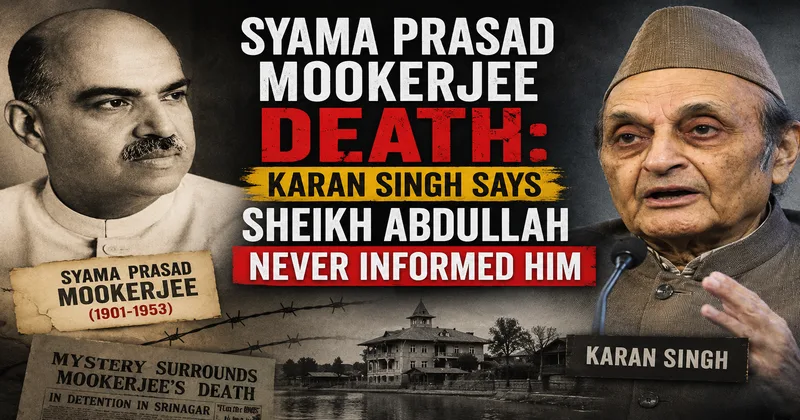
Within two months of custodial death of Jan Sangh leader Dr Shyama Prasad Mookerjee’s on June 23, 1953, Prime Minister of J&K Sheikh Abdullah was dismissed. The dismissal order was issued by Sadr e Riyasat Karan Singh who was just 22 (born March 1931) when he got the signal from Prime Minister Pandit Jawaharlal Nehru.
Karan Singh had then said that he learnt about Dr Mookerjee’s death and his body being transported to Calcutta from unofficial sources. The PM of J&K Sheikh Abdullah did not inform him about it!
The cruelty of the Sheikh and Nehru duo can perhaps be gauged from the fact that the arrangements for taking mortal remains of Dr Mookerjee to his home in Calcutta were made by his family.
What happens today when an Indian dies anywhere in the world? A Kashmiri dies in Iran? Or somewhere else, be it in the US or UK. The relatives make appeals to the Indian government to transport the mortal remains! These demands are made without batting an eyelid. The Indian government makes all the arrangements.
When Dr Mookerjee died in custody, at Srinagar, neither Sheikh nor Nehru governments did paid a penny for safe transport of his mortal remains to Calcutta.
A couple of years ago, many Indian students got stranded in Ukraine. The Indian government paid for the safe evacuation of all of them.
When hundreds of Kashmiri students were stranded in Iran, their parents expected them to be evacuated by the Indian government. They made noises when this was not possible due to a number of factors.
Just try to imagine the indignities and absolute hatred displayed by the National Conference head Sheikh Abdullah towards Dr Mookerjee. Not only when he was alive but after death also, the self-righteousness of the Sheikh was absolute as Dr Mookerjee was not treated as a political opponent but an enemy. Someone who had thrown an ideological challenge to Sheikh’s Article 370 which kept J&K isolated from the mainland India, despite being a part of it.
BJP Rooted In Dr Mookerjee’s Ideology
It is a common saying that revenge is a dish best served cold. Dr Mookerjee’s ideological progeny had to wait for 66 years till August 5/6, 2019, to avenge his death. His custodial death in Sheikh’s prison, after being held for 44 days without being formally charged, was avenged with the scrapping of Article 35-A that day.
Today’s ruling party at the Centre, the Bharatiya Janata Party (BJP), proudly describes itself as rooted in Dr Mookerjee’s Jan Sangh thoughts. The Jan Sangh was the ideological precursor of the BJP helmed by Prime Minister Narendra Modi today. This is a party which got its intellectual depth and narrative based on what Dr Mookerjee said at one time.
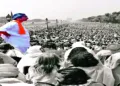
Modi and his BJP have won three Lok Sabha elections on the trot, by an open espousal and propagation of the ideological moorings of Mookerjee. Rewind to June 23, 2013, and Madhopur in Punjab on the banks of Ravi on the east bank of the river. It was from this venue that Modi had started his political journey at the national level that day. It was the first major rally that Modi, then CM of Gujarat, had held outside his own state.
Minister of State in PMO Dr Jitendra Singh was an emerging leader of BJP in 2013 who was seated in the front row as Modi addressed the Madhopur gathering. Former Himachal Pradesh Chief Minister Shanta Kumar, former CM of Punjab late Prakash Singh Badal, Gurdaspur MP late Vinod Khanna and many others were the ones who were big draws of that rally at Madhopur.
Modi’s Thoughts Clearly Enunciated
At the Madhopur rally, Modi clearly communicated to his own party, the RSS and the world at large where he stood ideologically. His speech on June 23, 2013, cleared all cobwebs regarding his positioning on core issues espoused by the BJP and the Sangh.
In Modi’s long political career, that speech remains one of the most important speeches ever made.
Incidentally, the significance of Mookerjee in the pantheon of the BJP can be never overstated. He is a clear polestar for the party who is guided to this day by his pronouncements. Mookerjee was arrested at Ladkhanpur on May 11, 1953, when he entered the state in defiance of the permit system then prevalent. He was taken from Ladkhanpur to Srinagar after his detention and died in custody on June 23, more than a month later.
He was held in custody in a house near Nishat garden and was never tried or charged during his detention. As such, his death could be called as a custodial death, death of a person held in custody without any trial.
Dr Mookerjee was hail and hearty when he was arrested by the state government of J&K led by Sheikh Abdullah on May 11. He died suddenly on June 23, apparently because he was never provided adequate medical care. Despite pleas by those close to Dr Mookerjee.
Family Never Informed About Illness
It is baffling that throughout Mookerjee’s detention, his mother, Jogmaya Debi, or any other members of his family were never intimated regarding his illness, leave aside any life-threatening condition. If he fell ill after May 11 arrest and transportation to Srinagar, it was not communicated to any of his associates in the Jan Sangh, or his family.
This becomes clear from a perusal of his mother’s letter to Nehru after receiving a letter from the former on July 2, 1953. This letter was written by Nehru to the unfortunate mother on June 30, and reached her via Dr Bidhan Chandra Roy.
In her response, she demanded JUSTICE saying that the Kashmir government never ever informed her about any illness Mookerjee had. She did not receive any letters or correspondence from Mookerjee during his detention.
She said that the circumstances of Mookerjee’s death were cause of deep suspicion and must be looked into. There must be an inquiry into various aspects of the suspicious death. Nehru assured her that Sheikh had said there was nothing suspicious about Mookerjee’s death. Yet, he (Nehru) had asked Sheikh Abdullah to visit Delhi and discuss the issue with him.
Jogmaya Debi’s Requests Rejected By Nehru
This so-called request or direction from the PM of India was pointedly ignored by the Wazir-e-Azam of J&K. Jogmaya Debi’s request was summarily rejected and never given any due consideration by the Central or the state government.
Is the house where Mookerjee died still there near Nishat? One is not clear but has the state BJP tried to locate this house and hold any commemorative function in honour of Mookerjee ever? No, there is nothing in the public domain to suggest that the state BJP ever did anything of the sort.
Several functions all over India marked the anniversary of a true patriot who agitated for complete accession and full application of the Constitution of India to J&K. This is an year when West Bengal, where Dr Mookerjee was born, has, for the first time, a BJP government.
The Jammu region remains divorced from the politics of the Valley just about as much today as it was during the days of Praja Parishad in 1953 whom Mookerjee supported. Mookerjee challenged Sheikh and Nehru, time and again, for adopting an ambivalent attitude on many issues. S P Mookerjee had challenged Sheikh Abdullah’s leadership and methods. He said that Abdullah dreamt about a virtual sheikhdom of his own.
Three-Nation Theory of Sheikh Abdullah
In a letter written to Sheikh in the beginning of 1953, Mookerjee said: “You are now developing a three-nation theory, the third being the ‘Kashmir nation’. These are dangerous symptoms and not good for your state or the whole of India”.
Earlier, on May 21, 1952, he also posed pertinent question to Nehru in Parliament: “Are Kashmiris Indians first and Kashmiris next and Indians first, or are they Kashmiris first, second and third and not Indians at all?” There was no reply. Mookerjee quipped: “Nehru claims to have discovered India. But he has to yet to discover his mind.”
After Mookerjee’s death, Nehru gave a clean chit to Sheikh, his ever trusted friend, even though Sadr-e-Riyasat Karan Singh had expressed grave misgivings about Sheikh’s conduct. The Sadr-e-Riyasat had said that all through Mookerjee’s detention, he was never told that the Jan Sangh leader was ailing.
Sadr e Riyasat Karan Singh’s Role
The news about Mookerjee’s death also reached the Sadr-e-Riyasat through unofficial channels. Karan Singh expressed shock that he had learnt about Mookerjee’s death from unofficial sources and also this that the body had been sent away from Srinagar. As Sadr-e-Riyasat, he was never informed by the Sheikh government regarding what was happening.
Nehru only expressed some inanities in response to Karan Singh’s letter and ignored him. However, he could not do so for a very long time and had to dismiss Sheikh Abdullah on August 9, 1953, less than two months after Mookerjee’s death.