Cairo: India’s first major textile investment in Egypt marks a significant expansion of New Delhi’s economic footprint in Africa, positioning Indian industry alongside global manufacturing powers in one of the continent’s most strategically important industrial corridors. Indian textile manufacturer Prestige Denim Mills has announced a US$20 million investment to establish a state-of-the-art denim manufacturing facility in Egypt’s West Qantara Industrial Zone, becoming the first Indian industrial investor in the region.
The landmark agreement was signed at the headquarters of the Suez Canal Economic Zone (SCZONE) in Egypt’s New Administrative Capital in the presence of SCZONE Chairman Waleid Gamal El-Dien. The project signals India’s growing participation in Africa’s industrial transformation and strengthens economic ties between New Delhi and Cairo at a time when global supply chains are increasingly diversifying.
A strategic entry into West Qantara
The facility will be developed on a 100,000-square-metre site in the West Qantara Industrial Zone, a rapidly emerging textile and apparel manufacturing cluster located near the Suez Canal, one of the world’s busiest maritime trade routes. The project is expected to generate around 1,000 direct jobs and will function as an integrated denim manufacturing complex, bringing weaving, dyeing and finishing operations under one roof.
Once operational, the plant is expected to produce up to 20 million metres of denim fabric annually. Around 70 per cent of the output will be exported to international markets, while the remaining 30 per cent will cater to domestic demand within Egypt.
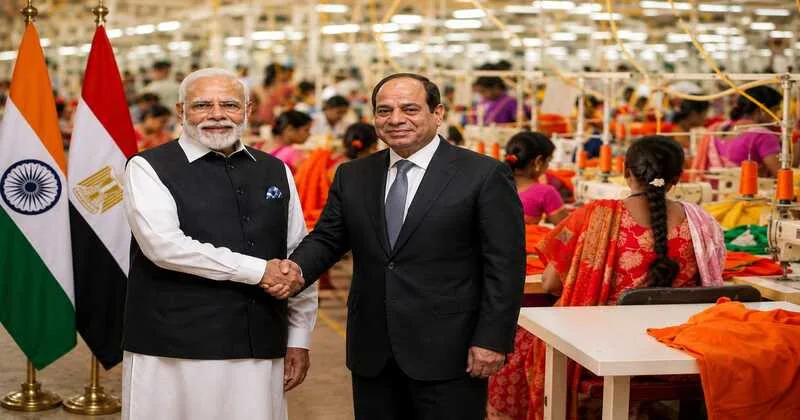
Met President Abdel Fattah El-Sisi of Egypt on the sidelines of the Evian G7 Summit.
India cherishes the long-standing friendship with Egypt.@AlsisiOfficial @G7 pic.twitter.com/wX33pJ493I
— Narendra Modi (@narendramodi) June 16, 2026
The investment forms part of Prestige Denim Mills’ strategy to expand its international manufacturing presence while leveraging Egypt’s unique geographical advantages. Located at the crossroads of Africa, Europe and West Asia, Egypt offers manufacturers direct access to major consumer markets through competitive logistics infrastructure and a network of international trade agreements.
Industry observers view the investment as a milestone not only for the company but also for India’s broader economic engagement with Africa. The project establishes an Indian presence in a zone that has increasingly become a magnet for global textile manufacturers and has long been dominated by competitors from China, Turkey and Pakistan.
Competing in a global manufacturing cluster
West Qantara’s transformation into a global textile hub has accelerated in recent years. Official figures indicate that textile investments in the zone have crossed US$1 billion, attracting companies from across Asia and Europe.
Among the largest projects is Chinese manufacturer Everfar’s US$130 million integrated textile and garment complex. Pakistan’s Interloop Group is investing US$35.2 million in a ready-made garment manufacturing facility. Turkey, which currently enjoys a strong presence in the region, had around 15 active projects in West Qantara as of April.
Major Turkish investments include Nil Orme’s US$35 million project and Eroglu Moda’s US$5.6 million facility. Other international players include South Korea’s H&L Korea, which is developing a US$15 million garment manufacturing unit, Germany’s Sun Garden with a US$7 million investment, and Greece’s Mariniro, which has committed US$4 million to apparel manufacturing operations.
Against this backdrop, Prestige Denim Mills’ entry is being viewed as a strategic breakthrough for Indian industry. By securing a foothold in a manufacturing zone populated by some of the world’s most influential textile exporters, India has demonstrated its ability to compete in high-value global production networks and expand its industrial reach beyond traditional markets.
Egypt’s rising importance and India’s expanding presence
Egypt’s attractiveness as a manufacturing destination continues to grow. According to the International Monetary Fund (IMF), Egypt’s gross domestic product is projected to reach US$429.65 billion this year, making it Africa’s second-largest economy behind South Africa.
The country’s proximity to the Suez Canal provides a major competitive advantage for manufacturers seeking efficient access to European, African and West Asian markets. Reduced transportation costs, favourable trade agreements and tax incentives have further enhanced Egypt’s appeal to foreign investors.
India’s textile ecosystem is attracting strong global buyer participation and international business engagement. 📈
✅ 3,000+ buyers from 111 countries at Bharat Tex 2024
✅ 6,000+ overseas buyers at Bharat Tex 2025
✅ 1.2 lakh+ trade visitors participated
✅ Thousands of… pic.twitter.com/qNYYQZiIIm— Ministry of Textiles (@TexMinIndia) June 17, 2026
SCZONE Chairman Waleid Gamal El-Dien described the Prestige Denim Mills investment as an important milestone for West Qantara and a reflection of increasing international confidence in Egypt’s industrial ecosystem. He noted that continuous infrastructure upgrades and industrial expansion programmes have strengthened the zone’s position as a preferred destination for textile and apparel investments.
For India, the project represents more than a business investment. It marks a significant step in New Delhi’s efforts to deepen economic engagement across Africa and strengthen its presence in strategically important global manufacturing centres. As global apparel sourcing patterns continue to evolve, Prestige Denim Mills’ investment places India among the leading international players shaping the future of textile manufacturing in Egypt, while reinforcing the country’s growing economic influence across the African continent.