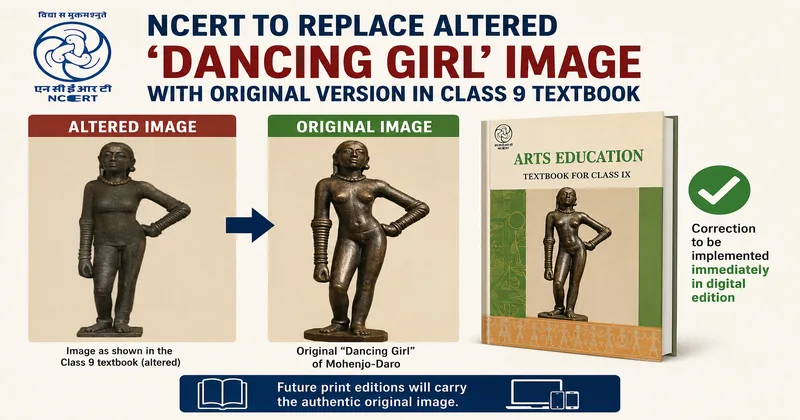
NEW DELHI: The National Council of Educational Research and Training (NCERT) has decided to replace a modified illustration of the famous “Dancing Girl” of Mohenjo-Daro in its recently released Class 9 arts education textbook with the original version of the sculpture. The decision comes after concerns were raised over the depiction of the 4,500 year-old bronze figurine, one of the most celebrated artefacts of the Indus Valley Civilisation. Readers noticed that the image looked different from the original sculpture, as parts of the torso appeared to be covered.
NCERT Director Dinesh Saklani confirmed that the issue was examined by the concerned department. According to Saklani, the matter was reviewed in consultation with experts, following which it was decided that the modified image would be replaced with the original version of the sculpture. He said that as soon as the issue came to NCERT’s notice, the concerned department was asked to examine it. After consulting experts, NCERT decided to replace the modified image with the original version. He added that the correction is being made immediately in the digital textbook, while future print editions will feature the original image. The decision is expected to settle the controversy over the illustration and reflects NCERT’s effort to ensure accuracy in educational content. The original “Dancing Girl” image also appears in other NCERT textbooks, including the Grade 6 Social Science textbook.
https://twitter.com/ANI/status/206651592946770359
The textbook is part of NCERT’s first dedicated arts education series introduced under the National Education Policy (NEP) 2020 and the National Curriculum Framework (NCF). The initiative aims to integrate arts education more deeply into mainstream learning and provide students with a broader understanding of India’s cultural and artistic traditions.
The controversy was around the representation of a sculpture that occupies a special place in the study of ancient Indian history. The original “Dancing Girl” was discovered during excavations at Mohenjo-Daro, one of the principal urban centres of the Indus Valley Civilisation, which flourished around 2500 BCE. Despite being only about 10.5 centimetres tall, the bronze statue has attracted the attention of archaeologists and historians for nearly a century because of its detailed design and realistic appearance.
The sculpture shows a young woman standing with one hand on her hip. She is traditionally shown unclothed, wearing only jewellery, including a necklace and numerous bangles stacked along one arm. Historians often cite the figure as evidence of the advanced metalworking skills and artistic sophistication of the Indus Valley people. They are of the belief that textbooks help students learn about the past, so it is important that images and information are accurate. Some experts believe that any changes made to famous artefacts should be clearly explained to avoid confusing students. However, others point out that textbook illustrations are sometimes modified for educational or design reasons. They say the challenge is to present historical objects in an engaging way while still staying true to the original artefacts.
Interestingly, this is not the first time the Dancing Girl has become the subject of public debate. In 2023, the figurine attracted national attention when a modern adaptation was unveiled as the mascot of the International Museum Expo in New Delhi. The event, inaugurated by Prime Minister Narendra Modi on International Museum Day, showcased a contemporary version of the ancient sculpture as a welcoming symbol for visitors. Organisers described the mascot as a modern interpretation inspired by the original artefact and intended to represent India’s cultural heritage in a contemporary context.