Muzaffarabad’s verdict on Pakistan’s Kashmir narrative
June 17, 2026
  • Read Ecopy
  • Circulation
  • Advertise
  • Careers
  • About Us
  • Contact Us
Android AppiPhone AppArattai
Organiser
  • ‌
  • Bharat
    • Assam
    • Bihar
    • Chhattisgarh
    • Jharkhand
    • Maharashtra
    • View All States
  • World
    • Asia
    • Europe
    • North America
    • South America
    • Africa
    • Australia
  • Editorial
  • International
  • Opinion
  • RSS @ 100
  • More
    • Op Sindoor
    • Analysis
    • Sports
    • Defence
    • Politics
    • Business
    • Economy
    • Culture
    • Special Report
    • Sci & Tech
    • Entertainment
    • G20
    • Azadi Ka Amrit Mahotsav
    • Vocal4Local
    • Web Stories
    • Education
    • Employment
    • Books
    • Interviews
    • Travel
    • Law
    • Health
    • Obituary
  • Subscribe
    • Subscribe Print Edition
    • Subscribe Ecopy
    • Read Ecopy
  • ‌
  • Bharat
    • Assam
    • Bihar
    • Chhattisgarh
    • Jharkhand
    • Maharashtra
    • View All States
  • World
    • Asia
    • Europe
    • North America
    • South America
    • Africa
    • Australia
  • Editorial
  • International
  • Opinion
  • RSS @ 100
  • More
    • Op Sindoor
    • Analysis
    • Sports
    • Defence
    • Politics
    • Business
    • Economy
    • Culture
    • Special Report
    • Sci & Tech
    • Entertainment
    • G20
    • Azadi Ka Amrit Mahotsav
    • Vocal4Local
    • Web Stories
    • Education
    • Employment
    • Books
    • Interviews
    • Travel
    • Law
    • Health
    • Obituary
  • Subscribe
    • Subscribe Print Edition
    • Subscribe Ecopy
    • Read Ecopy
Organiser
  • Home
  • Bharat
  • World
  • Operation Sindoor
  • Editorial
  • Analysis
  • Opinion
  • Culture
  • Defence
  • International Edition
  • RSS @ 100
  • Magazine
  • Read Ecopy
Home Bharat

Muzaffarabad’s Revolt Against Islamabad: How PoJK protests exposed the contradictions in Pakistan’s Kashmir narrative

The mass protests in Muzaffarabad and across Pakistan-occupied Jammu and Kashmir (PoJK) have exposed deep contradictions in Pakistan’s long-standing Kashmir narrative. What began as an agitation over electricity tariffs evolved into a broader demand for accountability, representation, and genuine self-determination

Lokesh DharLokesh Dhar
Jun 17, 2026, 08:00 pm IST
in Bharat, World, South Asia, Asia, Jammu and Kashmir
Follow on Google News
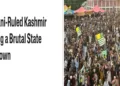
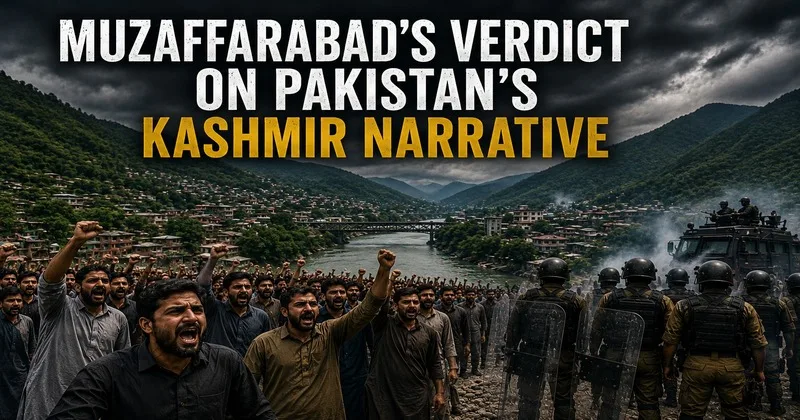
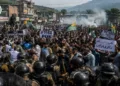
The unrest in Muzaffarabad highlighted growing demands for economic justice, accountable governance, and greater political representation in PoJK

The unrest in Muzaffarabad highlighted growing demands for economic justice, accountable governance, and greater political representation in PoJK

FacebookTwitterWhatsAppTelegramEmail

In June 2026, the streets of Muzaffarabad and Rawalakot did something that seventy-seven years of diplomacy could not. They exposed Pakistan’s Kashmir narrative for what it has long been: a claim advanced in the name of the people of Pakistan-occupied Jammu and Kashmir (PoJK) without their meaningful consent.

The protests began not over geopolitics but over something far more basic: electricity bills. Residents of PoJK, many of them Pahari and Gojri speakers whose identities receive limited institutional recognition even within the region, have repeatedly complained that they pay electricity tariffs several times higher than consumers in mainland Pakistan, despite the region’s rivers powering significant portions of Pakistan’s hydropower network. Families asked a simple question: why should communities living amid resource-rich mountains pay exorbitant prices for electricity generated from their own land?

The Joint Awami Action Committee transformed that economic grievance into a popular movement. Its 38-point charter of demands, covering subsidised flour and electricity, accountable governance, and the abolition of twelve legislative seats reserved for Kashmiri refugees settled in mainland Pakistan, reflected the breadth of accumulated discontent. Those reserved seats have long allowed Islamabad’s favoured parties to engineer governments in Muzaffarabad, bypassing local voters. When the Supreme Court of Pakistan-administered Kashmir ruled in June 2026 that the seats could not be abolished without a constitutional amendment, it became the immediate flashpoint that brought people onto the streets. The Pakistani state’s response was revealing: the JAAC was banned under anti-terrorism legislation, and protesters were met not with dialogue but with batons, arrests, live ammunition, and internet shutdowns. At least eleven people were killed and more than seventy were injured. Unverified claims of far higher casualties circulated on social media, and the communications blackout that accompanied the crackdown made independent verification impossible. Whatever the precise numbers, one fact remains indisputable: governments secure in their legitimacy do not fear information. Internet blackouts are often less a tool of governance than an admission of insecurity.

The irony of the crisis is striking. PoJK contributes significantly to Pakistan’s hydropower generation, yet local communities have long argued that they receive few of the economic benefits derived from these resources. This reflects a familiar pattern seen across many resource-rich regions of the world, where wealth flows outward while development remains uneven at home. In PoJK, the protests were not separatist in character. Their demands were strikingly ordinary: affordable electricity, accountable governance, and economic justice.

The unrest also draws attention to a deeper constitutional contradiction. Despite being presented internationally as “Azad” or free, Pakistan-administered Jammu and Kashmir occupies an ambiguous political position. It is neither a full province of Pakistan nor a sovereign political entity exercising complete autonomy. Key areas such as defence, foreign affairs, and strategic decision-making remain heavily influenced by Islamabad. Critics have long argued that this arrangement creates a democratic deficit: a territory invoked globally in the language of self-determination while many of its most consequential decisions are made elsewhere.

For decades, Pakistan has positioned itself at international forums as the defender of Kashmiri rights and aspirations. At the United Nations Human Rights Council, the Organisation of Islamic Cooperation, and numerous diplomatic platforms, Islamabad has claimed to speak on behalf of Kashmiris. Yet the events in Muzaffarabad exposed an uncomfortable asymmetry. International responses that are often swift elsewhere appeared muted when protesters in PoJK demanded rights and representation. The resulting sense of abandonment among local communities is not merely emotional; it reflects growing questions about who truly speaks for Kashmiris and whose voices receive global attention.

Any honest assessment of Kashmir’s future must also acknowledge the divergence that has emerged across the Line of Control over the past seven decades. Jammu and Kashmir witnessed Legislative Assembly elections in 2024, the first in a decade, conducted through a largely peaceful democratic process, albeit under a governance arrangement that had only recently restored elected representation. Infrastructure investments have transformed connectivity across difficult terrain. The Chenab Bridge, inaugurated in June 2025, stands as a striking symbol of engineering ambition, completing a railway link that extends deeper into a region long defined by its inaccessibility. Tourism has recovered, and public investment has increased. These are real changes, and they matter. Yet they exist alongside unresolved questions about political autonomy and civil liberties that no infrastructure project resolves on its own.

Also Read: Amazon Aryabhata Ad Row: Hindu organisations call for boycott of Amazon for insulting India’s Scientific Heritage

There is another dimension to the present crisis that India should approach with seriousness rather than symbolism. In the Neelum Valley, just across the Line of Control, lie the ruins of Sharda Peeth, one of the great centres of learning in South Asian history and among Hinduism’s eighteen Shakti Peethas. It was from this region that the Sharada script spread across large parts of North India and beyond. For displaced Kashmiri Pandits, Sharda Mata represents not merely a place of worship but a living connection to memory, heritage, and homeland.

For nearly eight decades, that connection has remained physically severed. The site continues to deteriorate under Pakistani administration. The Kartarpur Corridor demonstrated that faith and heritage can transcend political hostility when political will exists. A sustained diplomatic effort toward establishing a Sharda Corridor, framed as a heritage and pilgrimage initiative open to all communities that revere the site, would be both morally justified and strategically significant. Such an initiative would test whether the principle of cultural access applies equally across borders.

India’s condemnation of the crackdown is expected and justified. Yet there is a danger in treating this moment merely as a diplomatic opportunity. The people of PoJK are not strategic assets, and their suffering is not a talking point. Their demands are neither radical nor unreasonable. They seek affordable electricity, accountable governance, and a meaningful voice in decisions that shape their future.

Pakistan’s Kashmir narrative has long rested on the principle of self-determination. But self-determination cannot be invoked abroad while dissent is suppressed at home. The challenge to that narrative did not come from New Delhi, Washington, or international forums. It came from Muzaffarabad itself, and it came in the form of a question Pakistan has no clean answer to: if this territory is truly free, why does it take eleven deaths to ask for cheaper electricity?

 

Topics: Self DeterminationPakistan Occupied Kashmirpojk protestsMuzaffarabadPakistan politicsSharda PeethJoint Awami Action CommitteeKashmir Narrative
ShareTweetSendShareSend
✮ Subscribe Organiser YouTube Channel. ✮
✮ Join Organiser's WhatsApp channel for Nationalist views beyond the news. ✮
Previous News

Assam: CM announces free bus service for NEET-UG 2026 candidates; Directs robust measures to conduct the examination

Next News

Karnataka: Dharmasthala defamation conspiracy alleged; Hindu organisations demand probe into Prakash Raj’s role

Related News

POJK Boils Over: Thousands return to streets, defying Pakistan’s crackdown

POJK Revolt Intensifies: JAAC strikes back against Pakistan; Thousands gather despite threats and internet shutdown

Protest erupts in POJK

Why is PoJK protesting? JAAC ban, anti-Pakistan slogans and public anger against Pakistan Army — Read here

Protesters in Rawalkot

Bloodshed in POJK: Four policemen killed, protesters dead as JAAC unrest turns violent

Representative Image

Pakistan: POJK to go for polls on July 27 under shadow of JAAC agitation

First Anniversary of Operation Sindoor: The Doctrinal shift

Mufti Saeed Khan’s explosive revelations expose the dark realities of militant-run camps in Pakistan-occupied Jammu & Kashmir, shaking the global narrative on ‘jihad’ and human rights

Pakistani cleric exposes ‘Jihad’ abuse in PoJK, reveals sexual exploitation in militant-run camps

Load More

Latest News

Purvanchal’s industrial rise under the double-engine government reflects growing investment, ODOP exports, factories, and jobs across eastern UP

How UP’s double-engine government transformed Purvanchal from an industrial backwater into a rising economic powerhouse

Years of ABVP-led advocacy and protests have resulted in Keralam moving ahead with the PM SHRI scheme

Keralam moves ahead with PM SHRI scheme; ABVP says long struggle for students has paid off

Karnataka: Dharmasthala defamation conspiracy alleged; Hindu organisations demand probe into Prakash Raj’s role

The unrest in Muzaffarabad highlighted growing demands for economic justice, accountable governance, and greater political representation in PoJK

Muzaffarabad’s Revolt Against Islamabad: How PoJK protests exposed the contradictions in Pakistan’s Kashmir narrative

CM announces free bus service for NEET-UG 2026 candidates

Assam: CM announces free bus service for NEET-UG 2026 candidates; Directs robust measures to conduct the examination

The Modi era is presented as a transformative phase in Indian politics, governance, and national identity, reflecting the aspirations of a rapidly evolving India

Modi Yug: How twelve years of governance reshaped India’s aspirations, identity & development trajectory

People around a kund

“Kumbh Mela is a powerful medium for social unity,” stated RSS Sah Sarkaryavah Atul Limaye in Nagpur

Maharana Pratap

Maharana Pratap and the Immortal Struggle of Haldighati: Eternal symbols of self-respect, freedom & indomitable courage

Centre has introduced a major regulatory reform by placing all syrup formulations, including cough syrups, under prescription-only control through a new MoHFW notification

Major Policy Shift in Drug Control: All syrup formulations now require prescription under new MoHFW notification

U-Turn on PM SHRI: Kerala to Continue with Scheme, Says CM VD Satheesan

Load More
  • Privacy
  • Terms
  • Cookie Policy
  • Refund and Cancellation
  • Delivery and Shipping

© Bharat Prakashan (Delhi) Limited.
Tech-enabled by Ananthapuri Technologies

  • Home
  • Search Organiser
  • Bharat
    • Assam
    • Bihar
    • Chhattisgarh
    • Jharkhand
    • Maharashtra
    • View All States
  • World
    • Asia
    • Africa
    • North America
    • South America
    • Europe
    • Australia
  • Editorial
  • Operation Sindoor
  • Opinion
  • Analysis
  • Defence
  • Culture
  • Sports
  • Business
  • RSS @ 100
  • Entertainment
  • More ..
    • Sci & Tech
    • Vocal4Local
    • Special Report
    • Education
    • Employment
    • Books
    • Interviews
    • Travel
    • Health
    • Politics
    • Law
    • Economy
    • Obituary
  • Subscribe Magazine
  • Read Ecopy
  • Advertise
  • Circulation
  • Careers
  • About Us
  • Contact Us
  • Policies & Terms
    • Privacy Policy
    • Cookie Policy
    • Refund and Cancellation
    • Terms of Use

© Bharat Prakashan (Delhi) Limited.
Tech-enabled by Ananthapuri Technologies