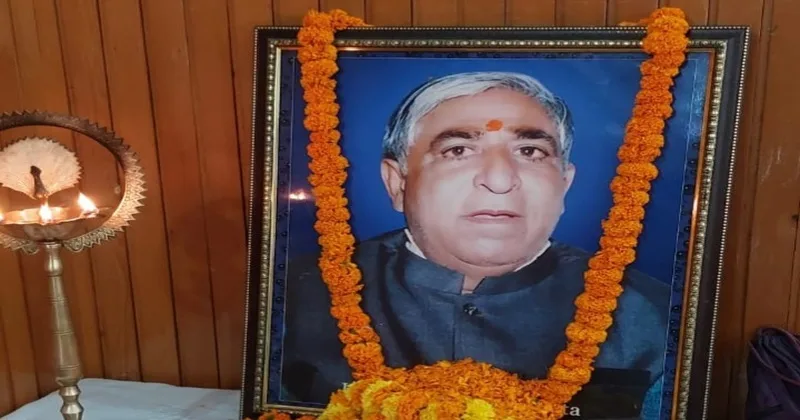
On a fateful day June 17, 2014, twelve years ago, we came to know about the tragic and untimely demise of Hiralal Chatta, the then President of All State Kashmiri Pandit Conference(ASKPC). He took over from the veteran & a great leader Pt. Amarnath Vaishnavi after his death in the year 2012. It was a natural choice at that point of time, as Hiralal Chatta was the closest junior colleague of Pt. Vaishnavi for the last five decades in RSS & ASKPC.
Hiralal was born on February 24, 1943 at Rajghat-Baramulla(Kashmir) in a prominent family of Chattas. His father was a humble employee of the Post & Telegraph department. Hiralal got his early education in Baramulla. He did his BSc in Government Degree College, Baramulla. He got a couple of jobs in the state government but chose to serve in the Education department. He did his B.ed while he was serving as a teacher in the Government High School in his native district. He was always a darling of the students wherever he served as a teacher. He retired as Zonal Education Officer, Chenani-Udhampur in the year 2003.
From his childhood he was trained in the RSS school of thought and had developed a great commitment to serve the society and the Indian nation in various capacities in the Kashmir valley. He played a pivotal role in making RSS reach and spread in Sopore, Handwara, Kupwara, Bandipur and other far flung villages of the erstwhile Baramulla district. Besides the RSS, he was deeply associated with Sanatan Dharam Sabha, Baramulla and the Akhil Bharatiya Vidhyarthi Parishad (ABVP). He also had his hand in establishing Ramayan Satsang in Sopore. In the districts of Baramulla, Kupwara and Bandipur, Hiralal was a big voice of the minority Hindu community.
During the Hindu agitation of 1967 in Kashmir, he worked tirelessly to unite the community of Kashmiri Pandits. He staged satyagraha during the height of the movement and was jailed. During emergency, he was detained for interrogation by the police and later released the next day. During the organised protests against the 1986-carnage on Hindu temples & other places of worship in the valley, he played a very gallant role. As a part of the Joint Hindu Action Committee, he contributed a lot that restored the confidence back to the KP community living in far-flung areas of north Kashmir.
When the ‘vigraha’ of Mata Bhadrakali was stolen from the revered shrine of the deity in Handwara area in early 1980s, Hiralal organised agitation against it along with the other prominent activists of Baramulla, Handwara, Kupwara, Sopore and Bandipur. This author was also deputed by my seniors in the RSS in Srinagar to go to Baramulla, join the protests and report. We went in a big bus-procession from Baramulla to Mata Bhadrakali shrine and a largely attended rally was addressed by many including Hiralal. Consequently, the ‘Vigraha’ was recovered thereafter by the police authorities.
During the 1990s, when terrorism was at its peak, the Vigraha of Mata Shri Bhadrakali was stolen again but it was recovered after a long investigation, search operation and special efforts of the central and state governments. Hiralal Chatta fought for it vigorously during the struggling period of exile of the community. With the active support of the Indian army, other security forces and the police, the pristine glory stands restored to this great and historical shrine.
After his retirement from his services, he also joined BJP formally and was a member of its J&K state Working Committee for a number of years. He also took part in Tiranga Yatra of BJP and courted arrest a number of times. He was one of the architects of shaping the Kashmir Displaced District unit in J&K BJP. His association with other KP organisations under the banner of Kashmiri Pandit Organisations United Forum enriched collective efforts of the community to derive far-reaching results.
Hiralal had a very intimate relationship with the prominent leader of the community, Adv. Tikalal Taploo and he worked for him when he (Taploo) contested the Assembly elections. Hiralal himself fought once for the Habbakadal assembly constituency unsuccessfully during the 2009 Assembly elections. His proximity with different prominent BJP and RSS leaders at the national and state level was well known to everyone who mattered.
Hiralal Chatta got a great recognition during the most tumultuous period of the forced mass exodus of the Kashmiri Pandit community in 1990-91. His close relatives were killed by the Islamic terrorists in the district of Baramulla. It was a very difficult time for the displaced community, social organisations, government and the leaders of the community and the political parties. He along with other senior and junior colleagues contributed tirelessly throughout and helped people in their hard times. He under the leadership of Pt. Vaishnavi took control of the affairs at the Geeta Bhawan, Jammu and formed J&K Sahayata Samiti under the directions of RSS in Jammu and was appointed the General Secretary of this philanthropic organisation.
He was instrumental in organising a number of protest demonstrations during the 1990s in Jammu and Delhi that forced the administration to arrange for establishment of refugee camps for the displaced population. He also fought for the rights of students, employees and traders among the Kashmiri Pandits and got a number of things done by the administration for them. In the Kashmiri Pandit Representative Assembly organised on 13 July 2000, Hiralal endorsed the concept of Homeland for Kashmiri Pandits in the valley and termed it a separate state.
He was among others including Amarnath Vaishnavi and R.K.Raina responsible for the establishment of Amar Balidan Trust at Jammu which did and is doing philanthropic activities benefitting hundreds of needy people within the displaced community. He joined in Jammu the historic ‘Kashmir Sankalp Yatra’ organised by Panun Kashmir in the year 2007 covering 11 states and UTs in 50 days espousing the cause of Kashmir and Kashmiri Pandits throughout the country.
He was part of several Kashmiri Pandit delegations that made their presentations before the Parliamentary Standing Committees on Home Affairs in regard to the Kashmiri Pandit community from the year 2008 to the year 2012. He also made presentations in the meetings organised by the Ministry of Home Affairs in Delhi and Jammu in which issues pertaining to the displaced Pandit community were discussed. His speech in the well attended meeting of the Department of Home Affairs in the North Block at New Delhi in 2013 brought a number of changes to the benefit of the displaced Kashmiri Pandit community.
Hiralal, unfortunately, was very inattentive towards his own health and his family. He was so overwhelmed with his social and organisational obligations that his family and his own health got relegated to second and third priority. This author met him in RSS camp at Kheer Bhawani-Tullamulla, Kashmir in the year 1973. We would often visit each other’s homes in Kashmir and would even stay there when on tour. He never nourished any sort of malice towards others but would respect the fact of ‘difference of opinion’ on important issues. Hiralal Chatta will be always remembered as a down to earth tenacious leader of the Kashmiri Pandit community who proved himself a core nationalist and patriot.