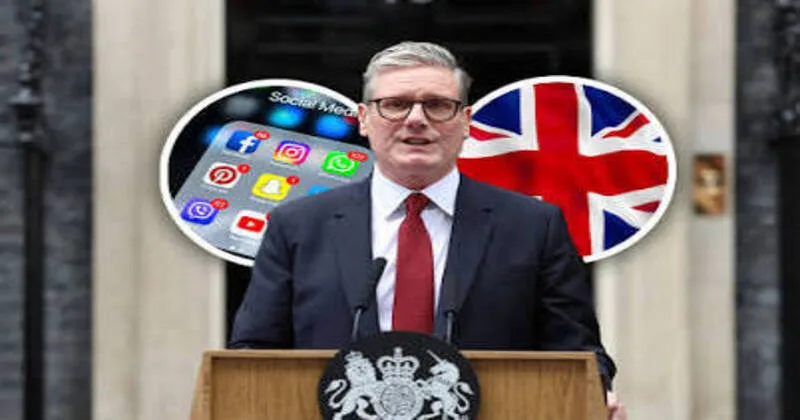
In line with Australia, the United Kingdom as well, has initiated a landmark policy shift aimed at protecting the children below the age of 16 from online vulnerabilities. London is all set to ban social media for under-16s. The measure is intended to insulate children from online risks and other hazardous impacts inflicted by social media, thus making the lives of children happier and safer by articulating a healthier digital landscape. The current minimum age to access social media is 13. However, this is regulated by tech companies. Thus, the British government proposal will act as a legally accepted tool to regulate social media for children under 16.
Inspired by the Australian model, it is said that the UK will implement one of the world’s toughest online safety rules. The measure would restrict online gaming, livestreaming and even AI chatbot features. Prime Minister Keir Starmer announced the prohibition of social media for children under 16 years of age, after months of extensive discussions and deliberations with parents, teachers, child safety advocates & organisations and tech giant representatives who regulate social media platforms. The cumulative opinion is that excessive online engagement is causing severe harm to the young minds.
Thus, Prime Minister Keir Starmer reiterated, “It is clear to me, a full ban is the right choice”. “It will make a huge difference, it will make our children safer, it will make our children happier, it will give them more time, more security, more freedom to grow up, more opportunity”, PM Starmer added. The United Kingdom also conducted extensive surveys to collect opinion regarding the ban on social media in the country. Accordingly, more than 83 per cent of the parents highlighted the risks associated with online indulgence. They asserted that vulnerabilities outweighed advantages of using social media, thus it is suitable to ban.
Why is the UK government banning social media for children?
For many years now, Britain has gradually tightened control and vigilance over the social media platforms to channelise it in a pro-societal way. This includes, mandatory age verification to access certain contents, regulation on tech firms to modify algorithms so that it is child-friendly, designing the app in such a way that children are not allowed to share explicit images etc.
However, the government has repeatedly reiterated that these measures are not sufficient enough to ensure online safety and more vigilance is inevitable to consolidate the safety of children under the age of 16 years. For example, the data exposes threatening facts about kids’ online safety. Around 8 in 10 children between the age group of 3 to 17 years have atleast one active social media account. Among children aged between 13 to 15 years, 95 per cent of them are addicted to social media.
Also, 37 per cent of the children aged between 3 to 5 years use social media which is a frightening fact about a child’s mental health and vulnerabilities. The number has drastically spiked compared to 2023. Such a huge-scale of online engagement by the kids compelled the government to impose a drastic ban on the social media platforms. Thus, after months of consultations with stakeholders, the UK government has decided to impose a blanket ban on social media for under 16-s.
In fact, initially Prime Minister Keir Starmer was sceptical of a blanket ban on social media. He argued that blanket ban could push teenagers to a more hazardous or lesser regulated online platforms, dark webs through illegal means, thus enhancing the vulnerability cost. He had also said that at 16, when children get sudden exposure to social media with unhindered access, they might lack digital literacy and use it in a hazardous way.
However, with the spiking intensity of online threats and adverse impact on children’s mental health, the UK government has decided to ban social media for under 16-s.
How will the ban work?
Although the UK has confirmed a ban on social media platforms for under 16-s, it has not officially clarified, which are the platforms being affected and the mechanisms used for imposing the ban. It is said that platforms such as TikTok, Snapchat, Instagram will be banned for under 16-s. Restrictions will also be on gaming and other live streaming platforms that will aid children to interact with strangers online, that has high-risk and vulnerability.
The ban will also be on the endless scrolling feature on social media and romantic or sexual AI chatbots. The government is additionally considering measures designed to prevent minors from using virtual private networks or VPNs, to circumvent online safeguards and gain access to inappropriate content.
How will the authenticity of the age be determined?
To evade chances of faking the age and illegally using social media, the British government is looking at many ways to confirm the authentic age of the users. Through the online safety act, the British already have a framework for age verification. However, to further strengthen measures to check the age of the social media users, the British government is considering mechanisms such as facial age estimation technologies, digital identity checks, credit-card verification systems, email-based analysis etc.
Technology companies have also proposed different approaches to age assurance. Some argue that the app developers should be responsible, while others believe device manufacturers and app-store operators should play a larger role. In Australia, a combination of methods is used to give access to social media for children. This includes behavioural analysis that estimates age based on usage patterns. Other approaches involve selfie-based age estimation systems, identity document checks etc.
According to the British government, a full ban on social media is under process and it can be completely operationalised by next spring as all the regulatory mechanisms are being finalised. In lines with Australia, even, Poland, Spain, France and other European countries are considering a ban on social media for children in order to carve a healthier digital ecosystem for children and also to ensure a safe, risk-free and a mentally healthier upbringing devoid of stress, trauma, addiction and other vulnerabilities.