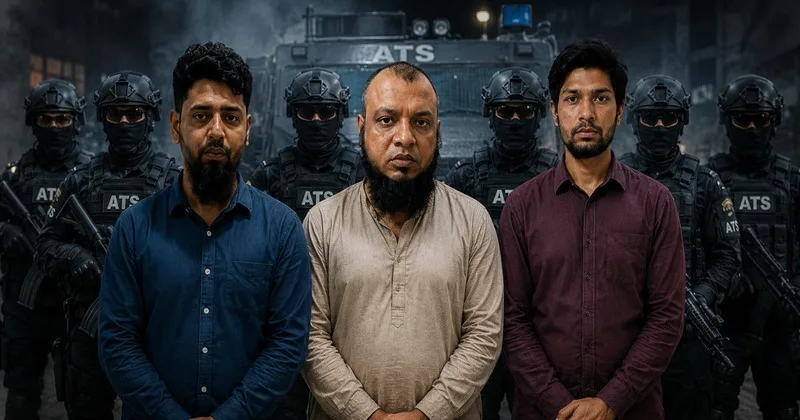
Bhopal: The nature of terrorist conspiracies against India is constantly evolving. While attempts were once made to destabilize the country through cross-border infiltration and arms smuggling, social media, encrypted messaging platforms and digital networks have now become the new weapons of terrorists. Three consecutive arrests made by the Madhya Pradesh Anti-Terrorism Squad (ATS), in Bhopal, Deoband (Uttar Pradesh), and Alwar (Rajasthan), have once again highlighted the gravity of this threat. Investigations have revealed that the network’s links extend from Nuh in Haryana all the way to Pakistan.
Investigation Began in Bhopal, Spread Across Multiple States
The entire case originated on the night of June 11 in the Kazi Camp area of Bhopal, when the ATS detained Mohammad Faraz, alias Khalid Saifullah, based on a tip-off. Initial interrogation and the examination of his mobile phone, laptop, and other digital devices yielded several crucial leads. These leads guided investigative agencies to Deoband in Uttar Pradesh.
The ATS arrested Naeem Abdullah there. Agencies claim that Naeem and Faraz had been in contact for a long time and that Naeem played a pivotal role in connecting Faraz with foreign handlers. Efforts were being made to expand the network and recruit new members via social media and messaging applications.
Arrest in Alwar Unveils Key Network Secrets
The third and most critical phase of the investigation centered on Alwar, Rajasthan. The ATS arrested Shakir Mev, son of Yunus, from Nakhanol village under the Tapukara police station limits. According to investigative agencies, Shakir was acting as a “second-in-command” within the network. His primary responsibilities included recruiting individuals, coordinating activities, and keeping the network active.
The investigation also revealed that Shakir had been living as a ‘Maulvi’ at a mosque in Rajasthan. Following his arrest, he was brought to Madhya Pradesh, where a special court remanded him to ATS custody until June 20.
New Name Assigned from Pakistan; Handler Connection Revealed
The most startling revelation from the ATS investigation concerns a link to Pakistan. According to the investigating agency, Mohammad Faraz had been assigned the alias ‘Shaheed Khalid Saifullah’ from Pakistan. Agencies believe this is not merely a case of a name change but indicates an affiliation with a specific ideology and network.
Bhiwadi Superintendent of Police Brijesh Jyoti Upadhyay stated that the local police provided assistance at the request of central agencies. A joint team also conducted a search operation in the Tapukara area. Investigating agencies are closely examining the role of a Pakistani handler through whom the network was allegedly being operated.
Nuh Connection Raises Concerns for Agencies
During the investigation, links to the Nuh district of Haryana have also surfaced. The Nuh region has previously been under the surveillance of security agencies due to radical activities and suspicious networks. Consequently, the emergence of the Nuh connection has expanded the scope of the investigation. The ATS is currently working to piece together the connections spanning Madhya Pradesh, Rajasthan, Uttar Pradesh and Haryana. Agencies suspect that the network is not limited to just three individuals and that a larger module may be active behind it.
Investigation into Martial Arts Training and Plans to Go Abroad
Interrogation has revealed indications that some of the accused were planning to undergo specialized training, such as martial arts and travel abroad. Investigating agencies are trying to determine the objective of these activities and identify the individuals involved. Furthermore, a thorough investigation is underway regarding potential attacks, the recruitment of youths, the spread of radical ideology and the role of foreign handlers. Forensic analysis of digital chats, social media accounts, and contacts is expected to uncover further details. Terror Threats Surface Multiple Times Over the Past Year
It is worth noting that this is not the first instance to alert security agencies. Over the past year, several incidents across the country have pointed to the active presence of terror networks.
In August 2024, the Special Cell of the Delhi Police busted an alleged weapons training camp in the Sarekala forests within the Chopanki police station limits in Rajasthan’s Bhiwadi region. Six individuals linked to an Al-Qaeda module were arrested during this operation. That incident also indicated that efforts were underway to organize and train youths within the country.
Additionally, the National Investigation Agency (NIA), the Anti-Terrorism Squad (ATS) and other security agencies busted several suspected modules across various states. Investigations revealed attempts to influence youths via social media, provide them with radical content and connect them with foreign organizations.
The Changing Face of Terrorism
Security experts believe that the nature of terrorism today has become far more complex than in the past. Terrorist organizations are now making extensive use of digital mediums alongside direct attacks. Reaching out to the youth via social media, communicating on encrypted platforms and operating networks through handlers based abroad have emerged as new challenges.
This is why security agencies are now maintaining strict surveillance not only on physical activities but also on the digital realm. Thanks to technical surveillance, cyber intelligence and improved coordination among states, several major plots have been thwarted at their nascent stages.
Vigilance: The Ultimate Security Shield
The arrests made in Bhopal, Deoband, and Alwar indicate that conspiracies against India have not ceased; rather, they are surfacing in new forms. While timely action averted a potential threat, the situation underscores that the menace of terrorism is not confined merely to border areas. Identifying networks attempting to become active within the country and dismantling them at an early stage remains the greatest challenge for security agencies.
In this context, a robust intelligence network, technical surveillance, inter-state coordination and public awareness constitute the most effective shield against terrorism.