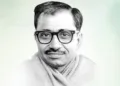
When Prime Minister Narendra Modi describes his government’s welfare mission, he reshares the philosophy of Pandit Deendayal Upadhyaya “Antyodaya”, the rise of the last person in the line. For PM Modi, this is not ceremonial homage to an ideological thought but a working blueprint. Deendayal Upadhyaya had insisted that a nation must be judged by what reaches its poorest citizen, not by the comfort of those already secure. Twelve years of Garib Kalyan initiatives are in essence of providing food, fuel, finance and shelter to the very last person.
Philosophy Older Than the Schemes
Every welfare state claims to serve the poor. Few organise themselves around the poorest. The distinguishing mark of India’s welfare turn over the past dozen years has been a single, idea borrowed from Pandit Deendayal Upadhyaya. It is test of governance that is not the contentment of those at the front of the queue but the reaches to the person standing at its very end. Antyodaya ‘the rise of the last’ was never meant to be a slogan stitched onto scheme brochures. It was meant to be an operating principle and the architecture of Garib Kalyan initiatives shows what happens when a government takes it as nations first.
Each dimension of deprivation in India ranges from hunger, fuel poverty, the absence of a bank account, to a house. Taken together they amount to a coordinated assault on the conditions that keep a family poor across generations. These were not framed as charity dispensed from above, but as entitlements owed to citizens, delivered with a measure of predictability the poor had rarely been allowed to expect.
Food as a Floor Beneath the Poorest
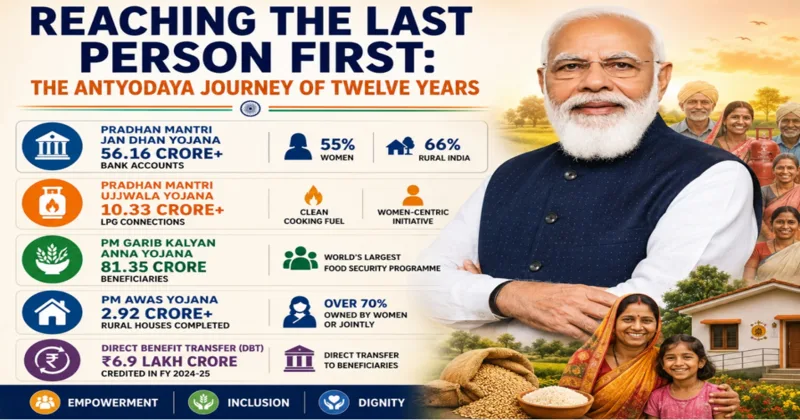
Antyodaya logic has clearer impact on the Pradhan Mantri Garib Kalyan Anna Yojana. Born in the desperate early weeks of the 2020 pandemic, it became a successful program than an emergency measure. In December 2023, the Union Cabinet committed to providing free foodgrains to 81.35 crore persons for a further five years from January 1, 2024, at an estimated cost of around Rs 11.80 lakh crore. To grasp the scale, consider that this single scheme covers roughly two-thirds of the country’s population and ranks among the largest social welfare programmes in human history.
The design rewards the poorest most generously. In Antyodaya Anna Yojana the households, most vulnerable in society receives 35 kg of foodgrain a month, while priority households receive 5 kg per person. The scheme did not invent new quotas, it removed the price at the ration shop entirely, converting a subsidy into something closer to a guarantee.
For an Antyodaya family, the State now absorbs an economic cost of roughly Rs 1,371 for 35 kg of rice or Rs 946 for the equivalent wheat, every month, so that the foodgrain reaches the family at zero cost. For a household living on the margin, that buffer is the difference between a calorie-secure month and a hungry one, freeing scarce cash for medicine, schooling or rent.
The Revolution of Direct Beneficiary Transfer
If Antyodaya supplied the philosophy, the Jan Dhan-Aadhaar-Mobile trinity supplied the machinery that made honest delivery possible. For decades, the tragedy of Indian welfare was not the absence of schemes but the leakage between announcement and arrival. Money and grain meant for the poor vanished into a thicket of middlemen and ghost beneficiaries. The JAM trinity attacked that thicket directly, routing benefits into verified bank accounts and stripping out the intermediaries who had long skimmed the system.
The government data assessed across 2009 to 2024, shows the picture of development. A quantitative study released by the Ministry of Finance found that the Direct Benefit Transfer system delivered cumulative savings of Rs 3.48 lakh crore by plugging leakages. Subsidy allocations fell from 16 per cent of total government expenditure to 9 per cent, even as coverage expanded sharply. In food subsidy alone, Aadhaar-linked ration authentication saved Rs 1.85 lakh crore, PM-KISAN saved Rs 22,106 crore by weeding out 2.1 crore ineligible beneficiaries and MGNREGS achieved timely wage transfer for 98 %of payments by saving Rs 42,534 crore.
The major focus is one of dignity restored through transparency. A composite Welfare Efficiency Index constructed for the study rose from 0.32 in 2014 to 0.91 in 2023, meaning that a far larger share of every rupee now reaches its intended recipient. This is the inversion the reformers sought where a system once defined by patronage, where access depended on whom you knew is replaced by one where a verified identity and a bank account are enough. The poor no longer deprives they receive what is theirs.
Clean Fuel and the Dignity of Breathing
The same direct-delivery instinct transformed the rural kitchen. The Pradhan Mantri Ujjwala Yojana, launched in May 2016 to provide deposit-free LPG connections to adult women from poor households, by July 2025 it delivered about 10.33 crore connections across the country. Women who once spent two to three hours a day gathering firewood and cooking in a haze of smoke, with all the respiratory disease that entailed, were handed clean fuel and the hours and lungs, that came with it.
Ujjwala carried the Antyodaya principle into its principal others had abandoned. The scheme reached forest dwellers, tea-garden workers, island communities and migrant families, the very households that earlier rounds of LPG expansion had passed over. Cooking-gas penetration, which stood at 62 per cent in 2016, has since climbed to near saturation. To shield these households from volatile global prices, the government continues a targeted subsidy of Rs 300 per cylinder for up to nine refills a year, with Rs 12,000 crore committed for 2025-26 alone.
Welfare With a Woman at the Centre
The feature of the entire Garib Kalyan project it placed women at the centre of welfare delivery, not as afterthought but as design. Consider the evidence stacked across schemes. Ujjwala connections are issued exclusively in the name of the woman of the house. Under the Pradhan Mantri Awas Yojana, the Prime Minister noted that more than 80 per cent of houses are owned solely by women or jointly with them, a deliberate choice to vest the family’s single largest asset in female hands. With 2.92 crore rural houses completed under PMAY-Gramin as of December 2025, that policy has handed property rights to women on a scale few nations have attempted.
The Jan Dhan account is the foundation stone of the whole edifice, tells the same story. Of the 57.71 crore Jan Dhan accounts opened, over 55 % are held by women and more than 66 % belong to rural India. A bank account in a woman name is not a trivial thing. It is the instrument through which subsidies arrive, savings accumulate and credit becomes possible. The Lakhpati Didi initiative, which has already enabled over two crore women to cross an annual income of one lakh rupees, builds directly on that base.
What emerges is a theory of empowerment that runs through the plumbing of welfare rather than the rhetoric around it. Put the gas connection, the house deed and the bank account in a woman name and you alter the balance of agency within millions of households quietly and durably. Nari Shakti is not a separate project, it is the connective tissue running through food, fuel, finance and shelter alike.
The Garib Kalyan approach increasingly aims at saturation, the principle that every eligible household, without exception and without discrimination it should be covered. PMAY-Gramin now extends to 4.95 crore pucca houses by 2029, Ujjwala chases full coverage, PMGKAY is committed through the latter half of this decade.
This is what gives the twelve-year record its coherence. Food, fuel, finance, housing each delivered directly and increasingly routed through a woman. It is measured against the standard of the last door rather than the first. Leakages persist, inclusion errors remain and the task of weeding out ineligible beneficiaries demands constant vigilance. India has spent twelve years proving that welfare for the poor need not mean waste, that dignity and efficiency can advance together and that the surest measure of a nation commitment is found not at the front of the queue but at its very end.