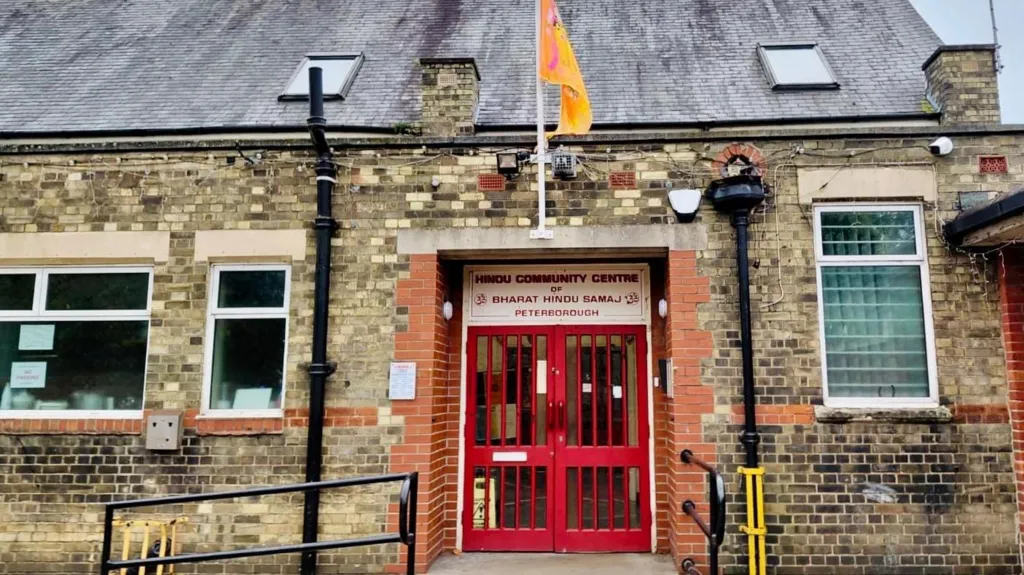
The High Court in the United Kingdom has begun hearing a legal challenge filed by the Bharat Hindu Samaj temple against Peterborough City Council’s decision to sell the temple site to the United Kingdom Islamic Mission (UKIM).
The temple, which has operated from the Rock Road site since 1986, argues that the council’s decision was unlawful and should be set aside. The site is regarded as a major place of worship for Hindus across parts of eastern England, including Cambridgeshire, Norfolk, Lincolnshire and Leicestershire.
The dispute centres on the council’s decision in February this year to sell the freehold of the Rock Road property to UKIM, an Islamic organisation. The sale has raised concerns among members of the Hindu community, who fear the temple may lose its long-standing home.
Representing the temple, barrister Toby Fisher told the court that the challenge is not directed against UKIM or its bid for the property. Instead, he argued that there were serious flaws in the council’s decision-making process.
According to court submissions, Bharat Hindu Samaj had been in discussions with Peterborough City Council since 2017 regarding the future of the site and the possibility of acquiring part or all of the property.
However, after receiving an offer from UKIM in 2023, the council invited final bids for the site in September 2025. UKIM reportedly offered to exceed any existing cash offer by up to five per cent and made it clear that the proposed religious facilities would serve the Muslim community.
The temple’s legal team argued that council officers made significant errors during the evaluation process and that councillors later adopted those recommendations without proper scrutiny.
Fisher told the court that there were “significant flaws in the reasoning” of council officers and alleged that the cabinet had effectively allowed officers to determine the outcome of the competitive process.
The temple has also argued that the council failed to meet its obligations under the Equality Act 2010. According to the submissions, closure of the temple would have a major impact on local Hindus because the temple has no alternative premises.
The temple serves not only as a place of worship but also as a community centre. It hosts social and educational activities throughout the week, including lunch clubs, cultural programmes and charitable outreach initiatives.
The legal team also pointed to the wider reach of UKIM, noting that the organisation operates dozens of centres and branches across the United Kingdom, while the temple has no alternative location available.
Peterborough City Council has strongly rejected the allegations.
Representing the council, barrister Catherine Rowlands told the court that there was no evidence to suggest councillors had been misled or that any unlawful delegation of powers had taken place.
In written submissions, Rowlands said the council was fully aware of the site’s importance to the Hindu community and reached its decision only after years of engagement with the temple and a transparent bidding process.
“The council made its decision only following many years of engagement with the claimant and a transparent, fair and lawful bidding process,” she stated.
She further argued that the council had properly considered its obligations under the Equality Act and had taken all relevant factors into account before approving the sale.
According to the council, the disposal process was conducted fairly and lawfully, with elected councillors retaining responsibility for the final decision.
The hearing is being overseen by Justice Morris. Proceedings are expected to conclude later this week. A written judgment will be issued at a later date, which will determine whether the council’s decision can stand or whether the sale process must be reconsidered.
The outcome of the case is likely to be closely watched by religious and community groups across the UK, as it raises broader questions about the protection of long-established places of worship and the responsibilities of public authorities when disposing of community assets.