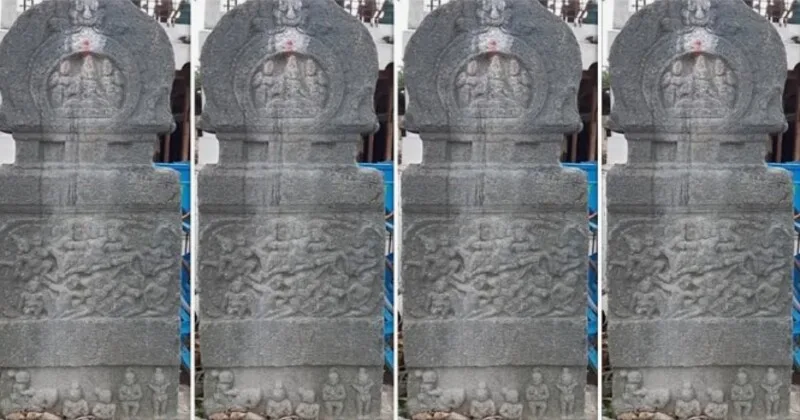
Gadag : Karnataka’s rich historical and cultural legacy has gained another remarkable addition with the discovery of a rare Rashtrakuta-era inscription in Mevundi village of Mundargi taluk in Gadag district. The newly unearthed memorial stone sheds light on an extraordinary story of unwavering loyalty and devotion, narrating the self-sacrifice of a royal servant named Ratteyanna following the death of his king.
Unlike conventional hero stones that commemorate warriors who died in battle, the Mevundi inscription records an unusual act of voluntary self-sacrifice performed out of deep respect and loyalty toward a deceased ruler. Historians believe the inscription provides valuable insights into a little-known medieval Karnataka tradition known as “Keelugunte.”
The discovery was made by a team of history enthusiasts led by researcher Shwetha Bhasme, who has been conducting extensive studies on memorial stones and hero stones scattered across Karnataka. Bhasme is currently preparing a detailed thesis on the subject, and during fieldwork in Mevundi village, her team identified the unique inscription.
At first glance, the stone appeared to be an ordinary memorial monument. However, a closer examination of the inscriptions carved on its surface revealed a fascinating chapter from Karnataka’s medieval past. The text records the story of a devoted servant whose loyalty to his king transcended death itself.
According to details inscribed on the stone, the events date back to the period of Rashtrakuta rule in Karnataka. During that era, a king named Kuppe Arasa governed the region of Puligere, corresponding to present-day Lakshmeshwar and its surrounding areas.
Historical records on the inscription indicate that Kuppe Arasa died after suffering from a severe illness. His death deeply affected his trusted servant, Ratteyanna, who had served the ruler with unwavering dedication. Unable to bear the loss of his beloved master, Ratteyanna resolved to sacrifice his own life as a mark of supreme loyalty and devotion.
One of the most striking aspects of the inscription is the account of Ratteyanna’s final journey. The memorial stone suggests that after learning of his king’s death, the loyal servant travelled hundreds of miles in search of his ruler’s burial site or memorial. His journey eventually brought him to the present-day Mevundi region, where a memorial dedicated to Kuppe Arasa had been established.
Standing before the tomb or memorial of his king, Ratteyanna voluntarily ended his life, believing that his devotion could only be fulfilled by joining his master in death. To ensure that future generations remembered this extraordinary act of loyalty, a memorial stone was erected at the site, immortalising his sacrifice.
Historians say the inscription is a rare and direct reference to the ancient Karnataka practice known as “Keelugunte.” Linguistically, the word is believed to derive from “Keelu,” meaning to pull or draw, and “Gunte” or “Kunte,” referring to a grave, burial pit, or resting place.
The practice involved close associates, bodyguards, or loyal retainers voluntarily sacrificing themselves after the death of a ruler. Such acts were considered the highest expression of loyalty and devotion to one’s king. Historical references suggest that similar traditions existed during the rule of the Gangas and Rashtrakutas, but physical evidence documenting the custom remains extremely rare.
Experts note that this inscription is significantly different from most hero stones found across Karnataka. Typically, hero stones commemorate warriors who died while defending their villages, protecting women and cattle, or fighting enemies on the battlefield. These memorials celebrate martial valour and military achievements.
The Mevundi inscription, however, tells a completely different story. There is no battle, enemy attack, or military conflict associated with the event. Instead, it honours a servant whose emotional bond, loyalty, and respect for his ruler motivated him to undertake a long journey and voluntarily sacrifice his life before his king’s memorial.
Researchers believe the discovery could open new avenues for understanding the social, political, and cultural structures of medieval Karnataka. The inscription offers valuable clues about the relationship between rulers and their retainers, concepts of loyalty and honour, and the religious and cultural beliefs that shaped society during the Rashtrakuta period.
Historians and archaeologists have described the find as an important source of information for future studies on Karnataka’s medieval history. They hope that further investigations by archaeological and historical departments will uncover additional evidence related to the Keelugunte tradition and other lesser-known customs of the era.
The discovery once again highlights Karnataka’s vast and largely unexplored heritage, demonstrating how inscriptions and memorial stones continue to reveal forgotten stories from the state’s illustrious past.