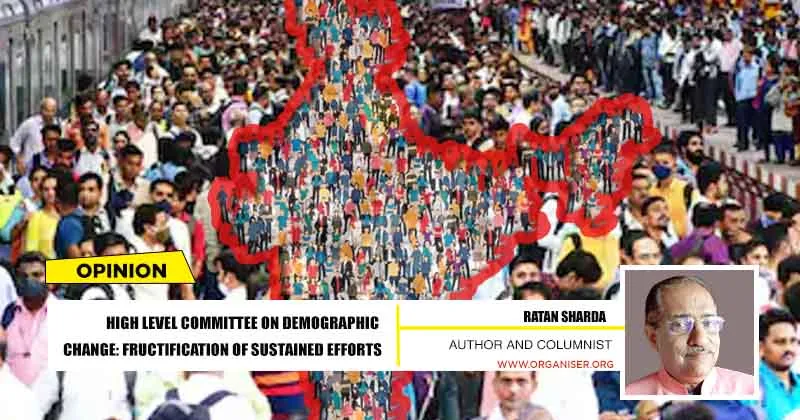
Union Home Minister Amit Shah has announced the formation of a high-powered committee based on a directive outlined by Prime Minister Narendra Modi during his Independence Day address. It seeks to address a long-overdue issue that has been a matter of concern for citizens who are studying the phenomenon of demographic shifts. Rashtriya Swayamsevak Sangh (RSS) has, since long, highlighted these gaps in our domestic policy framework.
The newly constituted high-level committee will examine “unnatural” demographic changes caused by illegal immigration and infiltration. The panel aims to assess unusual population shifts and recommend legislative and administrative measures to strengthen national border security and preserve social stability.
Last year, a working paper by the Economic Advisory Council to the Prime Minister (EAC-PM), titled “Share of Religious Minorities: A Cross-Country Analysis (1950–2015)” and led by Dr. Shamika Ravi, analysed demographic shifts among religious communities across 167 countries, including Bharat. One of the key findings of the study was that the share of the Hindu majority population in India declined by approximately 7.82 per cent between 1950 and 2015. During the same period, the share of the Muslim population increased by about 43.15 per cent. The share of other minority groups, such as Christians and Sikhs, also rose, though only marginally.
The RSS has been examining this issue through a much broader lens for a long time, and its concerns have been reflected repeatedly in resolutions and statements issued by its top decision-making bodies since Independence. The quotations below are extracted from my book, Conflict Resolution – The RSS Way.
Decades of Warnings
In 1964, ABPS of RSS passed a resolution about Hindu refugees from Pakistan. In this resolution it had referred to the lurking danger of East Pakistan Muslims creating a fifth column within the nation in West Bengal and Assam. An excerpt of the said resolution reads –
“Our Government should be prepared for police action, as suggested by the then Deputy Prime Minister, Shri Sardar Patel, in 1950, and stern measures, as suggested by Home Minister Shri Gulzarilal Nanda, to expel 25 lakh Pakistani infiltrators from our country and to check further infiltration should be taken. Apprehensions about the implementation of these measures have been created as the Government of Assam has expressed its opposition to some of them, and also due to the proposed meetings of the Home Ministers of India and Pakistan, to which the latter has readily agreed, obviously with the sole and definite intention of scuttling Shri Nanda’s proposals. Any delay or softness in the matter is fraught with grave consequences, and strong measures should be taken against Pakistani fifth columnists and their spies in the country.”
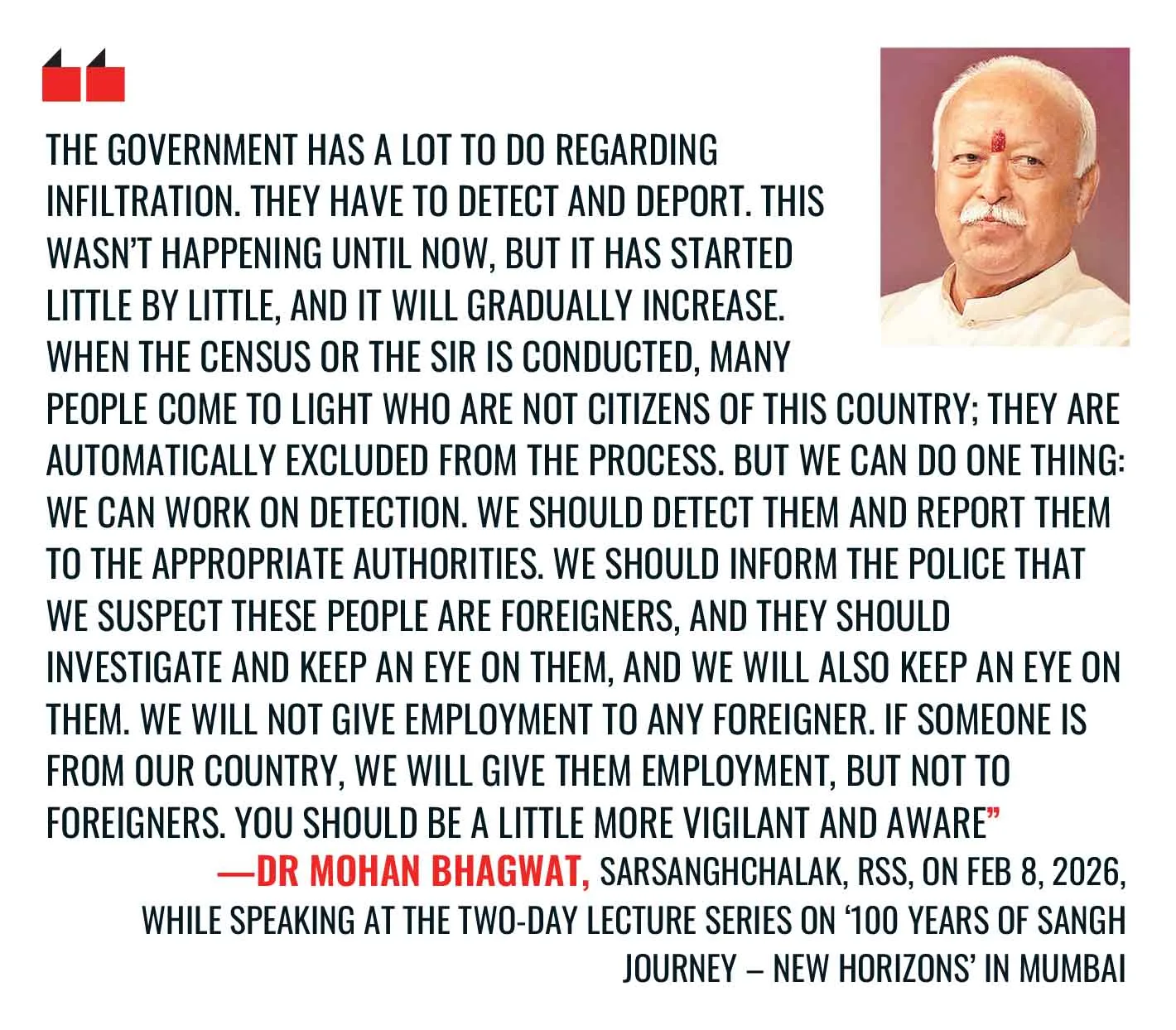
An incident on February 12, 1991 during Communist regime that should have made policymakers of Bharat sit up and take urgent steps was simply ignored. It was not reported by any media except Swastika, a nationalist Bengali magazine of Bengal. It was highlighted by RSS in its resolution in 1991 that – “It was a most shocking experience to see hundreds of Bangladeshi Muslim infiltrators having the audacity to hold a press conference at the Press Club in central Calcutta under the banner of the ‘Bangladeshi Mohajir Sangh’, where they also circulated a leaflet bearing the signatures of twenty-seven Bangladeshi Muslims. Throwing to the wind all the rigours and norms of the laws of the land, they asserted that more than a lakh Bangladeshi Muslim infiltrators had already settled in and around Calcutta and that others were scattered in Bombay, Delhi, Ahmedabad, and other parts of the country. They demanded that they be given Indian citizenship. This unprecedented scenario gave the impression that the processionists had, in fact, the tacit consent and unlawful protection of the authorities. The Home Secretary of the West Bengal Government, when contacted later, expressed his unawareness of any leaflet or even the procession.”
RSS had, over the years, expressed its concern about changing demographics and sought measures such as population control and public education for communities refusing to follow policy guidelines on population control. It noted in a resolution in 1997 that: “Border districts have become serious regions of concern, further exacerbated by unchecked infiltration across the borders, especially on the Eastern side. We express grave concern over the explosive situation developing across the North Eastern states. Since the beginning, we have been of the firm view that the happenings there are not mere sporadic eruptions caused by some immediate provocation, but are the outcome of a well-planned, long-term conspiracy.”
In 2004, the RSS Central Committee passed a resolution highlighting demographic threats based on the recently released Census 2001 data on religion, which brought into the limelight many alarming facts that should have been regarded with grave concern. It noted that demographic changes do lead to social and political changes. It pointed out that the nation was partitioned mainly due to demographic imbalances in the Hindu-Muslim proportion in certain parts of the country. It noted: “Now, after 57 years, we are again seriously confronted with a demographic imbalance in various parts of our country. In 6 districts of Assam and 3 districts of Bengal, which are adjacent to Bangladesh, Hindus have already become a minority. Additionally, in 4 districts of Assam and 7 districts of Bengal, they are on the verge of becoming a minority. This is happening because of infiltration across the Bangladesh border. […] In Uttar Pradesh and Bihar, all the districts on the border with Nepal show very high Muslim density ranging from 20 to 68 per cent, thus creating a ‘corridor’ of high Muslim presence from Bangladesh to Pakistan, as was visualised by the architect of Bharat’s Partition, Mr Jinnah, along with the Britishers. Eleven states have registered a decadal growth rate of more than 30 per cent in the Christian population, while nine states have registered a decadal growth rate of more than 30 per cent in the Muslim population.”
The RSS strongly deplored the deliberate attempts by a large section of the media and intellectuals to push all facts relating to the issue under the carpet. The attitude of political parties in downplaying the issue due to fear of an adverse impact on their vote banks was also deplored. The resolution noted that the “three principal reasons for these imbalances are (1) the lack of uniform population control policies for all religious groups in society, (2) religious conversion, and (3) infiltration from Bangladesh and Pakistan. […] Considering the situation, the ABKM demanded that:
- Central and state Governments should develop a comprehensive policy for uniform population control across all religious groups
- All State Governments should legislate and enact effective anti-conversion laws
- Central and State Governments should take all necessary steps to stop infiltration, and the Central Government should adopt a policy to detect infiltrators, delete their names from the voters’ lists, and deport them.
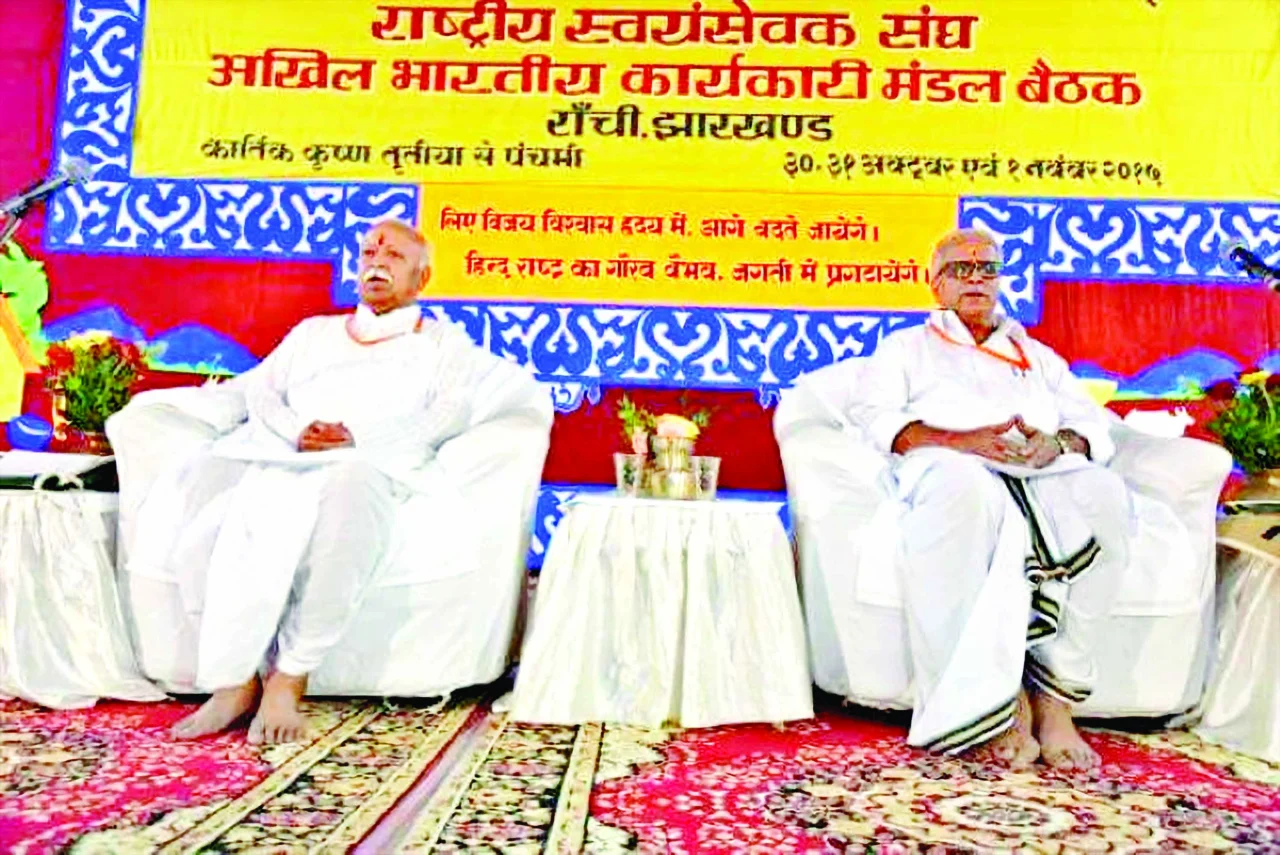
Again, in 2015, an RSS resolution called for addressing the imbalance in population growth rates. It noted, “The Akhil Bharatiya Karyakari Mandal is of the opinion that the severe demographic changes brought forth by the analysis of the religious data of Census 2011 highlight the necessity of the review of the population policy. Vast differences in the growth rates of different religious groups, infiltration, and conversion resulting in a religious imbalance in the population ratio, especially in border areas, may emerge as a threat to the unity, integrity, and cultural identity of the country.” It further noted:
In addition to that, the growth rate of the Muslim population has been much higher than the national average in the border districts of border states such as Assam, West Bengal, and Bihar, clearly indicating unabated infiltration from Bangladesh. The report of the Upamanyu Hazarika Commission appointed by the Hon’ble Supreme Court, as well as several judicial pronouncements from time to time, have also corroborated these facts. It is also a fact that the infiltrators are usurping the rights of the citizens of these states and are becoming a heavy burden on the already scant resources, apart from creating socio-cultural, political, and economic tensions. […] The religious imbalance in the population of the North-Eastern states has assumed serious proportions. In Arunachal Pradesh, people belonging to religions of Bharatiya origin constituted 99.21 per cent of the population in 1951. This came down to 81.3 per cent in 2001 and further to 67 per cent in 2011. In just one decade, the Christian population of Arunachal Pradesh has grown by almost 13 percentage points. Similarly, in Manipur, the share of religions of Bharatiya origin in the population, which was more than 80 per cent in 1951, has come down to 50 per cent in 2011. These examples and indicators of the unnatural growth of the Christian population in many districts of the nation indicate an organised and targeted religious conversion activities by certain vested interests. The Akhil Bharatiya Karyakari Mandal expresses deep concern over all these severe demographic imbalances and urges the Government to “Reformulate the National Population Policy, keeping in view the availability of resources in the country, future needs, and the problem of demographic imbalance, and apply it uniformly to all. And, totally curb illegal infiltration from across the border. Prepare a National Register of Citizens and prevent these infiltrators from acquiring citizenship rights and purchasing land.”
Turning Warnings into Policy
It is considered so dangerous by ‘secular’ politicians that any politician who has spoken about the problem of illegal immigration by Bangladeshi Muslims and the border districts turning Muslim-majority has lost elections. The last example of this backlash from so-called minorities was Buddhadeb Bhattacharya. In Assam too, this was the situation until the BJP challenged this notion in 2016. There is no doubt that 2026 has proved to be a watershed moment in Bharatiya political history, where the reverse consolidation of Hindus led to a comprehensive victory for the BJP in Assam and Bengal. However, this kind of consolidation cannot save the nation from the problems arising from demographic imbalance.
The mandate and objectives of this Committee are to conduct a scientific and comprehensive study of the nature and causes of abnormal demographic changes, specifically focusing on social and religious communities. It is also tasked with examining how illegal cross-border migration, planned or orchestrated settlements, and socio-environmental factors influence demographic data. Further, it is to provide time-bound solutions for border management, including the identification and deportation of illegal immigrants, and to suggest institutional mechanisms for long-term population stabilisation. Thus, this is not merely a political statement but a national security imperative.
Therefore, the RSS should feel satisfied that its sustained campaign for an integrated, multi-dimensional national policy has found an echo in the proposed study and the expected direction of the policy framework. This Committee faces a sense of urgency that must have been conveyed to it by Amit Shah. Only with such clarity can we save our nation from ghettoisation, divisive politics, and the possibility of the Balkanisation of Bharat.