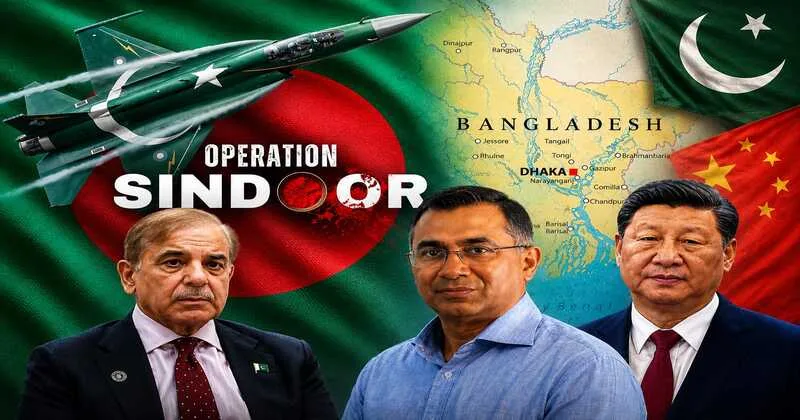
Bangladesh’s reported move to acquire China-designed and Pakistan-manufactured JF-17 fighter jets is emerging as one of the most controversial defence decisions in South Asia. The proposed deal being pushed ahead during a period of major geopolitical shifts in the region, comes despite growing criticism surrounding the aircraft’s battlefield credibility, technical reliability, and strategic value after Pakistan’s experience during India’s Operation Sindoor.
The debate is no longer limited to military procurement. It has now evolved into a larger question about whether Dhaka is walking into a costly strategic trap designed by Beijing and Islamabad at a time when Bangladesh faces economic stress and a rapidly changing security environment.
Several retired Bangladesh Air Force veterans have openly questioned the wisdom of purchasing the JF-17 platform. Their criticism gained momentum after Operation Sindoor, during which India carried out precision strikes on Pakistani terror and military infrastructure using stand-off weapons and beyond-visual-range capabilities that Pakistan struggled to counter effectively.
Operation Sindoor and the collapse of Pakistan’s Air defence narrative
Operation Sindoor fundamentally altered regional perceptions about Pakistan’s Chinese-origin military systems. According to accounts cited in Eurasia Review, Pakistan failed to effectively stop Indian precision strikes conducted largely beyond visual range. A retired Bangladesh Air Commodore, speaking anonymously, reportedly stated that Pakistan’s military equipment “came a cropper” during the four-day confrontation with India.
The remarks are significant because Pakistan has long marketed the JF-17 as a battle-tested fighter suited for modern aerial warfare. However, the inability of Pakistan’s broader Chinese-backed defence architecture to prevent Indian strikes has triggered serious concerns among strategic observers in Bangladesh.
🇧🇩 Will Bangladesh acquire the Chinese-Pakistani JF-17 fighter?
Bangladesh is looking to modernize its aging force. One of the top potential candidates? The Chinese-Pakistani JF-17 Thunder Block III fighter jet.
🔶What is JF-17? – A lightweight, multirole fighter jet jointly… pic.twitter.com/WOa6x5FmWv
— Sputnik (@SputnikInt) May 28, 2026
India’s use of BrahMos supersonic cruise missiles during Operation Sindoor exposed critical weaknesses in Pakistan’s Chinese-supplied air defence systems. Key Pakistani airbases and military infrastructure were hit with precision, despite the presence of systems such as the HQ-9 and LY-80, both supplied by China. The operational outcome raised uncomfortable questions for countries considering Chinese military hardware.
If Pakistan’s air defence network struggled against supersonic BrahMos missiles, analysts began asking how such systems would cope against the next generation of Indian hypersonic weapons that travel beyond Mach 5. Dr Sudhir Mishra, former CEO and Managing Director of BrahMos Aerospace, offered a blunt assessment.
According to him, intercepting even a single hypersonic missile with present-day capabilities would be extraordinarily difficult. He explained that the combination of extreme velocity, manoeuvrability, and minimal reaction time changes the entire interception equation.
This assessment aligns with wider global military understanding. Hypersonic systems can cover massive distances within seconds, reducing defensive reaction windows to mere moments. The plasma sheath generated around such weapons at extreme speeds can also interfere with radar tracking, further complicating interception attempts. For Bangladesh, these realities matter because the JF-17 acquisition is not being viewed in isolation. It is being evaluated against the battlefield performance of the wider China-Pakistan defence ecosystem that was tested during Operation Sindoor.
Bangladesh’s JF-17 debate intensifies
The proposed JF-17 purchase has generated growing unease within Bangladesh’s strategic community. According to political analyst Anjuman A Islam writing in Eurasia Review, discussions regarding the possible deal intensified ahead of Bangladesh Prime Minister Tarique Rahman’s scheduled June visit to China, his first foreign visit after assuming office. The report claimed that Chinese Ambassador to Bangladesh Yao Wen has actively engaged Bangladesh’s military leadership, including the Army and Air Force chiefs, to build support for the acquisition.
At the centre of the controversy is the perception that China is aggressively attempting to expand arms sales in South Asia despite mounting questions regarding the performance and reliability of its military equipment. The criticism became sharper following multiple aviation incidents linked to Chinese-origin aircraft in Pakistan and Bangladesh.
Recently, a high-level Pakistani delegation visited Bangladesh to push the possible JF-17 sale. However, another reported crash involving a JF-17 near Kamra in Pakistan intensified scrutiny. Kamra is closely associated with Pakistan’s fighter production infrastructure. Reports cited in Eurasia Review claimed that both Pakistan and China attempted to suppress details surrounding the crash in order to prevent reputational damage to the aircraft programme.
Deputy Prime Minister and Foreign Minister, Senator Mohammad Ishaq Dar @MIshaqDar50, embarks upon a historic visit to Bangladesh. In Dhaka, he will hold important meetings with Bangladeshi leaders. The visit is a significant milestone in Pakistan-Bangladesh relations as a… pic.twitter.com/In13QwBcJj
— Ministry of Foreign Affairs – Pakistan (@ForeignOfficePk) August 23, 2025
The same concerns had already emerged after the crash of a Pakistan Air Force training aircraft on May 20. Reports alleged that authorities moved quickly to obscure the aircraft’s country of origin as a coordinated cover-up effort. These incidents added to existing anxieties in Bangladesh, particularly after the country witnessed one of its deadliest aviation disasters in 2025.
A Chinese-made F-7 Air Force training aircraft crashed into Milestone School and College in Dhaka following a technical malfunction, killing more than 20 students and injuring hundreds. For many observers in Bangladesh, the tragedy became a painful reminder of the risks associated with unreliable military hardware.
China’s expanding defence footprint in South Asia
The JF-17 debate also reflects a larger geopolitical contest unfolding across South Asia. China has increasingly used defence exports as a strategic instrument to deepen influence in neighbouring countries, particularly those located around India’s periphery. Pakistan remains Beijing’s most important military partner in the region and serves as a key manufacturing base for several Chinese-origin defence platforms. The JF-17 itself symbolises this partnership, designed by China and produced in collaboration with Pakistan. However, critics argue that the aircraft’s battlefield image has not matched its marketing.
The concern expressed by retired Bangladesh military veterans is particularly important because it emerges from within the region rather than from external competitors. Their argument is not ideological but operational. They question whether Bangladesh should invest heavily in a platform linked to repeated technical concerns and tied to a defence network that failed to stop Indian strikes during a real military confrontation.
According to the Australian Institute of International Affairs, Bangladesh’s proposed commitment to a Sino-Pakistani aviation system could cost up to USD 720 million. The report warned that such a massive investment raises serious questions at a time when Bangladesh is navigating economic fragility and geopolitical recalibration.
The report further argued that a defence decision of such magnitude requires parliamentary scrutiny, independent economic evaluation, and open public debate because of its long-term implications for Bangladesh’s fiscal space and strategic posture.
This criticism strikes at the heart of Dhaka’s traditional foreign policy doctrine, “friendship towards all, malice towards none.” Critics fear that deeper integration into the China-Pakistan defence orbit could undermine Bangladesh’s carefully balanced regional diplomacy.
India’s emerging technological advantage
Operation Sindoor did more than expose Pakistan’s defensive weaknesses. It also highlighted India’s accelerating military modernisation and growing stand-off strike capabilities. India’s BrahMos missile system demonstrated high precision and operational effectiveness during the strikes. More importantly, Indian defence development is now moving toward hypersonic technologies that could further widen the military gap in the coming years.
During my visit to Bangladesh, I met student leaders (NCP), BNP, Jamat leaders. Under the previous govt, we did not have good relations. After Feb elections, we will proactively engage with Bangladesh: Pakistan FM Ishaq Dar pic.twitter.com/4uRrqXZqLY
— Sidhant Sibal (@sidhant) December 27, 2025
The Defence Research and Development Organisation (DRDO) is actively developing advanced programmes such as the Extended Trajectory Long Duration Hypersonic Cruise Missile (ET-LDHCM) and the Long-Range Anti-Ship Hypersonic Missile (LR-ASHM). India has already achieved major milestones in scramjet propulsion technology, including sustained engine tests exceeding 12 minutes. These developments indicate substantial progress in indigenous hypersonic capabilities.
Current projections suggest that India may begin operational deployment of certain hypersonic systems between 2027 and 2030. Some naval and air-launched variants could enter service during the late 2020s, while broader integration is expected in the early 2030s. These systems are expected to complement the BrahMos family and provide India with a layered long-range strike capability capable of overwhelming conventional air defence networks. For Bangladesh, this changing strategic environment complicates the logic behind investing heavily in systems that are already struggling against current-generation Indian capabilities.
A strategic choice with long-term consequences
Bangladesh now finds itself at a crucial strategic crossroads. The proposed JF-17 acquisition is no longer being discussed merely as a military procurement programme. It has become a test of whether Dhaka intends to anchor itself more deeply within the China-Pakistan strategic framework despite growing evidence of operational weaknesses exposed during Operation Sindoor. The criticism emerging from retired Bangladesh Air Force veterans reflects broader concerns that Dhaka may be purchasing into a defence ecosystem whose limitations were publicly exposed during India’s precision strikes on Pakistan.
At the same time, repeated technical controversies involving Chinese-origin aircraft, from the F-7 crash in Dhaka to reported crashes in Pakistan, have intensified fears regarding reliability, transparency, and accountability. India’s growing technological edge, especially in precision strike and hypersonic weapons development, has further altered the regional balance. Operation Sindoor demonstrated that battlefield narratives built through aggressive marketing can quickly collapse when tested in actual conflict conditions.
For Bangladesh, the central question is no longer whether the JF-17 is affordable or politically convenient. The larger issue is whether investing hundreds of millions of dollars into a disputed platform tied to a failed defence architecture serves the country’s long-term national interest in an increasingly volatile South Asian security environment.