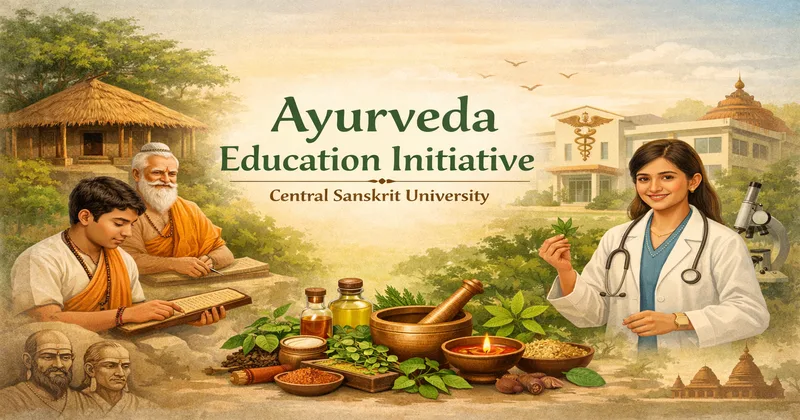
To strengthen Bharat’s traditional healthcare system and nurture dedicated Ayurvedic practitioners from an early age, the Central Sanskrit University has announced a new initiative that will help students to begin their journey toward becoming Ayurvedic doctors immediately after qualifying Class 10. The university’s latest decision aims to make Ayurveda education more accessible, structured, and attractive to students who genuinely want to pursue traditional Indian medicine as a profession. Under the new framework, eligible students will be able to seek admission through a Pre-Ayurveda BAMS Entrance Examination, leading to a Gurukul-based Ayurveda education system aligned with modern academic standards.
According to Vice-Chancellor Prof. Srinivas Varkhedi, the initiative has been designed to connect students with Ayurveda, India’s knowledge traditions, and the Gurukul method of learning from the very beginning of their academic journey.
For years, admission to the Bachelor of Ayurvedic Medicine and Surgery (BAMS) course largely depended on the National Eligibility cum Entrance Test (NEET). As a result, many students entered Ayurveda only after failing to secure seats in MBBS programmes. The newly announced pathway aims to change that perception by attracting students who consciously choose Ayurveda as their primary career goal rather than as a secondary option. The university will oversee admissions and the affiliation of Ayurveda Gurukuls in accordance with standards prescribed by the National Commission for Indian System of Medicine. It will ensure that the educational quality remains consistent with national requirements.
केंद्रीय संस्कृत विश्वविद्यालय द्वारा आयुर्वेद शिक्षा को अधिक सुलभ, व्यवस्थित एवं समर्पित विद्यार्थियों तक पहुँचाने के उद्देश्य से एक महत्वपूर्ण पहल की गई है।
इस पहल के अंतर्गत कक्षा 10 के उपरांत विद्यार्थी प्री-आयुर्वेद बीएएमएस प्रवेश परीक्षा के माध्यम से आयुर्वेद गुरुकुलम…
— CENTRAL SANSKRIT UNIVERSITY (@CentralSanskrit) June 2, 2026
Ayurveda’s Historical Legacy
Long before the emergence of modern hospitals and pharmaceutical industries, Ayurveda was the primary healthcare system across the Indian subcontinent. Ancient texts such as the Charaka Samhita and Sushruta Samhita documented sophisticated approaches to diagnosis, surgery, nutrition, disease prevention, and holistic wellness. For centuries, Ayurvedic practitioners relied on an understanding of diet, herbal formulations, lifestyle modifications, and natural therapies to cure or address various health conditions. This system focused not only on treating diseases but also on preventing them by maintaining the body’s natural balance and promoting a healthy lifestyle.
Even today, many of Ayurveda’s foundational principles such as the importance of nutrition, immunity, physical activity, sleep, and stress management continue to connect with contemporary health research.
Back to Ayurveda and Traditional Wellness During COVID-19
The Covid-19 pandemic led many people to rethink their approach to health and wellness. As concerns about immunity and overall well-being grew, a large number of Indians turned to Ayurveda and other traditional health practices. During this period, many households in India started using herbal drinks, turmeric-based remedies, yoga, breathing exercises, and other traditional methods that are believed to support immunity and healthy living. Demand for Ayurvedic products also increased significantly across India during those times.
While modern medicine played the key role in treating Covid-19 patients and developing vaccines, the pandemic highlighted the importance of preventive healthcare and healthy lifestyles.
Today, more young people are exploring Ayurveda not only as a way of life but also as a promising field of education, research, and healthcare. Educational institutions and research centres are seeing growing interest in traditional Indian knowledge and its connection with modern science.
One of the most significant changes in recent years has been the growing recognition of Ayurveda as a serious professional field. Experts say that different systems of medicine are important for improving public health, with each contributing in its own way. Students pursuing a BAMS degree receive extensive education and practical training in subjects such as anatomy, physiology, pathology, pharmacology, surgery, and Ayurvedic medicine. Across many parts of India, Ayurvedic doctors play an important role in healthcare, especially in disease prevention, management of long-term illnesses, and community health services.
As healthcare evolves, Ayurvedic doctors are contributing not only to clinical practice but also to research, public health initiatives, wellness industries, pharmaceuticals, education, and interdisciplinary healthcare models.
Central Sanskrit University’s vision extends beyond medical education. Prof. Varkhedi explained about the Setubandha Scholar and Vidwan Scheme, which is a unique initiative jointly supported by the Ministry of Education and the Indian Knowledge Systems (IKS) Division. Under the programme, students trained in Gurukul traditions are receiving scholarships to undertake research projects at leading institutions, including the country’s premier technological institutes. Participants will work with faculty members and researchers to combine traditional knowledge with modern scientific methods. The initiative is expected to open new opportunities for research and help scholars explore how ancient Indian knowledge can contribute to fields such as healthcare, technology, education, and sustainable development.
Thus, by allowing students to begin specialized preparation after Class 10, Central Sanskrit University hopes to cultivate deeper expertise, stronger professional dedication, and greater appreciation for India’s medical heritage.