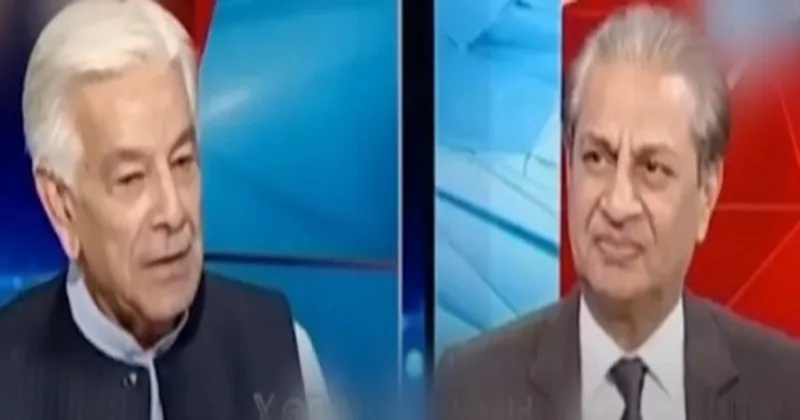
In a viral video that has triggered widespread debate, Pakistan Defence Minister Khawaja Asif in an interview acknowledged that the ancestors of most Pakistani Muslims were Hindus and criticised the distortion of history in Pakistan’s education system. Stating that many Pakistanis deny their indigenous roots and falsely claim foreign ancestry from Saudi. His remarks have reignited discussions on identity, ancestry, and the shared civilisational heritage of the Indian subcontinent.
During the interview, Asif acknowledged that the ancestors of most Pakistani Muslims were Hindus and argued that many Pakistanis have distanced themselves from this historical reality.
Recalling his own family history, Asif said that many Kashmiri Muslim families, including his own, trace their origins to Hindus who later embraced Islam.
Asif narrated an incident involving former Prime Minister Nawaz Sharif. He claimed that while travelling with Nawaz Sharif, he shared the story of a figure associated with the Islamisation of Kashmir. Upon learning about the location of the individual’s last rites, Nawaz Sharif reportedly contacted officials and informed them that he would be delayed, requesting arrangements be made so that he could visit the site and pay his respects. Asif said that both he and Nawaz Sharif openly accepted the historical reality that many Kashmiri Muslim families, including their own, trace their ancestry to Hindus who later converted to Islam.
Stressing the importance of accepting historical realities, Asif remarked that there should be no hesitation in recognising one’s origins.
According to him, history should be studied objectively and dispassionately rather than through narratives designed to serve contemporary political objectives. He questioned popular historical claims and argued that historical events should be analysed on the basis of facts rather than myths or political symbolism.
Asif also expressed concern over the manner in which history is taught in Pakistan. Recalling his school years, he said students were introduced to figures such as Emperor Ashoka, Chandragupta Maurya, Kanishka, as well as the histories of Buddhism, Jainism, the Greeks, and other civilisations that shaped the Indian subcontinent. He lamented that many of these figures and traditions have gradually disappeared from mainstream educational narratives.
Questioning the reluctance to acknowledge this shared heritage, Asif said that learning about Ashoka, Chandragupta Maurya, or other historical personalities did not make him any less Pakistani. He maintained that one can take pride in being Pakistani while also recognising the civilisational history of the region.
Referring to The Murder of History, a book by Pakistani historian K.K. Aziz, Asif alleged that Pakistan’s education system has for decades promoted distorted and selective versions of history. He argued that generations of students have been taught narratives that neglect important aspects of the region’s past and fail to provide a balanced understanding of historical developments.
Asif further criticised the tendency among many Pakistanis to claim foreign ancestry. He remarked that a significant section of society attributes its origins to Saudi Arabia, Iran, Central Asia, or other regions, while ignoring indigenous roots within the Indian subcontinent. According to him, societies seeking to understand their identity must engage honestly with their past rather than deny it.
In another widely circulated video, Asif commented on Mahmud of Ghazni, stating that the medieval ruler is often glorified in Pakistan despite being a violent invader. He argued that Mahmud Ghazni’s campaigns resulted in violence not only against non-Muslims but also against Muslims who did not align with him. Questioning the hero-worship of such figures, Asif called for a more analytical and fact-based approach to history.
He maintained that historical identity should not be denied or concealed. According to Asif, nations become stronger when they confront their past honestly and develop an understanding of their civilisational heritage based on facts rather than ideological narratives.
Khawaja Asif’s remarks have reignited a long-standing debate on Pakistan’s civilisational roots and the historical identity of its people. While his acknowledgment that the ancestors of most Pakistani Muslims were Hindus has drawn criticism from sections of Islamist and radical groups that have opposed such narratives.
