Bhubaneswar: The Akhil Bharatiya Vidyarthi Parishad (ABVP), during its three-day National Executive Council Meeting in Bhubaneswar, adopted key resolutions, including a strong call to curb organized criminal networks and Jihadi ideologies that exploit women through various means, including religious conversion. The ABVP demanded that forced, fraudulent, or inducement-based religious conversions be declared a serious criminal offense, necessitating a robust national law. They also called for such cases to be tried in fast-track courts to ensure swift justice and stringent punishment. Furthermore, the ABVP advocated for a dedicated central-level investigative agency to probe organized crimes, cyber blackmail, and illegal conversion networks targeting women and young girls.
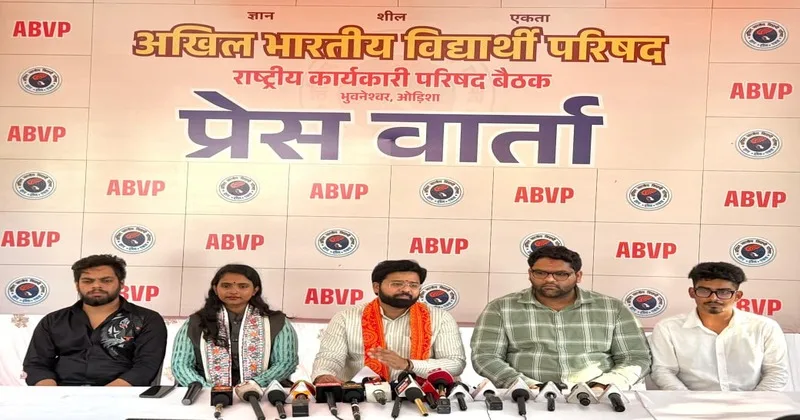
ओड़िशा की राजधानी भुवनेश्वर में संपन्न हुई अखिल भारतीय विद्यार्थी परिषद की राष्ट्रीय कार्यकारी परिषद बैठक में पारित प्रस्तावों एवं आगामी योजनाओं की विस्तृत जानकारी हेतु आयोजित प्रेस वार्ता को राष्ट्रीय महामंत्री डॉ. वीरेंद्र सिंह सोलंकी ने संबोधित किया।
प्रेस वार्ता के दौरान… pic.twitter.com/pBRdMFkelA
— ABVP (@ABVPVoice) June 1, 2026
In addition to this, the council passed four major resolutions focusing on educational reforms, women’s safety, urban Maoism, and the global geopolitical scenario. ABVP National General Secretary Dr. Virendra Singh Solanki shared these details at a press conference.
Focus on Women’s Safety and Organized Criminal Exploitation Networks
The first resolution, titled “Curb Organized Criminal and Jihadi Mindset Behind Exploitation of Women and Conversion Activities,” specifically addressed women’s safety and the issue of alleged organized exploitation and illegal religious conversions targeting women and young girls. The council expressed deep concern over incidents involving deception, coercion, fake identities, cyber blackmail, and inducements allegedly used to exploit women and influence their religious beliefs. ABVP stated that such activities not only violate the dignity, freedom, and human rights of women but also threaten social harmony and national unity.
The resolution cited several incidents from different parts of the country which, according to the organization, reveal the existence of organized criminal networks operating through emotional manipulation, false identities, and digital platforms. The ABVP maintained that while the Constitution guarantees every citizen the freedom to practice and profess their faith, conversions achieved through force, fraud, fear, or inducement are contrary to constitutional principles and individual rights.
Call for Strong Legal and Institutional Framework
To address these concerns, the council urged the government to enact a comprehensive national law criminalizing forced or fraudulent religious conversions. It also called for the creation of a specialized central investigation mechanism to examine organized crimes linked to cyber exploitation and illegal conversion activities. The resolution further recommended stronger monitoring systems to prevent the misuse of social media and digital platforms, mandatory internal complaints committees in educational institutions and and workplaces, dedicated safety cells for women students, and awareness programs aimed at preventing exploitation. ABVP also advocated for wider implementation of self-defense initiatives such as Mission Sahasi and called for enhanced schemes promoting women’s education, skill development, entrepreneurship, and empowerment.
Education Reform and Implementation Challenges
Another resolution, titled “Effective Ground-Level Implementation Essential to Make Education Reforms Outcome-Oriented,” addressed the implementation of educational reforms and highlighted the need for effective execution of transformative policy initiatives. The council acknowledged that measures such as the National Education Policy (NEP) 2020, the National Eligibility-cum-Entrance Test (NEET), the Common University Entrance Test (CUET), and institutional ranking systems like the National Institutional Ranking Framework (NIRF) were introduced with the objective of improving transparency, quality, and accessibility in education. However, it observed that shortcomings in implementation have hindered the realization of their intended benefits.
ABVP expressed concern over recurring irregularities in national-level entrance and recruitment examinations. Referring to issues related to question paper security, examination management, cancellation of test centers, delays in admissions, and procedural inconsistencies, the council noted that these challenges have created uncertainty among students. It also pointed to concerns regarding the functioning of regulatory and accreditation bodies, including allegations of a lack of transparency, delays in evaluations, and inconsistencies in institutional assessments.
The council further observed that several reforms under NEP 2020, including the Four-Year Undergraduate Programme, Academic Bank of Credits, Multiple Entry-Multiple Exit system, and multidisciplinary education, have faced implementation challenges due to inadequate infrastructure, limited institutional preparedness, insufficient faculty training, and a lack of clarity in guidelines. According to the resolution, confusion regarding credit transfers, degree equivalence, academic continuity, and employability has affected both students and teachers.
ABVP urged both the Central and State Governments to ensure adequate resources, stronger institutional accountability, improved digital infrastructure, and effective coordination among educational stakeholders. It emphasized that education reforms can achieve meaningful outcomes only through transparent, time-bound, and student-centric implementation, leading to an affordable, inclusive, and high-quality education system.
Urban Maoism as an Emerging Internal Challenge
Another resolution, titled “Urban Maoism Emerging as a Serious Challenge Amid the Decline of Armed Maoism,” focused on the emerging challenge of urban Maoism. While appreciating the significant decline of armed Maoist insurgency due to coordinated security operations, improved intelligence mechanisms, developmental initiatives, and rehabilitation policies, the council cautioned that Maoist ideology continues to persist in new forms.
ABVP noted that the influence of armed Maoism has diminished considerably in traditional conflict zones due to successful government interventions and improved socio-economic development in tribal regions. However, it argued that Maoist ideology is increasingly attempting to gain influence through urban networks operating within universities, cultural institutions, media platforms, social organizations, and digital spaces.
The council described urban Maoism as a complex challenge because it often functions under the cover of intellectual, academic, or social activism, making identification and monitoring more difficult than conventional insurgency. According to ABVP, ideological radicalization and misinformation campaigns aimed at influencing youth and promoting anti-national narratives require serious attention.
The resolution called for a comprehensive approach that addresses not only the remnants of armed Maoist structures but also the ideological ecosystems that allegedly facilitate their growth. ABVP also emphasized the need for effective rehabilitation measures, educational opportunities, and stable employment for former Maoists who have surrendered, ensuring they do not return to violence. The organization appealed to students and citizens to remain vigilant against extremist ideologies and contribute toward strengthening national unity, democratic values, and constitutional institutions.
Global Uncertainty and India’s Strategic Position
The fourth resolution, titled “Collective National Resolve for Restraint and Vigilance Needed in an Era of Global Uncertainty,” examined the rapidly evolving global geopolitical and economic landscape. The council observed increasing global uncertainty stemming from geopolitical conflicts, economic realignments, and strategic competition among major powers. It cited ongoing international tensions, including regional conflicts and their impact on energy markets, inflation, trade flows, and global stability.
ABVP noted that rising tensions in West Asia and disruptions in key maritime routes have contributed to increasing energy prices and economic uncertainty worldwide. As a major energy-importing nation, India faces direct implications from these developments. The council highlighted that fluctuations in fuel prices and broader economic pressures affect ordinary citizens, including farmers, students, and the middle class.
India’s Foreign Policy and Global Role
Despite these challenges, the resolution praised India’s balanced and independent foreign policy approach. It highlighted India’s commitment to strategic autonomy and national interest while maintaining constructive engagement with multiple global partners. The council observed that India’s diplomatic efforts, humanitarian outreach, and multi-alignment strategy have strengthened its position as a responsible and credible global actor.
ABVP also viewed the current global environment as an opportunity for India to enhance its long-term economic and strategic resilience. The resolution welcomed initiatives aimed at diversifying trade partnerships, strengthening technological capabilities, expanding semiconductor manufacturing, promoting energy security, and reducing dependence on any single market or supply chain.
The council further stated that amid growing challenges to multilateral institutions and increasing protectionism, India has an opportunity to play a larger leadership role in shaping a more equitable and inclusive global order. It called upon the country to use international platforms, including BRICS and other multilateral forums, to advocate for institutional reforms and stronger representation for developing nations.
Concluding the resolution, ABVP urged India’s youth to embrace innovation, self-reliance, national security awareness, and responsible resource utilization. The council expressed confidence that India’s youth would play a decisive role in addressing emerging challenges and contribute to the country’s rise as a responsible global leader committed to peace, development, and human welfare.
Collectively, the four resolutions reflect ABVP’s focus on issues ranging from women’s safety and educational governance to national security and global developments, while emphasizing the role of youth participation in shaping India’s future.
ABVP National General Secretary Dr. Virendra Singh Solanki stated, “The resolutions adopted during the National Executive Council Meeting are not merely responses to contemporary challenges; they also reflect ABVP’s broader national vision and long-term commitment to building a developed, secure, prosperous, and self-reliant India. Through these resolutions, we have collectively reaffirmed our commitment to making education more effective, student-centric, and employment-oriented; addressing emerging challenges such as Urban Maoism that threaten national security; curbing organised crimes, exploitation, and conversion conspiracies targeting women; and fostering vigilant and responsible citizenship in an era of global uncertainty where national interest must remain paramount. At a time when India is emerging as a major global power, strong synergy between the energy of youth, the intellectual capacity of educational institutions, and the resources of the industrial sector has become indispensable. Increased investment in Research and Development is the need of the hour if India is to emerge as a global leader in innovation, research, and the knowledge-based economy. Through this meeting, ABVP has called upon Indian industry to establish long-term partnerships with youth, universities, and research institutions, thereby strengthening a culture of innovation-driven development.ABVP will continue to work extensively in the coming year to strengthen national integration, promote Indian languages, awaken cultural consciousness, and enhance the positive participation of youth in various spheres of social life. We firmly believe that the youth of India, through their talent, innovative spirit, social responsibility, and national commitment, will play a decisive role in taking the nation to new heights. This National Executive Council Meeting will serve as an important milestone in that direction.”
To mark the historic 60th anniversary of the National Integration Tour under the Student Experience in Inter-state Living (SEIL), dedicated ‘SEIL@60’ programs will be organized across India, Dr. Solanki added.
Furthermore, ABVP will launch year-long nationwide campaigns focusing on various milestones, including ‘Screen Time to Activity Time’, ‘150 Years of Vande Mataram’, 50 years of the anti-Emergency movement, the 350th martyrdom year of Sri Guru Tegh Bahadur, and the 650th birth anniversary celebration of Sant Ravidas Ji.
State Secy Deetimayi Pratihari, Mahanagar Secy Gangadhar Padhi, and State Media Coordinator Vasudev Panigrahi were also present in the press conference .