
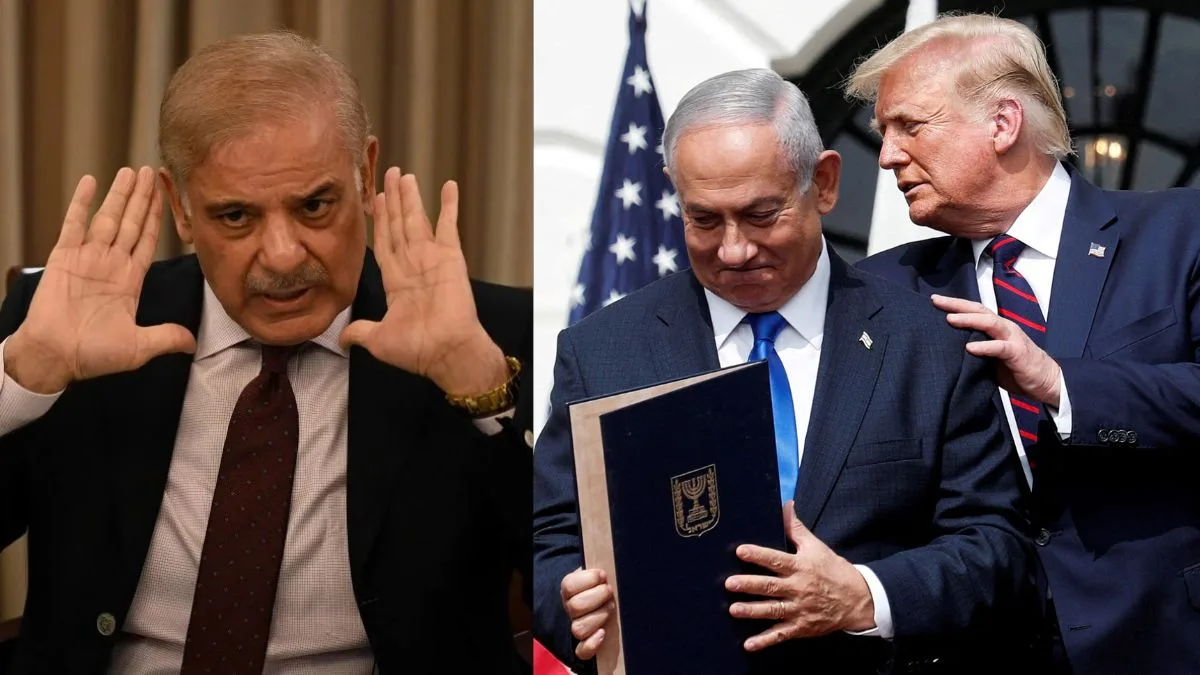
The Middle East looks different now than it did five years ago. The United Arab Emirates, Bahrain, Morocco, Sudan — one by one they have stepped forward, shaken hands with Israel, and signed their names to what became known as the Abraham Accords. What once seemed unimaginable became, through a combination of American pressure, economic incentive, and political calculation, an uncomfortable new normal. Now Washington is looking east. And Pakistan is next on the list. Pakistan keeps saying no — and that too with sharp response from Pakistan Defence Minister Khawaja Asif.
“Against Our Core Beliefs” – Khawaja Asif
Defence Minister Khawaja Asif put it plainly, the way Pakistani officials tend to when the subject is raised: Pakistan cannot sign anything that goes against its core beliefs.
“Personally, I don’t think we should join any such accord that clashes with our fundamental ideologies,” Asif said, adding that Pakistan’s position on Israel remains unchanged.
That is the official line, and it is delivered with the kind of firmness that is meant to close a conversation rather than open one.
But the real reason runs far deeper than a minister’s statement. The truth — the uncomfortable, plainspoken truth — is that any Pakistani leader who seriously entertains the idea of recognising Israel will lose their position. Not in a metaphorical, political-capital kind of way. In a very literal, your-government-falls kind of way. For millions of Pakistanis, recognising Israel is not a foreign policy choice. They consider it a betrayal — of faith, of history, of the very reason Pakistan exists.
What Are the Abraham Accords? The Strategic Reasons Behind US Pressure on Pakistan
For the Middle East, Arab countries would not shake hands with Israel until the Palestinians had their state. The Abraham Accords, brokered during Trump’s first term, simply walked past that assumption as if it were not there.
The UAE, Bahrain, Morocco — and Sudan, at least partially — stepped forward to formally recognise Israel, establishing diplomatic, trade and security ties. Not because the Palestinian question was resolved. But because their own calculations had changed. Iran felt more threatening than Israel. American security guarantees felt more valuable than pan-Arab solidarity. Economics made a compelling argument where ideology had run out of steam.
The name — Abraham, the patriarch shared by Judaism, Islam and Christianity — was a deliberate choice, designed to frame normalisation as reconciliation rather than betrayal. The declaration itself reads beautifully: tolerance, dignity, interfaith dialogue, a better future for children. But beneath the language, it is a geopolitical architecture — one designed to isolate Iran, anchor American influence, and build an informal security ring around Israel.
Trump’s second term has picked this project back up with noticeably more urgency. There is an ongoing US-Israel military campaign against Iran, a fragile ceasefire, inconclusive talks, and a president who wants a legacy-defining deal. Getting as many Islamic countries as possible into the Abraham framework — visibly, simultaneously — is part of that legacy. Which is where Pakistan comes in.
Why Don’t Pakistan want Abraham Accords? A Nation Born with an Islamic Cause
Pakistan came into being in 1947 as a homeland for the Muslims of the subcontinent. That founding identity has never been just a historical footnote. It lives in the country’s politics, its textbooks, its mosques, politics, and the national psyche — way ordinary people understand their place in the world.
For most Pakistanis, the Palestinian cause is not foreign policy. It is personal. It is tied to faith. It is, in the deepest sense, about who they are. The Pakistani passport still carries the declaration that it is not valid for travel to Israel. That is not a bureaucratic technicality. It is a statement of identity — one that successive governments have lacked the political will, or the desire, to remove.
To sign the Abraham Accords would not just be a diplomatic shift. It would feel, to millions of Pakistanis, like tearing out a page from the country’s soul.
Pakistan and the other Muslim Nations
None of this means the outside world hasn’t tried. The pressure from Gulf countries in particular has been pointed and deliberate. The UAE withheld a $3.5 billion loan. Visas for Pakistani workers — a lifeline for millions of families — became harder to obtain. Saudi Arabia offered various forms of assistance with strings quietly attached. The message from Gulf capitals was not subtle: align with us on Israel, or face economic consequences.
Pakistan took the money when it could. It smiled at its Gulf partners. And it still didn’t move.
Why? Because the cost of moving is too high — not in dollars, but in the domestic political reckoning that would follow.
Why Any Move Towards Israel Risks Mass Protests in Pakistan
Religious parties like Jamaat-e-Islami and Tehreek-e-Labbaik Pakistan do not win general elections. They do not need to. Their power lies in their ability to mobilise, to march, to block roads, to make a government’s life ungovernable. They have done it before over far smaller provocations than this.
Hand them the issue of normalisation with Israel and you hand them the most potent political weapon they have ever held. The streets of Karachi, Lahore, and Islamabad would not be calm. The clerics would not stay quiet. And any government that tried to push through such a deal would find itself facing a crisis it could not contain.
The case of a Pakistani journalist who visited Israel not long ago is instructive. He lost his job. Government ministers threatened him with travel bans. Others piled on with worse. This was not a response to a diplomatic agreement. It was a response to one individual’s trip. That tells you everything about the temperature.
Pakistan Military Watches and Waits
In Pakistan’s complex power structure, no conversation about foreign policy is complete without understanding the military’s role. The army has always been the final arbiter of decisions that matter — and it watches public sentiment with careful attention.
Far from being a passive observer of public sentiment, Pakistan’s military establishment has actively shaped and reinforced the country’s hardline anti-Israel position for decades. The army has long weaponised the Palestinian cause to legitimise its own primacy, sustain the Kashmir narrative, and justify its patronage of jihadist proxies.
Normalising ties with Israel would not just risk sparking protests on Pakistan’s streets; it would challenge some of the deepest assumptions that have shaped the country’s security and political establishment for decades. Within Pakistan’s power structure, many in the military and strategic community view any move towards Israel as more than a diplomatic decision—it is seen as a shift that could weaken the ideological foundations of the state and dilute its long-standing position on regional issue.
Since the military remains the most influential voice on national security, any civilian government seeking to pursue such a policy would face formidable institutional resistance.
The military will not greenlight anything that risks destabilising the domestic order. Not while the IMF is involved in sensitive bailout discussions. Not while tensions between the civilian government and the establishment remain close to the surface. No general, and no prime minister, wants to introduce a new fault line into an already fragile system.
Why Does America Want Pakistan Specifically?
This is the question worth sitting with. Pakistan is not Arab. It does not share a border with Israel or a direct stake in the territorial disputes of the Levant. So why does Trump name it in the same sentence as Saudi Arabia and Qatar?
Because of what Pakistan represents. It is the world’s second-largest Muslim-majority country. It is a nuclear state. And it carries perhaps the single most explicit anti-Israel statement of any passport on earth.
If Pakistan signs, the message to the Islamic world would be extraordinary. It would suggest that even the countries most visibly, most ideologically committed to Palestinian solidarity can be brought around. The symbolism alone would be worth more to Washington than any security arrangement.
There is also a more immediate, practical reason. Pakistan has been playing the role of mediator between Washington and Tehran — a position that requires being trusted in both capitals. Trump appears to be making a straightforward calculation: if you want to remain useful as a broker, you must also be willing to pay something. The Abraham Accords, in his framing, are that something. The US also indirectly indicates that signing the Accord, could unlock investment, improve access to American technology, ease tensions in a relationship that has grown increasingly transactional.
But politics is not only about arithmetic. It is about what people believe, what they feel, what they are willing to accept from those who govern them. And in Pakistan, on this particular question, the feeling is not ambivalence. It is not quiet discomfort. It is something closer to a red line drawn in the collective consciousness of a nation.
Abraham Accord: The Handshake that might not Come!
Until Pakistani society itself shifts — until the Palestinian cause recedes from the centre of Pakistani identity, until religious parties lose their capacity to mobilise, until a generation grows up for whom this is an abstraction rather than a conviction — the Abraham Accords will remain beyond reach.
No prime minister shall offer that handshake. No army chief shall approve it at this point. No government, however, closely it relies on American goodwill or Gulf money, will move on this and survive.
The accords changed the Middle East. They will not, for now, change Pakistan. The country’s identity will hold the line — not because of any single leader’s courage or stubbornness, but because on this question, the people of Pakistan have already decided.
And we shouldn’t expect that decision to change anytime soon.