Bharat has always been a land of creative ventures and profound intellectual traditions. The traditional knowledge systems of Bharat demonstrate the creative aptitude, scientific temperament, and philosophical depth of our ancestors. Architecture, town planning, Ayurveda, metallurgy, chemistry, governance, astronomy, mathematics, music, dance, and spirituality, almost every aspect of life was addressed with remarkable imagination and holistic understanding. The result was a civilisation that evolved practical solutions for everyday life in the form of rituals, customs, and traditions, many of which continue to remain relevant even today.
The philosophical foundation of Bharatiya education rested upon the ideals of Sat (truth), Chit (goodness or consciousness), and Anand (eternal bliss). The manifestation of the inner self through art was considered an expression of Bharatiya culture and philosophy. Creativity was not separate from life; it was embedded in every action, celebration, relationship, costume, dwelling, and social interaction. Education was therefore not merely the transfer of information but a process of self-realisation and refinement of consciousness.
Ancient Indian education was deeply connected with society, ethics, and practical life. Knowledge was not compartmentalised. Gurukulas and universities nurtured disciplined living, moral conduct, intellectual inquiry, and social responsibility. World-renowned centres of learning such as Takshashila, Nalanda University, Vikramshila, and Vallabhi University attracted scholars and students from across the world. These institutions set the highest standards in multidisciplinary teaching and research centuries before the rise of modern universities.
Demonstrating Knowledge of Geometry
The contribution of Bharat to mathematics through the concept of zero changed the course of human civilisation. Temple architecture demonstrated advanced sustainable construction technologies and astonishing knowledge of geometry, acoustics, hydrology, and climate responsiveness. Astronomical calculations achieved remarkable precision. Ayurveda viewed health holistically, integrating body, mind, and spirit. Knowledge was never isolated from ethics and spirituality.
Education in Bharat was traditionally understood as अर्थकरी, मुक्तकरी, युक्तकरी , that which provides livelihood, liberation, and wisdom. The aim was not only economic prosperity but also inner growth and social harmony.
We Lost It?
Over centuries, repeated invasions, colonial domination, and the imposition of alien educational systems gradually weakened India’s indigenous knowledge traditions. Colonial education policies primarily aimed to create a class of intermediaries suited to administrative functions rather than rooted thinkers connected with Indian civilisation.
Traditional systems of learning were marginalised. Sanskrit and regional knowledge traditions were pushed aside. The continuity between education, ethics, spirituality, creativity, and practical life was disrupted. A deep psychological disconnect emerged between modern educated Indians and their own civilisational heritage.
Gradually, education became increasingly examination-oriented, degree-centric, and detached from life. Creativity, moral development, cultural grounding, and spiritual inquiry lost their central place in mainstream education. Ironically, while the world began recognising the value of yoga, Ayurveda, mindfulness, sustainable living, and holistic education, many Indians themselves remained unaware of the richness of their own traditions.
Yet, despite these disruptions, the stream of Indian knowledge never completely disappeared. Through temples, oral traditions, families, festivals, arts, classical literature, and spiritual institutions, the continuity of Bhartiya civilisation survived. The river of Anand continued to flow through difficult and changing times.
NEP 2020 Restored It
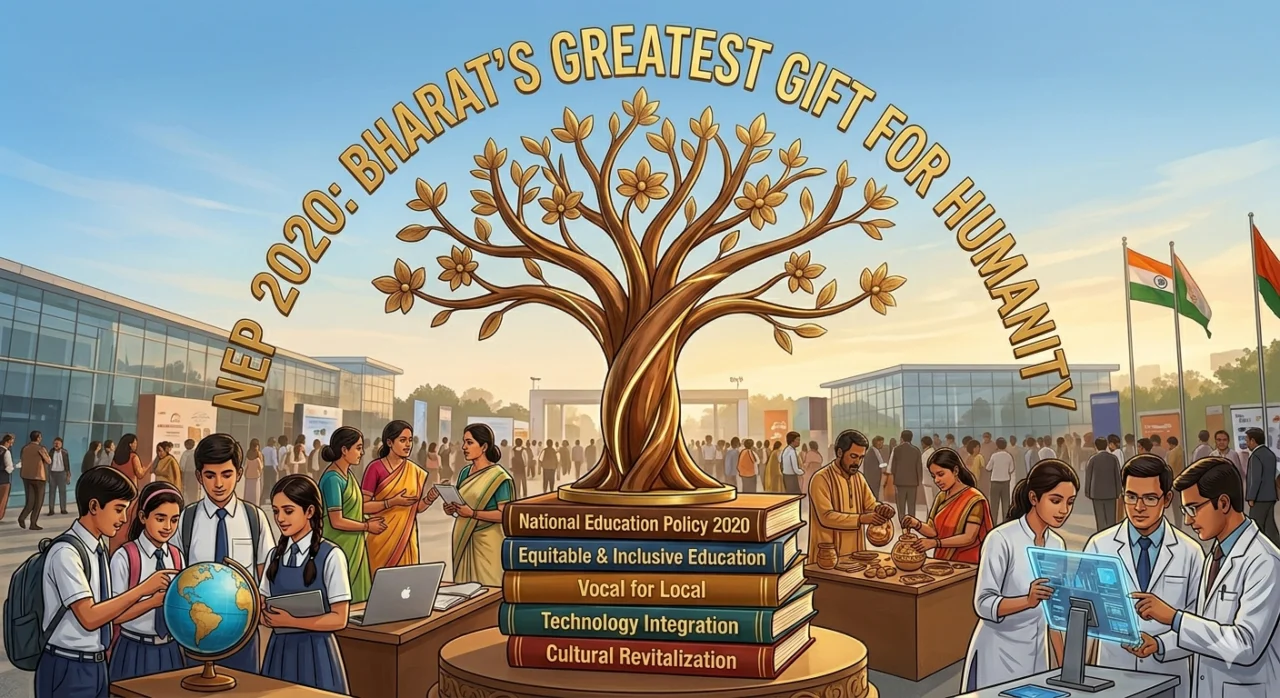
The National Education Policy 2020 marks a historic attempt to reconnect modern education with India’s civilisational wisdom while making it relevant for contemporary global realities. The policy recognises that India’s ancient knowledge traditions are not relics of the past but valuable resources for the future.
The introduction of NEP 2020 clearly states:
“The rich heritage of ancient and eternal Indian knowledge and thought has been a guiding light for this Policy.”
The policy emphasises that the pursuit of Jnan (knowledge), Pragyaa (wisdom), and Satya (truth) has always been considered the highest human goal in Indian thought and philosophy. Importantly, NEP acknowledges that education in ancient India aimed at the complete realisation and liberation of the self, not merely preparation for employment.
Unlike narrow revivalism, NEP 2020 attempts to integrate traditional wisdom with modern scientific inquiry and contemporary relevance. It seeks to nurture rooted yet globally competent citizens. The policy promotes multilingualism, Indian languages, interdisciplinary learning, arts integration, experiential education, ethics, environmental awareness, yoga, and Indian Knowledge Systems (IKS).
Today, many universities across India have started dedicated programmes in Indian Knowledge Systems, spirituality, Sanskrit studies, yoga sciences, Indic philosophy, Buddhist studies, Jainology, consciousness studies, and civilisational studies. These initiatives are not merely about preserving heritage; they aim to generate new research, innovation, and interdisciplinary engagement.
Examples of IKS
K J Somaiya Institute of Dharma Studies, part of Somaiya Vidyavihar University, offers structured academic programmes in Sanskrit, Yoga, Buddhist Studies, Jainology, Prakrit, Religious Studies, Philosophy, and Ancient Indian History. Dev Sanskriti Vishwavidyalaya focuses on yogic sciences, consciousness studies offering research-oriented programmes in Indian Knowledge Systems. Amrita Vishwa Vidyapeetham has introduced programmes around Dharma studies, Sanskritic traditions, yoga, consciousness, and Bharatiya knowledge traditions. Rishihood University promotes Indic civilisational thought, Sanskrit, Sri Aurobindo studies, and cultural leadership through its Centre for Human Sciences. Sampurnanand Sanskrit Vishwavidyalaya continues the traditional study of Vedas, Vedanta, Dharma Shastra, astrology, and Sanskrit learning. Indian Institute of Technology Kharagpur has introduced programmes integrating Indian mathematics, Sanskrit, Vedanta, wellness traditions, artificial intelligence, and Indic knowledge systems. University of Delhi has centres dedicated to Vedic and Yogic sciences. Institutions such as Kaivalyadhama, Morarji Desai National Institute of Yoga, Central Sanskrit University, Chinmaya Vishwavidyapeeth, Nalanda University, Indus University Institute of Indic Studies, and Sri Sathya Sai Institute of Higher Learning are also contributing significantly to this emerging academic landscape.
A remarkable initiative in this direction is the Bharatiya Gyan, Sanskrit evam Yog Kendra (BHAGYASY Kendram) established in 2022 at SNDT Women’s University. The Kendram is dedicated to advancing Indian Knowledge Systems through interdisciplinary research, training, publications, and outreach rooted in Bharatiya traditions.
The Kendram has organised more than fifty national and international programmes promoting Indian languages, culture, and scholarship. Its notable initiative, the Jagrani Project, launched in February 2024, seeks to revive and document the intellectual and spiritual contributions of Indian women sages such as Lopamudra, Ghosha, Apala, Gargi, and Maitreyi. Named after Jagrani Devi, mother of Chandrashekhar Azad, the project engages thousands of students across campuses through storytelling, performances, research, films, workshops, and cultural training, creating young custodians of India’s civilisational heritage.
Bachelors Degree in IKS has been initiated by SNDT Women’s University from the academic session 26-27. Residential Narayani Gurukulam has been established at its Chandrapur Campus.
Paradox
Despite growing interest in Indian Knowledge Systems, a paradox remains. On one hand, India aspires to become a global knowledge leader under the vision of Viksit Bharat 2047. On the other hand, many students and institutions still view traditional knowledge as outdated or irrelevant. Students are highly connected digitally yet often disconnected culturally and spiritually. Ancient knowledge is sometimes romanticised without rigorous study, while modernity is occasionally imitated without critical understanding.
The challenge therefore is not merely revival but meaningful integration. The goal cannot be blind glorification of the past nor complete rejection of modern scientific developments. Bharat’s educational future must balance tradition and innovation, spirituality and technology, ethics and progress.
Solution
The way forward lies in creating an educational ecosystem that is simultaneously rooted, relevant, research-oriented, and future-ready.
Indian Knowledge Systems should not remain confined to optional courses or symbolic references. They must become part of interdisciplinary inquiry across sciences, humanities, technology, governance, health, architecture, sustainability, and management.
Research on traditional systems should be evidence-based, rigorous, and globally benchmarked. Sanskrit and regional languages must be strengthened because they are repositories of vast intellectual traditions. Arts, crafts, yoga, meditation, ecological wisdom, and ethical education should become integral to holistic development.
Universities must encourage dialogue between traditional scholars and modern scientists. Technology can help digitise manuscripts, preserve oral traditions, and disseminate knowledge globally. Most importantly, education must reconnect students with the larger purpose of life, society, and nation-building.
The river of Anand that has flowed through India’s civilisation across centuries continues even today. Despite invasions, colonisation, and modern disruptions, the essence of Bharat survives. The present generation has the opportunity to reconnect with this timeless stream of knowledge and transform education into a force that is not merely informative, but transformative. Education in Bharat was never meant only to prepare individuals for earning a livelihood. It was meant to awaken consciousness, cultivate wisdom, and create harmony within society and nature. The rediscovery of this vision through NEP 2020 shall become India’s greatest contribution to the world in the twenty-first century.