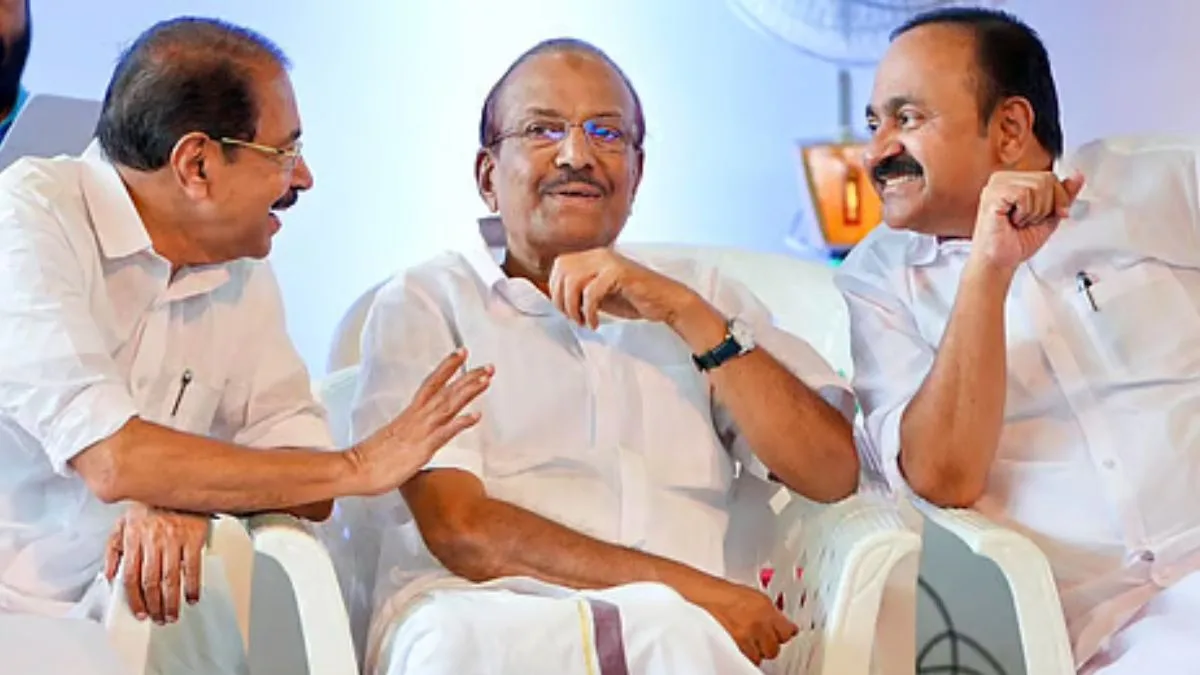
Once again, the charade of “secularism” in Keralam has shed its sophisticated veneer to expose its true, partisan colors—this time, explicitly at the expense of the Hindu community. With the swearing-in of the new UDF government, political analysts are no longer whispering about the front’s underlying biases; they are openly dissecting them. The installation of V. D. Satheesan as Chief Minister, driven by the combined heft of the Indian Union Muslim League, Jamaat-e-Islami, and radical remnants like the Social Democratic Party of India and Popular Front of India, marks a blatant shift in the state’s power dynamics.
Keralam New Cabinet – When Majority became Minority
The Hindu majority — 54% of Kerala’s population — receives 8 seats in the projected 20-member cabinet. That is a deficit of nearly 3 seats compared to what pure proportional representation would demand. Meanwhile, Christians at 16% get 6 seats — nearly double their proportional share. Muslims at 30% get 6 seats — exactly their proportional share, but historically unprecedented in representation.
The balancing act doesn’t stop at the cabinet table. The Speaker is Hindu. The Deputy Speaker is Muslim. The Chief Whip is Christian. Every constitutional post, carefully distributed like a communal quota spreadsheet — then sold to the public as “inclusive governance.”
The Hindu fragmentation strategy
What makes this particularly calculated is how Hindu representation is internally fragmented. The 8 seats are distributed across Nairs, Ezhavas, OBCs, and Scheduled Castes — each treated as a distinct vote-bank community, never as a unified Hindu constituency. This fragmentation is by design. A unified Hindu voter bloc would be politically inconvenient for the LDF’s coalition mathematics.
Christians and Muslims, by contrast, are treated as monolithic blocks — 6 seats each, for communities with vastly different population sizes. This is not proportional representation. It is communal appeasement with a progressive label.
The “Keralam model” question
The LDF government, led by a party that claims to be above religion, governs through one of the most explicitly communal power-sharing formulas in India. The irony is thick: a communist-led front that attacked the BJP for “Hindu nationalism” has built its own cabinet through a sectarian lens — just one that disadvantages Hindus.
This is the famous Kerala model in 2026: majority population, minority political voice. Appeasement politics rebranded as secularism. And a mainstream media that celebrates it as a triumph of pluralism.
Keralam Cabinet – The Break-Up
Forward Christian Population: 11.9%
- Required Seats: 2
- Allocated: 6
- Surplus: 4
- Sunny Joseph
- Roji M. John
- Mons Joseph
- C. P. John
- Anoop Jacob
Chief Whip: Decision not yet made
Latin Christian Population: 3.8%
- Required Seats: 1
- Allocated: 1
- Deficit: None
- Shibu Baby John
Scheduled Caste & Scheduled Tribe
Scheduled Caste: Population: 8.7%
- Required Seats: 2
- Allocated: 2
- Deficit: None
- K. A. Thulasi
- A. P. Anil Kumar
Scheduled Tribe: Population: 1.0%
No Representation
Muslim Population: 30.2%
- Required Seats: 6
- Allocated: 6
- Deficit: None
- P. K. Kunhalikutty
- P. K. Basheer
- K. M. Shaji
- N. Samsudheen
- V. E. Abdul Gafloor / Parakkal Abdullah
- T. Siddique
Shanimol Usman — Deputy Speaker, No Cabinet Rank