Keralam Assembly Elections 2026: Collapse of a political myth
June 24, 2026
  • Read Ecopy
  • Circulation
  • Advertise
  • Careers
  • About Us
  • Contact Us
Android AppiPhone AppArattai
Organiser
  • ‌
  • Bharat
    • Assam
    • Bihar
    • Chhattisgarh
    • Jharkhand
    • Maharashtra
    • View All States
  • World
    • Asia
    • Europe
    • North America
    • South America
    • Africa
    • Australia
  • Editorial
  • International
  • Opinion
  • RSS @ 100
  • More
    • Op Sindoor
    • Analysis
    • Sports
    • Defence
    • Politics
    • Business
    • Economy
    • Culture
    • Special Report
    • Sci & Tech
    • Entertainment
    • G20
    • Azadi Ka Amrit Mahotsav
    • Vocal4Local
    • Web Stories
    • Education
    • Employment
    • Books
    • Interviews
    • Travel
    • Law
    • Health
    • Obituary
  • Subscribe
    • Subscribe Print Edition
    • Subscribe Ecopy
    • Read Ecopy
  • ‌
  • Bharat
    • Assam
    • Bihar
    • Chhattisgarh
    • Jharkhand
    • Maharashtra
    • View All States
  • World
    • Asia
    • Europe
    • North America
    • South America
    • Africa
    • Australia
  • Editorial
  • International
  • Opinion
  • RSS @ 100
  • More
    • Op Sindoor
    • Analysis
    • Sports
    • Defence
    • Politics
    • Business
    • Economy
    • Culture
    • Special Report
    • Sci & Tech
    • Entertainment
    • G20
    • Azadi Ka Amrit Mahotsav
    • Vocal4Local
    • Web Stories
    • Education
    • Employment
    • Books
    • Interviews
    • Travel
    • Law
    • Health
    • Obituary
  • Subscribe
    • Subscribe Print Edition
    • Subscribe Ecopy
    • Read Ecopy
Organiser
  • Home
  • Bharat
  • World
  • Operation Sindoor
  • Editorial
  • Analysis
  • Opinion
  • Culture
  • Defence
  • International Edition
  • RSS @ 100
  • Magazine
  • Read Ecopy
Home Bharat

Keralam Assembly Elections 2026: Collapse of a political myth

2026 Keralam Assembly election has delivered a historic verdict that goes far beyond a routine change in Government; it marks the collapse of a decade-long political hegemony. The crushing defeat of the Pinarayi Vijayan-led LDF, whose seat tally plummeted to 35, has decisively shattered the perception of an “invincible” Left

KP KailasanathKP Kailasanath
May 13, 2026, 10:30 pm IST
in Bharat, Analysis
Follow on Google News
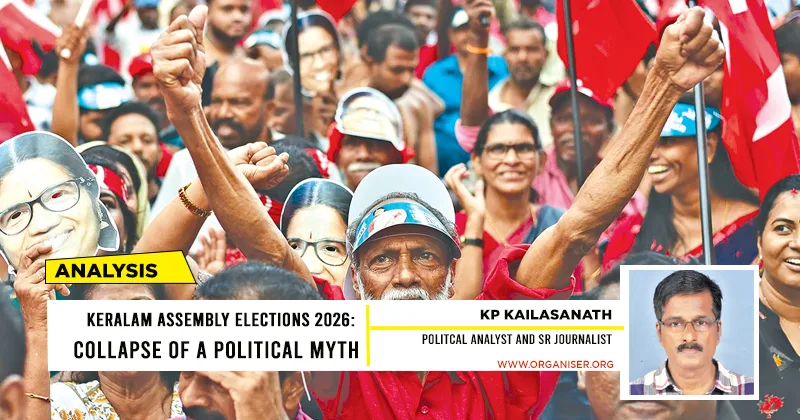
Congress-led UDF’s sweeping victory in Keralam marks the end of communist rule in India after nearly half a century

Congress-led UDF’s sweeping victory in Keralam marks the end of communist rule in India after nearly half a century

FacebookTwitterWhatsAppTelegramEmail

The recent Keralam Legislative Assembly election has marked a significant political shift. The government led by parties claiming to follow communist ideology has been voted out through the democratic process. The administration headed by Pinarayi Vijayan had been in power for the last ten years, and party leaders strongly believed they would continue in office. While observers predicted a UDF landslide or a hung assembly, Pinarayi Vijayan maintained he would secure 72 seats, a belief ultimately shattered by the massive anti-incumbency wave. The final results show that the leadership’s expectations were far away from public sentiment.

Governance Style and Party Culture

The 2026 Keralam election verdict transcends a simple rejection of Pinarayi Vijayan, pointing instead to a systemic crisis within the CPI(M) governance model. The administration’s centralisation of power and suppression of dissent mirror the historical failings of 20th-century communist regimes. Much like the Eastern Bloc’s need for glasnost and perestroika, Keralam’s political culture has long been criticized for intolerance and violence. The Kannur model—marked by violent clashes involving the BJP, Congress, and even the allied CPI—symbolises a party culture that struggled to accommodate pluralism. This defeat suggests that the public has decisively rejected not just an individual leader, but an insular, authoritarian style of governance that prioritised party dominance over democratic restructuring.

Centralisation of Power

Although the CPI(M) formally follows the principles of internal democracy and democratic centralism, the power increasingly became concentrated in the Chief Minister’s Office. Structures such as the Politburo, Central Committee, and State Committee existed, but in practice, few within the party were willing to challenge the leadership.

The visible rivalry between V.S. Achuthanandan and Pinarayi Vijayan exposed deep fissures that the Politburo failed to bridge. This lack of timely intervention allowed internal dissatisfaction to fester into open revolt. Historically, the CPI(M) suppressed dissent through expulsions, like M.V. Raghavan’s, or via the brutal silencing seen in the T.P. Chandrasekharan case. However, the 2026 elections revealed that fear no longer ensures loyalty. The victory of rebel candidates in traditional bastions like Taliparamba, Payyannur, and Ambalappuzha confirms widening organisational cracks, proving that the party’s historical intolerance toward internal criticism has finally triggered a systemic collapse. Allegations of Nepotism and Preferential Treatment

Allegations have also emerged regarding the growing prominence of P. A. Mohammed Riyas, a relatively junior leader and the Chief Minister’s son-in-law. Critics argue that the importance given to him and speculation about grooming him as a successor contradict the long-standing principles and internal norms traditionally upheld by communist parties in Keralam.

Arrogance and Intolerance

The administration was increasingly defined by perceived arrogance and authoritarianism. Pinarayi Vijayan faced severe backlash for dismissing a party worker’s query and telling journalists to “get out.” Tactics like screening press questions, walking out on critics, and using derogatory language against opponents—including N.K. Premachandran and a senior Christian bishop—furthered this image. This intolerant conduct alienated the public, transforming his leadership style into a viral symbol of a government disconnected from respectful democratic engagement.

Keralam, despite its early advantage in sectors like IT, saw opportunities shift to cities such as Bengaluru and Hyderabad. As a result, many Malayalees migrated to other states and abroad in search of employment and education. The state continues to depend heavily on remittances, while also relying on other states for essential goods. Public sector institutions have reportedly struggled, with many running at a loss.

KIIFB and corruption

The administration faced intense scrutiny over rising public debt and heavy borrowing through KIIFB. Allegations of corruption within cooperative institutions, specifically the Karuvannur Bank scandal linked to senior leadership, severely eroded trust. Furthermore, systemic political interference in public appointments compromised institutional integrity. By favoring loyalists through “backdoor appointments” and bypassing merit-based selection, the government alienated qualified youth, fueling a perception that fairness and transparency were sacrificed for the benefit of party interests.

Misuse and Image Building

The government faced criticism for excessive spending on publicity. The misuse of the Public Relations Department (PRD) for large-scale advertising campaigns led to accusations of creating a personality-centric image. Massive hoardings and promotional materials featuring the Chief Minister were visible across the state. The funds from KIIFB, which were intended for infrastructure development, were improperly diverted for the Chief Minister’s advertising campaigns.

Sabarimala Controversy

The administration’s handling of Sabarimala remains a major flashpoint. By facilitating activists’ entry under heavy security, the government deeply offended devotees, while subsequent allegations of gold misappropriation (4.5 kilograms of gold) further damaged credibility. Beyond religious friction, the government faced severe labour unrest. Delayed salary revisions for state employees and the suppression of ASHA workers’ protests over low wages fueled widespread discontent. Together, these issues painted a picture of a leadership dismissive of both cultural traditions and worker welfare.

Nepotism in the Guise of Ideology

The emergence of nepotism within the CPI(M) has dealt a devastating blow to its ideological credibility. The rapid ascent of P.A. Mohammed Riyas, the Chief Minister’s son-in-law, fueled allegations of dynastic grooming, contradicting the party’s anti-feudal roots. This erosion of institutional norms coincided with a historic decline in support within traditional strongholds like Pinarayi and Thalassery. Furthermore, the party’s strategy of nurturing sectarian groups for electoral gains backfired; by 2026, organisations like Jamaat-e-Islami consolidated minority votes independently. These factors—nepotism, decaying bastions, and lost strategic control—have collectively dismantled the CPI(M)’s long-standing political hegemony in Keralam.

Rejection, Not Just a Defeat

2026 results stand as a verdict against the centralisation of power, a perceived sense of intolerance and arrogance, and a growing disconnect between leadership and public sentiment. In the early years, E. M. S. Namboodiripad was often regarded as a political successor to Jawaharlal Nehru. The CPI(M), which ruled West Bengal for a prolonged period from 1977 to 2011, has since witnessed a significant decline, losing its foothold in states like Tripura and now appearing to move toward a similar trajectory in Keralam.


Topics: 2026 Keralam electionBJP in KeralamPinarayi VijayanCPIMSabarimala ControversyKeralam Legislative Assembly electionKIIFB and corruption
KP Kailasanath
KP Kailasanath
Politcal Analyst and Sr Journalist [Read more]
ShareTweetSendShareSend
✮ Subscribe Organiser YouTube Channel. ✮
✮ Join Organiser's WhatsApp channel for Nationalist views beyond the news. ✮
Previous News

Uttar Pradesh: CM Yogi rolls out 50 per cent fleet cut and work from home push; ‘Visit my state’ campaign planned

Next News

Balochistan: Pakistan Army Major among five killed in blast targeting convoy in Chamalang

Related News

Thiruvananthapuram court rejects bail pleas of 11 CPM activists accused of attacking ED officials

Keralam: Court refuses bail to CPM cadres accused of attacking ED officials after raid at Pinarayi Vijayan’s residence

Keralam ex- CM Pinarayi Viajayan and his daughter Veena Vijayan

Keralam: Former CM Pinarayi Vijayan’s daughter Veena Vijayan gets fresh ED summons in Rs 2.78 crore CMRL case

Kerala HC rejects CMRL appeal, clears way for ED probe against Pinarayi Vijayan’s daughter in money laundering case

Ex-CM Pinarayi Vijayan and his daughter Veena Vijayan (Left to Right)

Keralam: ED may confiscate assets of ex-CM Pinarayi’s daughter Veena Vijayan, examine bank lockers and summon her again

Governor enters the Assembly; State Police Chief seen behind him during the proceedings

Truncated Vande Mataram played in Keralam Assembly; Lok Bhavan and BJP protest, DGP entry sparks row

Kerala former CM Pinarayi Vijayan and his daughter Veena Vijayan

Keralam: Reports claim SFIO found monthly payments from 12 firms to Pinarayi Vijayan’s daughter; CPM defends ED attack

Load More

Latest News

Elomi Global Worship Centre in Omalloor, Pathanamthitta district ; Pastor Binu Vazhakkuttom (Left to Right)

Keralam: Child abuse allegations at Pentecostal worship centre in Pathanamthitta; locals demand Pastor Binu’s arrest

Modi Govt’s Tourism Revolution: 183 projects, Rs 9,225 crore investment & rise of India’s cultural & spiritual circuits

Padma Awards 2026: Tamil Nadu’s distinguished achievers receive national honours

India’s history is not merely a tale of foreign domination but also a remarkable story of resilience, resistance & civilisational continuity

Indian History: Not just foreign rule, but a timeless story of resistance, self-respect and civilisational resilience

From $10 Billion to $190 Billion: Indian Bioeconomy Touches New Heights in 12 Years

From $10 Billion to $190 Billion: India’s Bioeconomy leads a 12-Year science revolution

Nagpur | Acceptance of Bharatiya civilisational values is steadily increasing worldwide: Shanta Kumari

Representative Image

Passport Seva Divas: India issues 1.39 crore passports in 2025 as ‘Passport Seva Network’ expands to 545 Centres

Uttarakhand Government replaces Madrasa Board with Unified Minority Education framework

Uttarakhand Ends Madrasa Board Era: New Minority Education Authority to take over from July 1

As growth slows and business failures mount, China’s debt enforcement system is turning financial distress into long-term social exclusion

China’s debt blacklist traps millions of citizens in financial ruin, exposing the human cost of a slowing economy

Keralam Chief Minister VD Satheeshan (Left Side)

Keralam: CM Satheeshan’s new liquor policy proposal triggers internal conflict within Congress

Load More
  • Privacy
  • Terms
  • Cookie Policy
  • Refund and Cancellation
  • Delivery and Shipping

© Bharat Prakashan (Delhi) Limited.
Tech-enabled by Ananthapuri Technologies

  • Home
  • Search Organiser
  • Bharat
    • Assam
    • Bihar
    • Chhattisgarh
    • Jharkhand
    • Maharashtra
    • View All States
  • World
    • Asia
    • Africa
    • North America
    • South America
    • Europe
    • Australia
  • Editorial
  • Operation Sindoor
  • Opinion
  • Analysis
  • Defence
  • Culture
  • Sports
  • Business
  • RSS @ 100
  • Entertainment
  • More ..
    • Sci & Tech
    • Vocal4Local
    • Special Report
    • Education
    • Employment
    • Books
    • Interviews
    • Travel
    • Health
    • Politics
    • Law
    • Economy
    • Obituary
  • Subscribe Magazine
  • Read Ecopy
  • Advertise
  • Circulation
  • Careers
  • About Us
  • Contact Us
  • Policies & Terms
    • Privacy Policy
    • Cookie Policy
    • Refund and Cancellation
    • Terms of Use

© Bharat Prakashan (Delhi) Limited.
Tech-enabled by Ananthapuri Technologies