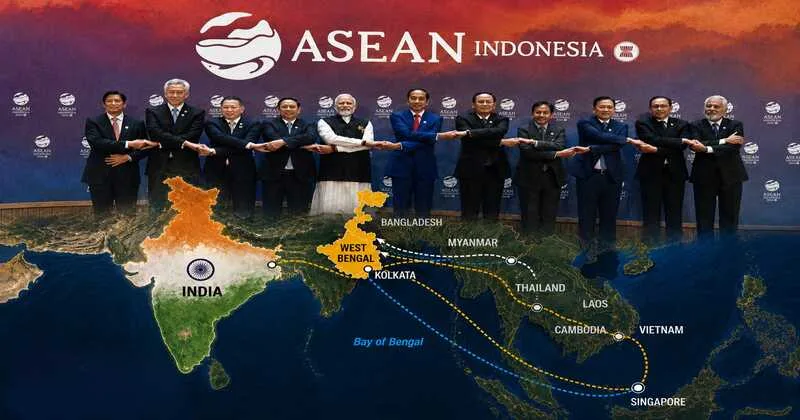
From the narrow Siliguri Corridor connecting the Northeastern states to mainland India, to the busy waters of the Bay of Bengal stretching towards Southeast Asia, the future of India’s Act East Policy increasingly runs through West Bengal. At a time when New Delhi is attempting to position India as a central power in the Indo-Pacific, the 2026 political mandate in West Bengal assumes strategic significance far beyond electoral politics. The change potentially clears the path for deeper coordination between the state and the Centre in transforming eastern India into a gateway linking the Northeast, Bangladesh, Myanmar and the wider ASEAN region through trade, connectivity and maritime outreach.
For more than one decade, the prolonged confrontation adopted by the Trinamool Congress-led state government towards the Union government has been slowing down this larger strategic vision, particularly in sectors where regional cooperation and cross-border connectivity required close coordination between Kolkata and New Delhi. The most visible example emerged in the Teesta water-sharing dispute with Bangladesh. In 2017 and later during the 2021 West Bengal Assembly election campaign, Chief Minister Mamata Banerjee publicly opposed the proposed Teesta agreement, arguing that Bengal itself lacked sufficient water resources. Her assertion that the Centre finalised the arrangement without consulting the state created friction not only between Kolkata and New Delhi but also between India and Bangladesh. Her slogan, “Teesta, uttarbanga ka hissa,” projected the river primarily as a regional political issue rather than a strategic diplomatic asset within India’s neighbourhood policy.
That approach repeatedly complicated India’s broader eastern diplomacy. The Act East Policy, formally strengthened after 2014 under Prime Minister Narendra Modi, depends heavily on seamless cooperation between the Union government and eastern states. Paradiplomacy, the growing role of state governments in foreign policy execution, became central to this framework. However, instead of complementing India’s regional outreach, the TMC government often treated strategic connectivity projects through the lens of domestic political confrontation. The result was administrative friction in development planning, delayed coordination and reduced policy synergy between Kolkata and New Delhi. The new mandate changes that equation fundamentally. A politically aligned government in Bengal now provides the Centre with an opportunity to integrate the state directly into India’s Indo-Pacific and Act East architecture without constant institutional resistance. Geography alone makes Bengal indispensable to this strategy.
Bengal as India’s eastern gateway
West Bengal occupies one of the most strategically valuable locations in the subcontinent. It shares borders with Jharkhand, Bihar, Odisha, Sikkim and Assam, while simultaneously serving as India’s interface with Bangladesh, Nepal and Bhutan. Through maritime access in the Bay of Bengal, it also links India with Myanmar, Thailand and the wider ASEAN region. Kolkata remains India’s largest eastern metropolitan hub and its most proximate major city for connectivity with eastern neighbours. While the Northeastern Region represents the final frontier of the Act East Policy, Bengal acts as the indispensable bridge connecting the Northeast with mainland India. Without Bengal, the logistical chain between New Delhi and the eastern frontier remains incomplete.
This geography gives Bengal a decisive role in the realisation of India’s Indo-Pacific strategy. The state is not merely a transit corridor; it is a potential economic and geopolitical anchor connecting the Bay of Bengal with Southeast Asia. Under a cooperative state administration, this positioning can now be fully utilised.
Connectivity corridors and strategic infrastructure
Several strategic infrastructure projects already place Bengal at the centre of India’s eastern outreach. The Chilahati-Haldibari rail link between India and Bangladesh has revived historic connectivity routes severed after Partition. Likewise, the Kaladan Multi-Modal Transit Transport Corridor connecting India with Myanmar through Sittwe Port creates an alternative access route to the Northeast bypassing the Siliguri Corridor. Bengal becomes critical in both these projects because Kolkata serves as a nodal logistical and commercial centre. The possibility of extending India-Bangladesh rail networks deeper into Myanmar and eventually towards Thailand, Laos, Cambodia, Singapore and Vietnam creates an entirely new economic geography in which Bengal directly participates in regional trade integration.
This aligns with what Indian foreign policy increasingly frames as the “3Cs”, Connectivity, Commerce and Cultural Commonalities. Enhanced connectivity with Bangladesh and Southeast Asia does not only strengthen India’s external relations; it directly stimulates economic activity within Bengal itself through transport networks, logistics hubs, trade corridors and industrial expansion.
The North Bengal Region already demonstrates how this geography functions in practice. Positioned between Nepal, Bhutan, Bangladesh and the Northeast, the region has historically served as a crucial subregional connector within the BBIN framework. The Siliguri Corridor, despite its strategic vulnerability, continues to handle massive trade and movement flows linking mainland India with the Northeast. A politically coordinated state administration can now transform this historic advantage into an economic engine aligned with national strategic priorities.
Revival of Bengal’s maritime importance
The revival of Bengal’s ports represents another crucial dimension of this transformation. Kolkata Port once occupied a central place in British imperial trade, particularly after the opening of the Suez Canal in 1869. Over time, however, its prominence declined sharply. After independence, cargo traffic shifted increasingly towards western ports like Mumbai and Kandla and eastern competitors such as Chennai and Visakhapatnam. By 2013, Kolkata Port had lost significant cargo shares from Nepal and Bhutan to Bangladesh’s Chittagong Port. Operational stagnation, infrastructural deficiencies and dependence on continuous dredging weakened Bengal’s maritime competitiveness. This decline also reduced the state’s contribution to India’s regional connectivity objectives.
The present transition creates an opening to reverse that trend. The Sagarmala initiative, aimed at modernising India’s port-led development architecture, can now be implemented in Bengal with greater state-centre coordination. The under-construction Sagar Deep-Sea Port, alongside proposed projects like Tajpur Port and Kulpi Port, could significantly enhance Bengal’s cargo-handling capacity and reduce the structural limitations of the riverine Kolkata and Haldia ports.
These developments gain additional importance because Nepal and Bhutan remain heavily dependent on eastern transit routes for third-country trade. Modernised Bengal ports can reclaim their earlier regional centrality while simultaneously strengthening India’s strategic influence in the Bay of Bengal.
Bay of Bengal and maritime strategy
India’s Indo-Pacific strategy increasingly prioritises maritime connectivity and Bay of Bengal integration. Bengal’s coastline therefore assumes direct strategic relevance. India’s coastal shipping agreement with Myanmar, finalised in 2020, reflects this shift. The agreement allows Indian vessels to access Mizoram through Myanmar’s Sittwe Port via the Kaladan river route. Kolkata Port is expected to connect directly with Sittwe, creating a maritime-commercial chain stretching from Bengal to the Northeast and further into Southeast Asia.
This network fits naturally into India’s broader Indo-Pacific ambitions. Rather than treating the Northeast as an isolated frontier, the new strategy integrates it into a wider Bay of Bengal economic corridor anchored partly in Bengal’s ports and logistics infrastructure.
Inland waterways further strengthen this framework. The Jal Marg Vikas Project connecting Haldia with Varanasi through National Waterway-1 represents India’s largest waterways initiative. By transporting fertilisers, food grains and minerals through inland waterways instead of heavily subsidised rail routes, the project reduces logistical costs while creating employment across eastern India. The India-Bangladesh Protocol on Inland Water Trade and Transit further expands this ecosystem through reciprocal cargo movement arrangements. Bhutan’s potential use of Chittagong Port through Indian waterways illustrates how Bengal can evolve into a regional transit and logistics hub serving multiple neighbouring economies simultaneously.
Economic potential and strategic alignment
Bengal’s economic advantages strengthen this transformation further. Kolkata possesses extensive human capital, relatively lower living costs compared to other metropolitan centres and an established commercial ecosystem. Agreements such as the 2019 memorandum between the port trusts of Kolkata, Chennai and Visakhapatnam with Thailand’s Ranong Port indicate the growing internationalisation of eastern maritime networks. The experience of Assam demonstrates how political alignment between the Centre and the state can accelerate strategic infrastructure and connectivity expansion. Over recent years, Assam emerged as a major conduit for India’s outreach towards Bangladesh, Myanmar and Southeast Asia through improved road, rail and air connectivity. The political synchronisation between Dispur and New Delhi enabled faster implementation of projects tied to India’s Act East agenda. West Bengal now stands at a similar turning point, but with even greater geopolitical weight due to its geography, ports, industrial base and international linkages.
The 2026 mandate therefore represents not merely an electoral transition but a strategic recalibration. By removing prolonged institutional friction between Kolkata and New Delhi, it opens the possibility of integrating Bengal fully into India’s eastern diplomatic, economic and maritime architecture. In doing so, Bengal can emerge not as a peripheral state caught in political confrontation, but as the central pillar of India’s Act East Policy and Indo-Pacific outreach.