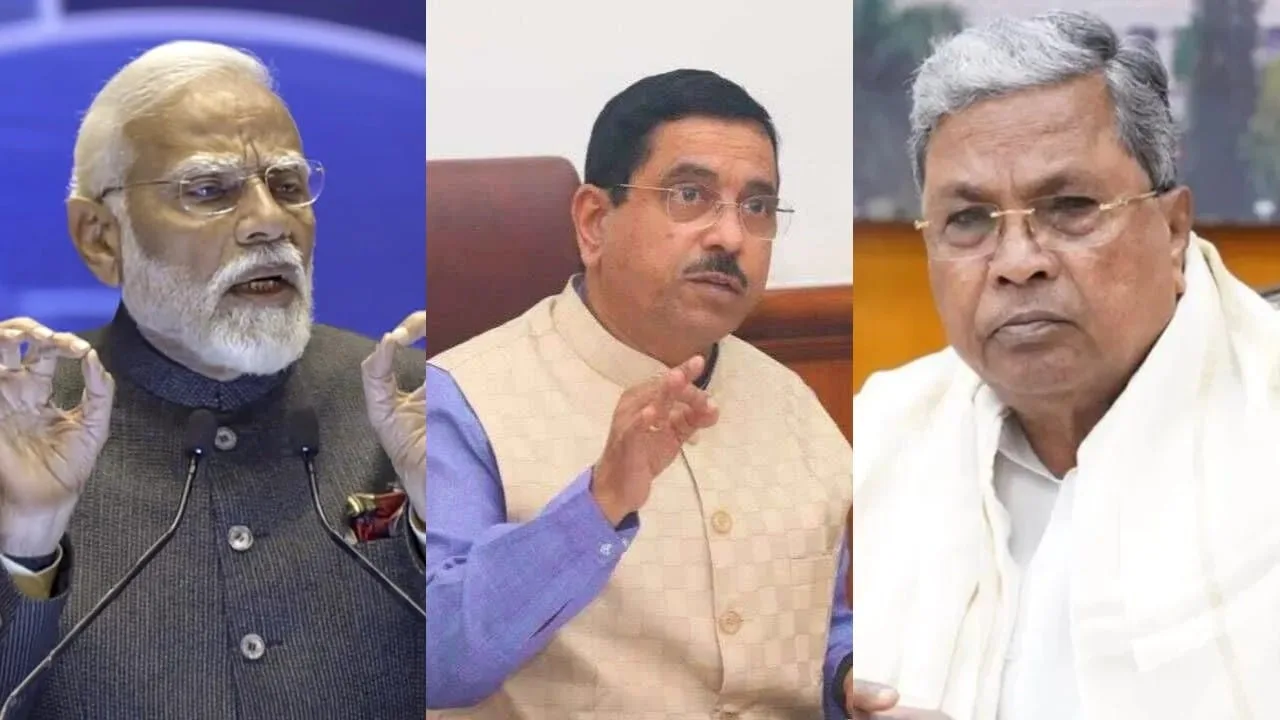
Bengaluru: The political confrontation over governance, fiscal management, and welfare spending in Karnataka intensified on Tuesday (May 12) after Union Minister Pralhad Joshi launched a sharp counterattack on Chief Minister Siddaramaiah, citing official data to challenge the state government’s claims on financial stability and development performance.
The exchange comes at a time when the Karnataka government is under heightened scrutiny over its flagship welfare guarantee schemes, which provide direct financial assistance and social support to households across various income groups. While the ruling Congress maintains that the programs are essential for economic equity and grassroots consumption support, opposition leaders argue that the scale of spending is creating fiscal pressure.
Karnataka CM @siddaramaiah ji seems deeply upset that Hon’ble PM Shri @narendramodi ji spoke the truth in Bengaluru. Perhaps because the reality of @INCIndia governance in Karnataka is now impossible to hide behind advertisements and scripted speeches.
The same @INCIndia that… https://t.co/0bqgfKUYva
— Pralhad Joshi (@JoshiPralhad) May 11, 2026
Joshi, in his response, pointed to revenue-expenditure patterns and alleged discrepancies between projected growth and actual fiscal outcomes. He argued that while welfare schemes may offer short-term political gains, they must be backed by sustainable financial planning.
“Governance cannot be driven only by announcements. It must be supported by strong financial discipline and transparent data,” he said, referring to state budget trends and expenditure allocations.
The Siddaramaiah-led administration, however, has rejected these allegations, maintaining that Karnataka’s revenue performance remains one of the strongest among Indian states.
They argue that the guarantee schemes are not standalone expenditures but part of a broader economic strategy aimed at boosting household consumption and local demand.
Urban governance in Bengaluru continues to be another major point of contention. Issues such as traffic congestion, waste management inefficiencies, and delays in civic infrastructure projects have drawn criticism from opposition parties. They have questioned coordination between agencies responsible for urban planning and execution.
In response, the state government has highlighted ongoing infrastructure initiatives including metro rail expansion, suburban rail development, and road widening projects.
Officials argue that Bengaluru’s rapid urban expansion naturally leads to execution delays due to land acquisition challenges, multi-agency approvals, and technical constraints.
In rural Karnataka, governance challenges persist, particularly in drought-prone and agriculture-dependent regions. Farmer groups have demanded faster implementation of irrigation projects, better crop insurance mechanisms, and timely compensation for climate-related losses. The government has responded by pointing to ongoing rural development programs and irrigation investments aimed at long-term sustainability.
Opposition parties, meanwhile, continue to raise concerns over administrative efficiency, procurement transparency, and project delays. They argue that while welfare spending has increased, execution capacity in infrastructure and service delivery must improve.
Amid the ongoing debate, opposition leaders have escalated their attack by alleging that the state is facing “serious fiscal stress” due to the scale of welfare commitments and rising expenditure obligations.
They argue that increasing dependence on borrowings and reallocation of funds has tightened the financial space for development works, leading to what they describe as a “budgetary strain situation.”
As Karnataka moves deeper into a politically active phase, analysts say the debate between welfare-driven governance and fiscal conservatism is likely to intensify further. With leaders like Joshi escalating criticism through data-backed arguments and the state government defending its policy direction, the issue of governance performance is expected to remain at the center of Karnataka’s political discourse in the coming months.