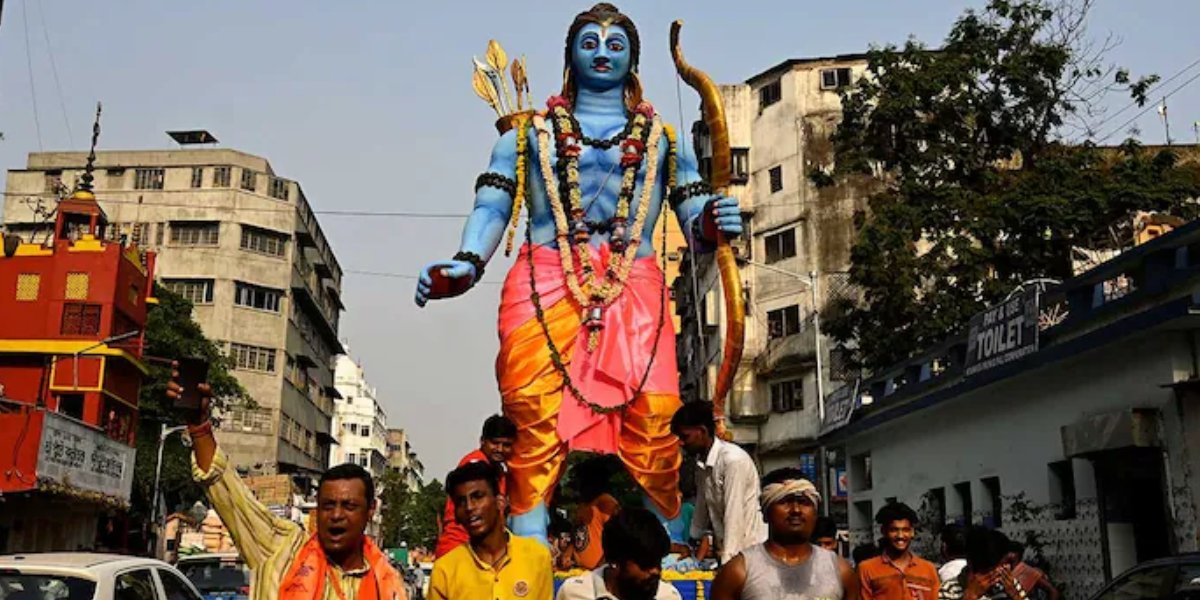
The week between March 22 and March 29, 2026 unfolded with an unusually high concentration of incidents linked to religious processions, public celebrations, administrative restrictions, and episodic violence across several Indian states and parts of South Asia. Ram Navami, Navratri, and related religious observances became the central axis around which multiple local disputes, law-and-order interventions, and confrontations developed.
Across Jharkhand, Uttar Pradesh, Bihar, West Bengal, Maharashtra, Madhya Pradesh, Rajasthan, Gujarat, Andhra Pradesh, Uttarakhand, and even Bangladesh and Pakistan, reports reflected a recurring pattern-procession route disputes, restrictions on DJ music, objections over permissions, and clashes in sensitive zones. Alongside these, unrelated but contemporaneous incidents of assault, vandalism, alleged coercion, and social media-related legal actions added to the intensity of the week.
A striking feature of this period was the overlap between administrative regulation and ground-level resistance, where festival-related restrictions or objections often escalated into protests or confrontations. In several cases, social media acted as an amplifier, turning local disputes into wider public controversies. Meanwhile, law enforcement agencies were repeatedly engaged in crowd control, arrests, investigations, and preventive deployments.
The detailed incidents from March 22 to March 29, 2026, are given below.
March 23, 2026
1. Minor Girl Allegedly Lured and Pressurised for Marriage by Man Using False Identity in Bhilwara
An incident was reported from the Shahpura area of Bhilwara district, Rajasthan, where a minor Hindu girl was allegedly targeted, lured, and influenced through social media by a man who introduced himself under a false identity. The case pertains to events dated 23 March 2026, when the girl’s father submitted a complaint to the Superintendent of Police, Bhilwara.
According to the complaint, the accused had contacted the girl on Instagram using the name “Aryan Singh Rajput” and developed a relationship with her. The family alleged that he mentally influenced the minor and began pressuring her for marriage. Upon suspicion, further inquiries by the family revealed that the individual was allegedly using a false identity.
The complainant stated that the accused was later identified as Murshidul Islam Laskar, a resident of Bengaluru. Following this, a case was registered at Shahpura Police Station as Case No. 86/2026 under relevant provisions of the Bharatiya Nyaya Sanhita, the Information Technology Act, and the Protection of Children from Sexual Offences Act. Police initiated an investigation and constituted a special team under senior supervision.
With technical assistance, the police traced the accused’s location to Bengaluru. A team was dispatched, and the accused was apprehended in Helakadi and subsequently arrested. Further legal proceedings have been initiated in the matter.
The victim in this case is a minor Hindu girl. No fatalities were reported.
The accused, identified as Murshidul Islam Laskar, to have acted alone. Authorities have confirmed his arrest, and the case remains under legal process.
2. Tribal Families Allegedly Converted to Christianity Through Inducements in Katihar
An incident from the Manihari area of Katihar district, Bihar, where six tribal Hindu families were allegedly converted to Christianity through inducements. The case is dated 23 March 2026 and involves a total of 29 individuals belonging to Scheduled Tribe communities.
The families were offered incentives such as promises of employment, improved medical treatment, and free education for their children. These offers were allegedly made by a conversion network and were said to target conditions of poverty, illiteracy, and social marginalisation among the families.
Over time, when the promised benefits reportedly did not materialise, the affected families reassessed their situation. Reports state that they subsequently chose to return to Hinduism through a coordinated ‘ghar wapsi’ process facilitated by local organisations, during which customary rituals were performed.
The development led to discussions in the Seemanchal region, with reports indicating that similar inducement-based conversions may have occurred in the past, particularly in the Manihari Assembly constituency. There were also indications that other families in the area were considering a similar return.
The victims in this case comprise 29 individuals from six Scheduled Tribe Hindu families. No fatalities were reported.
3. Hindu Couple Assaulted and Robbed, Abduction Attempt Reported in Jamalpur
An incident from Jamalpur district in Bangladesh, where a Hindu couple was assaulted and robbed, and an attempt was made to abduct the woman. The Incident is dated 23 March 2026 and took place in the Kharika Beel area while the couple was returning home from the Balijhuri Eid Fair in Madarganj Upazila.
Ananta Robidas and his wife Nishi Robidas, were intercepted by a group of local Youth. The group allegedly began verbally harassing them, and as the situation escalated, additional individuals joined and surrounded the couple. The assailants, reportedly armed with crude weapons, then attempted to forcibly abduct the woman.
When Ananta Robidas intervened to prevent the abduction, he was assaulted by the group. The attack continued until nearby residents, alerted by the disturbance, began gathering at the scene, following which the assailants fled. Before leaving, they reportedly took the couple’s mobile phones and cash.
A formal complaint was lodged at the Madarganj Model Thana. Acting on the complaint, law enforcement conducted an operation and detained three suspects identified as Zahid, Saiful Islam Sami, and Muhammad Saif from the Muktipara area. Police officials stated that the detained individuals were being interrogated and that efforts were ongoing to identify and apprehend others involved.
The victims in this case are two individuals, one male and one female. No fatalities were reported.
4. Hindu Woman Lured and Abducted; Family Assaulted and Abused in Kannauj
An incident took place in Kannauj district, Uttar Pradesh, under the Thathiya police station area, on 23 March 2026, where a 20-year-old Hindu woman was allegedly lured and abducted, and her family later faced assault and abusive language when they went to inquire about her.
The victim was taken away on a motorcycle by Mohd. Shahenshah, son of Abdul Aziz, a resident of Sultanapur, along with Mohd. Karan, son of Kallu, a resident of Kinaura. It was also stated that she carried jewellery and other valuables from home at the time of leaving.
When the victim’s mother reached the accused persons’ residence to ask about her daughter, she was confronted by Mohd. Shamshad, Mohd. Ibrar, and Mohd. Israr. The complainant stated that she was abused with caste-based slurs, assaulted, and issued death threats when she protested or demanded information about her daughter.
Following the complaint, police registered a case against the named individuals under relevant sections and initiated an investigation. A police team was formed to trace the woman and take further legal action.
The victims in this case are the Hindu woman, aged 20, and her mother. No fatalities were reported.
5. Administration Restricts DJ Use in Ram Navami Procession in Hisua, Bihar
An administrative decision in Hisua city of Nawada district, Bihar, on 23 March 2026 restricted the use of DJ systems during the Ram Navami procession. The direction was issued during a peace committee meeting held at the local police station ahead of the upcoming Chaitra Chhath and Ram Navami celebrations.
The meeting was attended by senior administrative and police officials, including Sub-Divisional Officer Amit Anurag and Sub-Divisional Police Officer Sadar-02 Rahul Singh, along with other government representatives and local public members. During the discussion, officials outlined guidelines for conducting religious festivals in accordance with administrative instructions.
It was stated that the Ram Navami procession would be permitted only along a designated route and within a fixed time schedule. Along with this, a complete ban on DJ systems and display of weapons was announced. Organisers were also instructed to register volunteers and issue identity cards for better crowd management. Police deployment was planned in sensitive areas, and participants were advised against circulating rumours on social media.
The decision effectively placed restrictions on the use of sound systems commonly used during Ram Navami processions for devotional songs and chants. The matter was discussed as part of broader arrangements for maintaining law and order during the festival period.
The case remains classified under administrative proceedings with no reported legal escalation.
6. Ram Navami Processions Face DJ Restrictions in Begusarai, Bihar
An administrative order issued on 23 March 2026 in Barauni, Begusarai district, Bihar, placed restrictions on the use of DJ systems during Ram Navami processions. The decision was taken during a peace committee meeting held at Phulwadia police station ahead of the scheduled festival events.
The meeting was chaired by Sub-Divisional Magistrate Rakesh Kumar and attended by police and administrative officials, including Deputy Superintendent of Police Krishna Kumar and other local representatives. The discussion covered arrangements for motorcycle and foot processions planned for 29 and 30 March 2026 under different local organisations.
During the meeting, authorities issued guidelines for conducting the Ram Navami celebrations. These included a complete ban on DJ music during the processions, monitoring of social media for rumours, deployment of drone surveillance, and instructions to maintain law and order throughout the event. Organisers were also urged to follow prescribed routes and cooperate with security arrangements.
The administration stated that strict security measures had been put in place and warned that any violation of guidelines or anti-social activity would not be tolerated. Officials also emphasized peaceful observance of the festival and coordination with law enforcement agencies.
The matter remains an administrative decision related to festival management and public order during Ram Navami celebrations.
7. Ram Navami Processions Face DJ Ban in Aurangabad, Bihar
An administrative decision in Aurangabad district, Bihar, on 23 March 2026 imposed restrictions on the use of DJ systems during Ram Navami processions. The decision was taken during a peace committee meeting held at the Collectorate in Yojana Bhawan, chaired by District Magistrate Abhilasha Sharma and Superintendent of Police Ambrish Rahul.
The meeting reviewed arrangements for maintaining law and order during Ram Navami celebrations and issued detailed guidelines for processions across the district. Authorities stated that no procession would be permitted without a licence and that organisers must strictly follow designated routes, timings, and conditions.
As part of the directives, the administration imposed a complete ban on DJ music during Ram Navami processions. The use of weapons, sword displays, or any form of demonstration of force was also prohibited. Organisers were instructed to obtain prior permission for cultural or religious events and ensure deployment of volunteers for crowd management.
Officials further directed subdivision-level authorities to inspect procession routes, identify sensitive locations, and ensure proper security arrangements, especially near religious sites. Security measures included deployment of police forces, CCTV monitoring, drone surveillance, and continuous patrolling in sensitive areas. The administration also announced restrictions on misinformation and rumour circulation on social media.
Additional officials, including Deputy Development Commissioner Ananya Singh and other district administrative representatives, attended the meeting. Authorities emphasized that the festival should be conducted peacefully and in accordance with established guidelines.
The matter remains an administrative directive related to festival regulation and public order during Ram Navami celebrations.
8. Ram Navami Processions Face DJ Ban in Gaya, Bihar
An administrative restriction was imposed on 23 March 2026 in Dumaria, Gaya district, Bihar, where the local police prohibited the use of DJ systems during Ram Navami processions. The decision was taken during a peace committee meeting held at the Dumaria police station under the chairmanship of Station House Officer Raju Kumar.
The meeting included local representatives and community members and focused on arrangements for maintaining law and order during the festival. The police administration stated that DJ music would not be permitted under any circumstances during the Ram Navami procession. It also warned of legal action in case of violations related to sound regulations or public order.
Along with the DJ ban, the administration directed that the procession must strictly follow a fixed route and schedule. Any deviation from the approved plan or disturbance of order would invite action. Citizens were also urged to avoid rumours and cooperate with police instructions. Several local participants and public representatives were present during the meeting.
The directive forms part of broader administrative measures related to crowd control, security arrangements, and regulation of public religious processions during Ram Navami in the district.
9. Hindu Girl Lured, Sexually Exploited and Allegedly Pressured for Conversion in Lonavla
An incident from Lonavla, Maharashtra, on 23 March 2026, where a 19-year-old Hindu college student was allegedly lured into a relationship, sexually exploited, and later pressured for religious conversion by a man identified as Tausif.
The victim, a student of an engineering college, came into contact with the accused, who worked as a lab assistant at the same institution, through social media. He allegedly misrepresented himself as unmarried and built a relationship with her based on a promise of marriage. It later emerged that he was already married and had four children.
As the relationship progressed, the accused took the victim to a resort in Pawna Nagar, where he arranged a wedding-like setup and continued the relationship. Following this, she was sexually exploited. The deception reportedly came to light when the victim discovered his marital status and family background.
After this, the nature of the interaction shifted to coercion. The accused allegedly pressured the victim to convert her religion as a condition for continuing the relationship and also issued threats. He is further accused of misusing approximately ₹42,000 from her scholarship funds.
The victim subsequently approached the authorities, following which Lonavla Rural Police registered a case against the accused under relevant sections related to cheating, intimidation, and financial fraud, and initiated an investigation.
The victim in this case is a 19-year-old Hindu woman. No fatalities were reported.
10. Durga Temple Robbed During Navratri in Mohali, Punjab
An incident from Mohali, Punjab, on 23–24 March 2026, where the Maa Durga Temple located in Sector 68 was targeted in a theft during the Navratri period.
According to the temple administration, an unidentified individual entered the premises at night and broke open donation boxes inside the temple complex. The first attempt was made at the Vishnu shrine box, which contained a small amount of cash. The individual then attempted to break boxes at the Kali Mata and Hanuman shrines but was unsuccessful. Later, the donation box at the Shani Dev shrine was broken, from which approximately ₹9,000 to Rs 10,000 was stolen.
The following night, a similar attempt was reported again, during which the Kali Mata shrine box was broken, but no cash was found inside. Temple head Surinder Sood stated that a complaint regarding the incident was filed at Phase 8 police station.
The case involves a single unidentified accused, and police have initiated proceedings based on the complaint. No further details regarding the identity or motive of the individual have been established at this stage.
11. Hindu Woman Harassed During Navratri Pilgrimage in Panchmahal, Gujarat
An incident from Panchmahal district, Gujarat, on 23 March 2026, where a Hindu woman was allegedly molested and assaulted while undertaking a pilgrimage to the Pavagadh Mahakali Temple during Navratri.
The victim, identified as Denisha Vasan, was travelling on foot as part of a religious padyatra that began from Valsad on 9 March 2026. She was reportedly around 6 kilometres from the temple when the incident took place. The woman stated that while she was on her pilgrimage route, some individuals followed her on motorcycles, harassed her repeatedly, and one of them physically assaulted her before fleeing the spot.
She later shared details of the incident through social media, which drew significant public attention and reactions. Despite the assault, she continued her यात्रा and eventually reached the temple, later confirming that she returned home safely.
The incident has raised concerns regarding the safety of pilgrims, particularly women, on religious routes during large-scale festivals like Navratri. The matter gained widespread attention after the victim’s account circulated online, prompting calls for stronger security arrangements along pilgrimage routes.
The case involves one female victim. No fatalities were reported. The identity and number of individuals involved have not been officially established, and the matter remains under inquiry.
March 24, 2026
12. Unnao: Hindu student taken hostage and pressured for conversion after temple visit; attacked with weapons for resisting
A Hindu BSc student from Badraka village in Achalganj area of Unnao district was taken hostage and pressured to convert to Islam while returning from a temple visit on 24 March 2026.
The student, Nitin, was returning after darshan at Shuklapur Devi temple when he was intercepted near Mavaiya poultry farm by Kariya Khan and others accompanying him. The group allegedly made derogatory remarks about Hinduism and then forcibly restrained him, pressuring him to abandon his faith and convert to Islam.
Passersby alerted the local police post, after which police personnel reached the spot and rescued the student from captivity. Even after police intervention, the accused allegedly attempted to attack Nitin with a spear and sword, escalating the situation despite the presence of law enforcement.
Nitin later submitted a written complaint to the Superintendent of Police detailing the sequence of events, including the hostage situation, religious remarks, and conversion pressure. He also stated that his initial complaint was not treated as a serious criminal matter at the local level and was instead described as a routine dispute. He subsequently escalated the matter formally through a written complaint.
A video of Nitin describing the incident later circulated on social media, after which police stated that an investigation was underway.
The case involves one victim, Nitin, an adult male student from Badraka village in Unnao district.
The accused has been identified as Kariya Khan, along with members of his family and associates from a neighbouring village. However, the exact number of additional individuals involved has not been specified.
13. Police have confirmed that the matter is under investigation.
College professor’s social media post sparks outrage over derogatory remarks against Hinduism
In Dwarka, Gujarat, a social media post by an Associate Professor of Economics at Shardapith College, Prakash Wankar, triggered widespread protests after it was found to contain derogatory and inflammatory remarks against Hinduism and the Hindu community.
The post, shared via an Instagram story, included the statement “Hindu ko laat maro, Hindu koi dharma nahin” and accompanying content that claimed the term “Sanatan” does not appear in the Vedas, attributing its origin to Buddhism. The content circulated widely online, drawing strong objections from students, local residents, and religious organisations, who described it as offensive to Hindu beliefs and identity.
Following the post, protests were organised in Dwarka and nearby regions including Mithapur, Suraj Karadi, and the Okhamandal area. Demonstrations were also held by various Hindu organisations, which raised slogans and demanded action against the professor. Protesters submitted memorandums to the Sub-Divisional Magistrate and the college administration seeking a formal investigation and disciplinary action, including removal from service.
Several community and religious leaders criticised the remarks, stating that individuals in academic positions must act responsibly, particularly in institutions where a large number of students belong to the Hindu community. They further stated that such comments were disruptive to social harmony and inappropriate in an educational environment.
Community representatives also warned that continued inaction could lead to further escalation of protests and escalation of the matter to higher administrative and academic authorities. They demanded stricter safeguards to prevent such incidents in educational institutions.
The college administration acknowledged receipt of complaints and stated that the matter would be forwarded to the governing body for review. Local authorities have also initiated preliminary steps to examine the incident.
The affected group in this case comprises members of the Hindu community and students of the institution, who objected to remarks perceived as derogatory towards their religious identity and beliefs.
The accused is Prakash Wankar, an Associate Professor of Economics at Shardapith College in Dwarka, Gujarat. He is identified as the sole individual responsible for posting the content.
A complaint has been filed and the matter is under review by the relevant authorities.
14. Minor Hindu girl sexually exploited by Muslim man posing as Hindu in Surat
In Ichchapore, Surat, Gujarat, a minor Hindu girl was sexually exploited by a 23‑year‑old Muslim man who concealed his identity and posed as a Hindu. The victim, a Class 12 student, was lured into a relationship by the accused, identified in media reports as Mohammad Sajid, who used the Hindu alias “Abhishek Gupta” and edited his Aadhaar card through a mobile application to project a fake Hindu identity. Prosecutors allege that he adopted this false identity specifically to gain the trust of the minor Hindu girl and draw her into a romantic relationship.
According to police, once the accused had established a relationship with the victim, he took her to a hotel and sexually assaulted her. He also gave her a mobile phone, which he later used to obtain explicit photographs of the girl, reportedly employing those images as a tool of control and coercion. Media accounts state that when the victim’s family discovered the relationship and tried to intervene, the accused threatened to kill the victim’s brother, creating an atmosphere of fear and intimidation. Investigators further allege that he planned to flee to Bihar with the girl to evade legal action, but police apprehended him before he could abscond.
The case has expanded to include four additional accused persons, all of whom were taken into custody and remanded to four days of police custody. Two of them are alleged to have assisted the prime accused while he was in hiding; a third is described as a mediator who facilitated communication between the accused and the victim and accompanied them to the hotel where the sexual assault occurred. The fourth accused is said to have helped manipulate Aadhaar‑card details, including changing Sajid’s name and altering the victim’s age from 16 to 18 so that the minor could be checked into the hotel as an adult. Police have confirmed the use of digital tools to forge and tamper with official documents and indicated that the interrogation is ongoing.
The victim in this incident is one minor Hindu girl; there are no reports of any other person being physically harmed in this particular episode. She is described in public reports as a Class 12 student from the Ichchapore area of Surat, and her religious identity is recorded as Hindu. Authorities have not disclosed her exact name for privacy and protection reasons, in line with rules governing reporting on minors. Police state that she continues to be supported by counselling and welfare mechanisms, and the case has been treated as falling under the POCSO framework due to her minority status.
The primary perpetrator, Mohammad Sajid, is identified as a 23‑year‑old Muslim man who stands accused of rape, sexual assault, issuing death threats, and using forged documents to facilitate the crime. The four other accused are also described in media reports as male adults involved at different stages of the offence: two in hiding‑related support, one in mediation and logistics, and one in document tampering. All five are currently in police custody and face charges under relevant sections of the Indian Penal Code and the POCSO Act, with investigators treating the case as a serious crime involving deception, sexual exploitation, and the misuse of digital technology.
15. Hindu woman deceived by man posing as Hindu; espionage network angle emerges in Baddi
In Baddi, Himachal Pradesh, a Hindu woman was allegedly deceived into a relationship by a Muslim man identified as Suhel (also known as Suhail Malik), who is said to have posed as a Hindu using the alias “Romeo”.
According to details, the accused concealed his identity and adopted Hindu religious markers such as a sacred thread, rudraksha beads, and tilak to present himself as part of the Hindu community. He allegedly maintained this false identity while interacting with the woman, including meetings in Baddi where she believed him to be Hindu.
The case later came under scrutiny during an investigation into a Pakistan-linked espionage network. Suhel was among several individuals arrested in connection with the network, which authorities say was involved in sharing sensitive information related to troop movements, locations, and infrastructure details with handlers based in Pakistan.
Investigators also found that members of the network used false Hindu identities, visited multiple religious sites including temples in Haridwar, Rishikesh, and Rajasthan, and carried out surveillance activities in sensitive areas such as railway stations and military-adjacent locations while continuing their covert operations.
Officials further stated that the group used social media platforms, encrypted communication tools, and electronic surveillance equipment to collect and transmit information. Devices have been seized, and the investigation into the wider network and its activities is ongoing.
A Hindu woman residing in Baddi, Himachal Pradesh, who entered into a relationship under the belief that the accused was Hindu.
The primary accused is Suhel, also known as Suhail Malik, who is identified as a Muslim man. He is reported to be part of a larger group, with multiple co-accused individuals involved in related espionage and support activities.
The matter remains under investigation, with authorities examining both the relationship-based deception and the wider intelligence-linked network.
16. Ram temple structure demolished in Pune following complaint ahead of Ram Navami
In Viman Nagar area of Pune, Maharashtra, a structure identified as a Ram temple was demolished by municipal authorities on 24 March 2026, ahead of Ram Navami celebrations.
According to the available details, the temple had been in place for around five years in a residential society near Phoenix Mall. The action followed a complaint received by the Municipal Corporation alleging that the structure was unauthorised. Acting on the complaint, municipal officials proceeded with demolition without prior notice or detailed on-site verification, leading to the removal of the structure.
The demolition triggered strong reactions from local residents and devotees, who gathered at the Viman Nagar police station and raised objections over the action. For several hours, there was no immediate response from the police, according to accounts from the area. Later, after intervention and pressure from local groups, assurances were given that reconstruction of the temple would be initiated, and rebuilding work subsequently began.
The timing of the demolition, just before Ram Navami, led to heightened tensions in the locality, with residents expressing concern over the handling of the situation and the loss of a place of worship used by the community.
The affected parties were Hindu devotees associated with the Ram temple located in the society premises in Viman Nagar, Pune.
The action was carried out by municipal corporation authorities in response to a complaint alleging unauthorised construction. The complaint was reportedly filed by individuals from the local area, following which civic officials proceeded with demolition.
The matter reflects a dispute involving municipal enforcement action over property classification, which escalated into local tensions due to the religious significance attached to the structure.
17. Ram Navami in Ranchi placed under strict restrictions; DJ ban and heightened controls imposed
In Ranchi, Jharkhand, Ram Navami celebrations were brought under extensive administrative restrictions after the district police issued detailed guidelines on 24 March 2026.
According to the directives issued by the Senior Superintendent of Police, the use of DJ systems during Ram Navami processions was completely prohibited, with warnings of legal action for violations. Participation in each Akhara procession was also limited to 100 devotees, significantly reducing the scale of public gatherings that are traditionally central to the festival.
The administration additionally imposed a blanket ban on carrying weapons or performing traditional displays associated with Akhara processions. All routes for processions were required to strictly follow pre-approved permissions, with no deviations allowed. Surveillance was intensified through drone monitoring, along with mandatory videography and photography arrangements by organising committees. Participants were also required to carry identity cards, and detailed lists of members were to be submitted in advance to local police stations.
Further restrictions included a ban on songs, slogans, or music deemed offensive or objectionable, with provisions for cancellation of permissions in case of violations. The authorities stated that these measures were intended to maintain law and order and ensure communal harmony during the festival period.
The restrictions led to widespread discussion among local groups and organisers, as Ram Navami processions in the region are traditionally marked by large-scale participation, devotional singing, and public celebrations dedicated to Lord Ram.
The restrictions were issued by the Ranchi district police administration, specifically under the authority of the Senior Superintendent of Police.
Hindu devotees participating in Ram Navami processions in Ranchi, including Akhara groups and local religious organisations.
The matter reflects administrative intervention in the conduct of a major religious festival, involving multiple layers of regulation over processions, participation, and traditional practices.
18. Patna administration imposes restrictions on Ram Navami processions, bans DJ use
In Patna, Bihar, Ram Navami processions faced restrictions after the police administration issued directives prohibiting the use of DJs and imposing additional regulatory controls on religious gatherings ahead of the festival on 24 March 2026.
The instructions were issued by Inspector General of Police Jitendra Rana during a review meeting with police officials. As per the directive, any procession found using a DJ system would face immediate action. The administration also mandated that all Ram Navami processions obtain prior licences specifying participant numbers, sound arrangements, and other conditions. Processions were required to follow fixed routes, obtain police approval and escort, and comply with surveillance measures including CCTV monitoring and videography.
Further instructions included continuous reporting by local police stations on procession movement and strict enforcement of all conditions to ensure law and order during the festival period. The administration stated that these measures were intended to maintain public order, manage traffic, and prevent disturbances during large gatherings.
The order was issued by Inspector General of Police Jitendra Rana as part of the district-level administrative framework. No other individuals or groups have been named in connection with the issuance of these restrictions.
19. Greater Noida temple idol vandalised during Navratri, complaint filed against accused
In Greater Noida’s Reelkha village under the Dankaur police station area, a Durga idol installed inside a local temple was allegedly vandalised on 24 March 2026 during Navratri celebrations.
According to the details, the accused, identified as Babit Gautam, damaged the idol of Goddess Durga inside the temple premises and also made derogatory remarks against Hindu deities. The incident came to light after villagers noticed the damaged idol and gathered at the site, following which tensions rose in the locality.
A group of villagers later reached the Dankaur police station and submitted a written complaint, naming several residents as complainants and demanding strict action against the accused. The complainants stated that the act had hurt their religious sentiments and could disturb peace in the area.
Police officials confirmed that a complaint had been received and an investigation was initiated. The station in-charge stated that action would be taken based on the findings of the inquiry and also appealed for peace in the village.
The accused is identified as Babit Gautam, an adult male. No additional confirmed details regarding accomplices or further involvement have been officially stated.
20. Ram Navami and Chaiti Chhath Festivities Face Restrictions in Chaibasa Amid Administrative Guidelines
In Chaibasa, Jharkhand, Hindu festival celebrations of Ram Navami and Chaiti Chhath were subject to administrative restrictions issued by the district police ahead of the festivities. The measures included a blanket ban on the use of DJ systems during Ram Navami processions and a series of conditions governing the conduct of religious gatherings and processions.
According to official directions issued by Superintendent of Police Mukesh Kumar Lunayat, organisers and devotees were instructed to strictly adhere to pre-designated procession routes without deviation. The use of DJ music systems was completely prohibited, and authorities warned of immediate legal action in case of any violation. Permissions and compliance with administrative guidelines were made mandatory for conducting any procession.
The administration also introduced enhanced monitoring mechanisms, including 24-hour surveillance of social media platforms to curb the spread of rumours or misleading information. Additional police deployment was planned in sensitive areas, along with continuous patrolling at key locations to maintain order during the festival period.
Per the directive, any negligence or breach of rules was to be dealt with strictly under law. Officials stated that the measures were intended to ensure law and order and prevent any disturbance during the celebrations, while ensuring regulated conduct of public religious events.
21. Ram Navami Processions in Dhanbad Placed Under Strict Administrative Controls Ahead of Festival
In Dhanbad district of Jharkhand, preparations for Ram Navami celebrations were met with extensive regulatory measures imposed by the police administration. The directives were issued under the supervision of Senior Superintendent of Police Prabhat Kumar ahead of the festival on 24 March 2026.
The administration imposed a complete ban on the use of DJ systems during Ram Navami processions. Participation in each procession was restricted to a maximum of 100 individuals, and organisers were instructed to strictly follow pre-approved routes mentioned in their licences without any deviation. Authorities stated that any violation of the guidelines would invite strict legal action.
As part of the regulatory framework, Akhara committees were required to submit detailed lists of designated volunteers, including names, mobile numbers, and identity proofs, to local police stations. Every participant was also mandated to carry identification during the procession. The administration further made videography and photography of the entire procession compulsory, alongside intensified surveillance through drones, physical verification, and deployment of additional police forces in sensitive areas.
To maintain law and order, special traffic arrangements were introduced, and strict monitoring of social media platforms was ordered to prevent the spread of rumours or inflammatory content. Officials warned of legal action against individuals attempting to disrupt communal harmony.
The measures collectively placed Ram Navami processions under heightened administrative control, with authorities stating that the intent was to ensure security and orderly conduct of the festival.
22. Ram Navami Celebrations in Jamui Face Administrative Restrictions Including DJ Ban
In Jamui district of Bihar, preparations for Ram Navami in the Khaira block area were met with administrative restrictions imposed during a peace committee meeting held at Garhi police station on 24 March 2026. The meeting included police officials, local representatives, and community members to discuss arrangements for Ram Navami and Chaiti Chhath festivals.
During the meeting, the administration made it mandatory for organisers to obtain prior written permission before conducting any religious procession or event. A complete ban was imposed on the use of DJ systems and other restricted sound equipment during Ram Navami processions. Authorities also directed that all processions must conclude by 8 PM and warned that strict action would be taken against any violation of the prescribed conditions.
Further guidelines included maintaining law and order in the area, with instructions issued against disorderly conduct, including consumption of alcohol and any activities causing disturbance during the events. The Station House Officer Vipin Chandra Palta stated that public cooperation was necessary to ensure smooth conduct of the festivals.
The restrictions were presented by the administration as measures for maintaining peace and order during the upcoming religious celebrations.
March 25, 2026
23. Hindu Minor Girl Allegedly Kidnapped and Forcibly Converted in Kanpur; Two Arrested
In Kanpur, Uttar Pradesh, a minor Hindu girl was reported missing on 25 March 2026 from the Shastri Nagar area, prompting a police complaint by her father at the Kakadev police station. The complaint alleged that Mohammad Shahid of Babupurwa and his sister Khushnuma were involved in taking the girl away.
According to the complaint, the two accused allegedly facilitated the girl’s conversion to Islam without the consent or knowledge of her family. Following the report, police initiated action, arrested both Mohammad Shahid and Khushnuma, and later recovered the minor girl during the investigation.
Police officials confirmed that the accused were produced before the court and sent to jail. Further legal proceedings in the matter are currently underway.
Authorities stated that the investigation is ongoing to determine the full sequence of events and circumstances surrounding the incident.
24. Minor Hindu girl threatened and blackmailed to convert to Islam in Chikkaballapur, Karnataka
In Bilagola village, Mudigere taluk, Chikkamagaluru district, Karnataka, a minor Hindu girl has been subjected to sustained pressure, threats, and blackmail by a minor Muslim boy to convert to Islam and marry him. According to credible reports, the girl had been in contact with the Muslim minor boy, and over time he began demanding that she leave her Hindu faith and embrace Islam. The case has triggered a legal response under the Protection of Children from Sexual Offences (POCSO) Act and the Information Technology Act on allegations of harassment, intimidation, and misuse of digital content.
The girl’s family states that the minor boy threatened to kill her parents if she refused to convert or disclosed the matter to anyone, which led her to remain silent for fear of endangering her family. She also alleged that he threatened to circulate obscene photographs of her on social media if she did not agree to convert and marry him, using the images as a tool of psychological control. The complaint further names the parents of the Muslim boy, alleging that they encouraged or supported his conduct, and an FIR has been registered against them as well. Police have registered the case under the POCSO Act and the IT Act, treating the threats, blackmail, and coercion as serious offences against a minor.
The victim in this incident is a single minor Hindu girl, recorded as being under 18 years of age and belonging to the general category. Media reports and the complaint do not specify her caste or exact age, but they describe her as a student from Bilagola village whose ordeal has caused significant distress to her and her family. Authorities have not disclosed her full name, in line with rules protecting the identity of minor victims, and have indicated that she is being supported through counselling and welfare mechanisms. The case status is currently listed as “complaint filed,” with investigations underway.
The primary perpetrator is a minor Muslim boy, whose age is not specified in public reports but is acknowledged as below 18. The complaint alleges that he used the relationship with the Hindu girl not as a consensual peer‑level bond but as a means to pressure her into religious conversion and marriage, combining emotional manipulation with direct threats to her family. The allegation of parental involvement points to a broader environment in which the coercive behaviour was either endorsed or not checked. Police have registered cross‑complaints-both the assault complaint filed by the boy and the POCSO and intimidation complaint filed by the girl’s family-and Chikkamagaluru SP Jitendra Kumar Dayama has stated that a detailed and impartial investigation is in progress, with additional police deployment in the area to maintain law and order amid local tensions.
25. Hindu minor girl raped, blackmailed and coerced to convert in Lucknow
In Lucknow, Uttar Pradesh, a Hindu minor girl has been subjected to prolonged sexual exploitation, blackmail, and pressure to convert to Islam by a Muslim boy identified in media reports as Arsh Raza, who was known to her from school. The girl, a student in the city, entered into a relationship with the accused, who over time gained access to her private photographs and videos and used them to blackmail and control her. Under the threat of those images being circulated, she was allegedly taken to hotels and repeatedly raped and physically assaulted over several months, while also being forced to consume contraceptive pills that led to urinary infection and other health complications.
The victim’s family states that the Muslim boy continued the abuse by using threats and intimidation, demanding that she convert to Islam and marry him, while keeping her under constant fear of exposure and humiliation. The coercion created a sustained environment of psychological distress and isolation, with the recordings serving as a tool to prevent her from speaking out. The situation came to light only when her health deteriorated due to the forced consumption of pills and her family took her for medical examination, after which she disclosed the prolonged blackmail, sexual exploitation, and pressure to convert.
The Hindu minor girl in this case is recorded as a single minor, under 18 years of age, belonging to the general category; her caste and exact age have not been disclosed publicly. Authorities have not revealed her full name, in line with procedures for protecting minor victims, and she is being supported through medical and counselling channels. The case status is currently “case sub‑judice,” with legal proceedings underway.
The primary perpetrator is the Muslim minor boy, Arsh Raza, who stands accused of repeated rape, sexual assault, administering drugs that caused medical harm, blackmailing the victim with intimate recordings, and pressuring her to convert to Islam. Media accounts indicate that he was arrested from the P G I police station area in Lucknow under the Protection of Children from Sexual Offences (POCSO) Act and relevant provisions of the Indian Penal Code and the Information Technology Act. The role of his family members has also been taken up for investigation, as the victim’s family alleges that they attempted to threaten and silence them when the matter was raised. Police have stated that further inquiry into the accused’s conduct and the broader pattern of coercion is ongoing.
26. Hindu devotees injured in stone-pelting during Akhand Kirtan and Kalash Visarjan in Gaya, Bihar
In Gaya district of Bihar, a violent clash was reported during a Hindu religious gathering involving Akhand Kirtan and the concluding Kalash Visarjan ritual in Sitachak village. According to the complaint and police account, seven Hindu devotees were injured after a confrontation escalated into stone-pelting between two groups on 25 March 2026.
The incident began when a 24-hour Akhand Kirtan was being conducted by Hindu devotees with loudspeakers installed at multiple points in the village for devotional singing. Members of another group objected to the use and placement of loudspeakers, which led to an initial verbal dispute between both sides. The disagreement escalated during the Kalash Visarjan ceremony, when tensions rose further and stone-pelting broke out. Two of the injured devotees sustained serious injuries and were referred to Magadh Medical College and Hospital in Gaya for treatment.
Following the incident, police reached the spot and brought the situation under control. A total of six individuals from both sides were arrested. Authorities registered an FIR naming 22 individuals and also listed around 40 unidentified persons in connection with the incident. Police additionally seized a vehicle and a DJ system from the site and deployed heavy forces in the area to prevent further escalation, with continuous monitoring of the village due to tension.
The victims in the case were Hindu devotees participating in a religious ceremony, while the accused were reported to be members of another community involved in the confrontation. The matter remains under investigation and further legal proceedings are ongoing.
27. Pakur Administration Imposes Restrictions on Ram Navami Procession, Bans DJ Use Citing Law and Order Concerns
In Pakur district of Jharkhand, the local administration imposed restrictions on Ram Navami celebrations during a coordination meeting held on 25 March 2026. The meeting was chaired by the Sub-Divisional Magistrate and attended by police officials, administrative officers, and members of peace committees associated with Ram Navami and Chaitra Navratri arrangements.
During the meeting, authorities directed that the Ram Navami procession must strictly follow the designated route without any deviation. Organisers were instructed that any violation of the prescribed guidelines would attract strict administrative action. Citing directives of the Jharkhand High Court, the administration also imposed a complete ban on the use of DJ systems during the procession, stating that no committee would be permitted to seek or grant permission for such use.
Additional instructions included maintaining adequate distance between Akhara committees to ensure crowd control and smooth movement of processions. Organisers were also asked to deploy volunteers for maintaining discipline and to ensure compliance with all safety and regulatory measures. The administration further warned that any negligence or violation of rules would not be tolerated.
The directives were issued by officials of the district administration, including the Sub-Divisional Magistrate along with supporting administrative and police officers present in the meeting.
The restrictions applied to Ram Navami procession organisers and participating Akhara committees in Pakur district.
28. Idols of Hindu Deities Desecrated Ahead of Ram Navami and Navratri in Purulia
In Purulia district of West Bengal, idols of Hindu deities were found desecrated in the Kotshila police station area ahead of Ram Navami and during ongoing Navratri celebrations. According to reports, two idols of Lord Hanuman and one idol of Goddess Basanti were vandalised late at night by unidentified individuals under the cover of darkness. The incident came to light the following morning, leading to concern among local Hindu residents.
Following the complaint, police launched an investigation and arrested four individuals in connection with the vandalism. The accused were identified as Garu Mahato, Abinash Mahato, Kiriti Mahato, and Kripanath Mahato. Police stated that one of them was directly involved in the act while others were allegedly linked to instigation or participation. Authorities also maintained heightened security in the area to prevent escalation and ensure law and order.
As the situation developed, political exchanges followed. The ruling party claimed that opposition elements were attempting to create unrest ahead of elections, while the opposition denied any involvement and rejected the allegations. Police officials, including the district Superintendent of Police, confirmed the arrests and stated that a detailed investigation was underway, with continuous patrolling in place to maintain peace.
Police arrested four individuals in connection with the incident. They were identified as local residents, and authorities stated that they were linked to the vandalism and related activities under investigation.
The incident affected Hindu religious idols worshipped by local devotees, specifically representations of Lord Hanuman and Goddess Basanti, leading to distress among Hindu residents in the area.
29. Govindpur Administration Imposes Ban on DJ Use in Ram Navami Processions During Peace Committee Meeting
In Govindpur, Nawada district of Bihar, the local administration imposed restrictions on Ram Navami celebrations during a peace committee meeting held on 25 March 2026 at the Govindpur police station. The meeting was chaired by Block Development Officer Kumar Shailendra and attended by police officials, local administrators, and members of civil society.
During the meeting, the administration directed that the use of DJ systems would be completely prohibited in Ram Navami processions. Authorities also stated that the display of weapons, playing of objectionable songs, and raising of provocative slogans would not be allowed. Organisers were instructed to strictly adhere to government guidelines for the procession.
Police station in-charge Vijay Kumar informed attendees that the administration would closely monitor the spread of rumours during the festival and take strict action against violations. He also stated that prior permission and licensing would be mandatory for processions, and participants would be required to carry identification cards for monitoring purposes. The administration further urged the public to cooperate in ensuring peaceful celebrations.
Local dignitaries and committee members present at the meeting assured full cooperation with the authorities to maintain order during Ram Navami celebrations.
The restrictions were issued by Block Development Officer Kumar Shailendra, with support from local police officials and administrative staff present during the meeting.
The directives applied to Ram Navami procession organisers and participating committees in the Govindpur area of Nawada district.
30. Ram Navami Procession in Malvani Witnesses Clash Near Mosque; Devotees Detained After Violence
A Ram Navami procession passing through Malvani, Malad West in Mumbai turned violent on 25 March 2026 after a confrontation broke out near a mosque over the display of saffron flags by Hindu devotees.
The procession was moving along its designated route when devotees hoisted saffron flags at a location a short distance away from the mosque. This led to an altercation with local residents, which quickly escalated into a physical clash. A Muslim woman first assaulted a Hindu devotee, after which a larger group joined in and the situation turned into a mob attack on the procession participants. Several devotees sustained injuries during the incident.
Police intervened and brought the situation under control by deploying barricades in the area. Following the incident, five Hindu devotees were detained by the police. The locality remained tense for some time, and security arrangements were strengthened to prevent further escalation.
The total number of attackers has not been specified, and no clear identification details of all involved individuals have been made available in the public information.
March 26, 2026
31. Ram Navami Celebrations in Deoghar Curtailed as Administration Imposes Ban on DJ Music and Processions
In Deoghar district of Jharkhand, restrictions were imposed on Ram Navami celebrations on 26 March 2026, with the district administration prohibiting the use of DJ music and placing conditions on religious processions across the district.
The police administration, acting on directions from the Superintendent of Police, issued instructions that DJ music would not be permitted during the festival. It was also stated that no procession could be taken out without prior administrative permission. These directives were communicated through public announcements using loudspeakers across the Nagar Thana area and other parts of the district.
Hindu devotees and organisers were directed to comply strictly with the restrictions. The ban on DJ music was applied across both urban and rural areas, with heightened surveillance measures in place. Police deployment was increased at the station level, accompanied by continuous patrolling to monitor compliance.
Authorities warned that strict legal action would be taken against any violations, including the possible seizure of DJ vehicles. Officials also stated that action would be taken against individuals spreading rumours or attempting to disturb public order, and appealed to residents to follow the guidelines to ensure peaceful observance of the festival.
The restrictions were issued by the district police administration as part of law and order measures. The case status remains unspecified.
32. Bhagavad Gita Recitation Objected to During National Day Event in Bangladesh
During the 56th Independence Day and National Day programme on 26 March 2026 in Tanore Upazila, Bangladesh, an objection was raised regarding the inclusion of the Shrimad Bhagavad Gita in the official proceedings.
At the event, Professor Mujibur Rahman, a Member of Parliament associated with Jamaat-e-Islami, directed the Upazila Nirbahi Officer, Naima Khan, not to include the recitation of the Bhagavad Gita in the programme. The national event traditionally begins with recitations from religious scriptures, including both the Quran and the Bhagavad Gita.
The directive drew objections from Hindu organisations, including the Bangladesh National Hindu Grand Alliance. In a statement issued on 27 March 2026, its General Secretary Dr Mrityunjay Kumar Roy sought an explanation from the authorities regarding the instruction given during the state function.
Despite the objection raised, the programme proceeded with the recitation of the Bhagavad Gita, which was conducted by the Upazila officer. The case status remains unspecified.
The incident involved a public directive issued by a political figure during an official state event.
33. Hindu Deities and Scriptures Targeted in Separate Incidents Across States and Bangladesh
In Hardoi district of Uttar Pradesh, Hindu religious sentiments were outraged after Samajwadi Party leader Yadunanand Lal Verma made objectionable remarks against Lord Ram, Mata Kaushalya, and core Hindu beliefs during a public event held on 26 March 2026 in Antwa Kherwa village. Speaking at a programme organized on Emperor Ashoka’s birth anniversary, Verma used abusive language, mocked rituals such as the Ashwamedha Yagya, and dismissed practices like the recitation of the Hanuman Chalisa as superstition. He also made explicit and derogatory claims about Mata Kaushalya, falsely attributing them to the Valmiki Ramayana. A video of the speech circulated widely, triggering protests and demands for action. Police registered a case, and Verma was arrested on 27 March 2026. The Samajwadi Party subsequently revoked his primary membership.
In Bangladesh, a separate incident unfolded on 26 March 2026 during the country’s Independence Day programme in Tanore Upazila. Rajshahi-based Jamaat-e-Islami leader and Member of Parliament Professor Mujibur Rahman directed Upazila Nirbahi Officer Naima Khan to exclude the recitation of the Bhagavad Gita from the official programme. The event traditionally included readings from multiple religious scriptures, including the Quran and the Gita. The directive drew objections from Hindu organisations, including the Bangladesh National Hindu Grand Alliance, which questioned the move. Despite the instruction, the programme proceeded with the Gita recitation being carried out.
34. Hindu Villagers Targeted Through Religious Preaching at Public Event in Gujarat
In Sara village of Vansda in Navsari district, Gujarat, a public programme organised on 26 March 2026 to felicitate a retired Central Reserve Police Force jawan turned contentious after Christian prayers and religious preaching were conducted during the gathering. The event, held at night and attended by a large number of villagers, saw the presence of several pastors, including Pastor Daniel Shinde from Maharashtra.
The inclusion of structured prayers and preaching during what was presented as a community felicitation programme led to objections from local residents, who alleged that the gathering was being used to influence Hindu villagers towards conversion. Tensions escalated at the venue, resulting in a confrontation between groups, with videos of the incident circulating on social media.
Villagers also raised concerns that no prior administrative permission had been obtained for organising such a programme. Following the unrest, a team from Vansda police station reached the spot, intervened, and brought the situation under control after discussions with both sides. Police presence was subsequently increased in the area to maintain order.
Local residents later submitted a written application to the police, seeking a detailed investigation into the incident and appropriate action if any unlawful activities were found.
35. Inflammatory Social Media Posts Target Hindu Beliefs in Madhya Pradesh
In Dhar district of Madhya Pradesh, a man identified as Gopal Pal posted repeated objectionable and inflammatory content on social media targeting Sanatan Dharma, the Brahmin community, and Hindu deities, leading to outrage among local residents. His posts included derogatory remarks, including one linked to global developments, where he used insulting language directed at Brahmin mantras and Hindu religious beliefs.
The content triggered strong reactions from members of the Sarva Brahmin Samaj, who stated that such remarks had deeply hurt religious sentiments. A delegation comprising community members, including Dharmendra Joshi, Shrikant Dwivedi, Praveen Sharma, Amit Mandloi, Chunnu Vajpayee, Avinash Sharma, Prashant Rawal, Rajesh Sharma, Chetan Sharma, Surya Dubey, Raja Sharma, Rudra Sharma, Nilesh Joshi, Manish Bhargava, and Jitendra Pandya, approached the Kotwali police station and submitted a formal complaint to Inspector Deepak Chauhan.
The complainants sought strict legal action against Gopal Pal, citing the repeated and inflammatory nature of the posts. Police acknowledged the complaint, and the matter is under process following the submission of the application.
36. Restrictions Imposed on Ram Navami Celebrations in Madhya Pradesh’s Guna
In Guna district of Madhya Pradesh, restrictions were imposed on Ram Navami celebrations on 26 March 2026, with police authorities prohibiting the use of DJ music during the religious procession. The measures were introduced as part of heightened security arrangements ahead of the festival, which included drone surveillance, strict monitoring, and preventive actions such as the execution of bonds.
Hindu devotees and youth involved in organising the Ram Navami procession were directed not to use DJ music, resulting in a complete ban on DJs as part of the celebrations. The restrictions led to discontent among local residents, particularly youth, who gathered and protested outside the Kotwali police station, expressing dissatisfaction over limitations on customary practices associated with the festival.
The administration maintained that the measures were taken to ensure law and order and to prevent any untoward incidents during the celebrations.
37. Ram Navami Procession Dispute Leads to Restrictions in Aligarh
In Aligarh, Uttar Pradesh, Hindu devotees were unable to carry out a Ram Navami procession on 26 March 2026 under the Delhi Gate police station area following a dispute between the administration and the Maa Durga Maharani Temple Committee over the procession route in Kanwari Ganj.
The administration insisted that the procession follow the traditional route, while the temple committee, led by President Akhil Mangalik, objected, citing safety concerns. The committee stated that the old route had become hazardous due to narrow lanes, hanging electric wires, and the likelihood of heavy crowding, posing a risk to participants. It maintained that the procession would only be HELD if permission was granted for a safer alternative route.
The disagreement escalated into protests that continued for two days, with traders in Kanwari Ganj shutting down the market and staging a sit-in in support of the committee. Tensions further increased after the administration issued notices to 47 individuals, which protesters described as pressure tactics. Posters stating “Ram Navami nahi manayenge” were displayed in the market, indicating that celebrations would not be held under the prevailing conditions.
While permission was granted for a Kalash Yatra on 26 March, no approval was given for the main Ram Navami procession scheduled for 27 March via the proposed new route. The committee also pointed out that the same route had been permitted in the previous year. With no resolution reached and safety concerns unresolved, the procession was not carried out.
38. Ram Navami Celebrations Disallowed at Jadavpur University Amid Student Protests
On 26 March 2026, Ram Navami celebrations and puja were not permitted at Jadavpur University in Kolkata. The development occurred after students affiliated with the Akhil Bharatiya Vidyarthi Parishad organised a religious programme on campus, which included prayers and rituals.
The event was met with opposition from Left-wing student groups, who stated that no formal approval had been granted and argued that religious activities should not be conducted on university premises without permission. The situation led to a tense atmosphere on campus, with both sides raising slogans.
The university administration, led by the Vice Chancellor, stated that no official permission had been granted for the Ram Navami event. As a result, the celebrations were not allowed to proceed.
Students who had organised the programme questioned the decision, claiming differential treatment and stating that other religious observances, such as Iftar gatherings, had been permitted on campus. These claims were raised during the confrontation but were not independently verified within the scope of the incident.
The incident involved Hindu students seeking to conduct Ram Navami celebrations, while the denial of permission was issued by the university administration. Opposition to the event was led by Left-wing student organisations, who objected to the holding of the programme without formal approval.
The situation did not result in any reported violence, but it highlighted a dispute over permissions and the conduct of religious activities within the university campus.
39. Ram Navami Procession Attacked in Garhwa After Route Dispute
On the night of 26 March 2026, a Ram Navami procession in the Ramkanda police station area of Garhwa district, Jharkhand, was disrupted following a dispute that escalated into stone pelting and a communal clash. The procession had been taken out by Hindu residents on the occasion of Maha Ashtami during Ram Navami.
According to reports, members of the Muslim community blocked the procession route near the Kauakhoh Shiva platform, leading to a confrontation between the two sides. Objections were raised over the use of DJ music and the hoisting of religious flags during the procession. The situation escalated when stone pelting began, resulting in injuries and a tense atmosphere in the area.
Deputy Inspector General Kaushal Kishore reached the spot after receiving information about the incident. He stated that the procession had been conducted under police protection but was still targeted with stone pelting. Police used mild force and fired tear gas shells to disperse the crowd and bring the situation under control. The area was subsequently converted into a police camp. Several individuals, including a police officer, were reported injured and received medical treatment.
Garhwa Superintendent of Police Aman Kumar stated that a dispute related to the procession had also occurred on 25 March, after which both communities had agreed to allow it to proceed. However, during the procession, some individuals gathered and initiated stone pelting, leading to escalation. He confirmed that the station in charge had been suspended following the incident.
The incident involved Hindu devotees participating in the Ram Navami procession, while the attack and stone pelting were attributed to members of the Muslim community. Nineteen individuals from both sides were arrested in connection with the clash, and 18 vehicles were seized. Six policemen were reported injured during the incident.
40. Ram Navami Procession Halted in Nalasopara Amid Route Dispute and Police Action
On 26 March 2026, a Ram Navami procession in Nalasopara East, Palghar district, Maharashtra, was halted by police as it approached the Rahmat Nagar area. The procession had begun from Oswal Nagari Circle and was proceeding along its route when police objected to its passage through a lane leading towards the area.
According to reports, an argument broke out between police personnel and organisers over the route of the procession. The situation escalated into a scuffle, following which devotees present alleged that police resorted to a lathi charge. This led to panic among participants, resulting in a stampede-like situation at the place.
In response, devotees staged a protest by sitting on the road and raising slogans against the administration, which also affected traffic movement in the area. As tensions escalated, senior police officials deployed additional forces to control the situation and prevent further unrest. Authorities later stated that the situation had been brought under control and appealed to the public not to believe rumours.
The incident involved Hindu devotees participating in the Ram Navami procession, while the restriction of the route and subsequent use of force were actions attributed to the police authorities. In a video that circulated widely, some women participants claimed that the procession was stopped because the route passed through a Muslim-dominated area and questioned the basis of such restrictions.
41. Derogatory Social Media Post Targeting Hindu Deities in Kanpur Leads to Arrest
In the Kakwan police station area of Kanpur, Uttar Pradesh, a case was reported involving objectionable content targeting the Hindu faith. According to media reports, a 40-year-old man identified as Mohammad Sharif circulated a video on social media containing derogatory and obscene remarks about Hindu deities. The content was described by the police as highly objectionable and capable of disturbing public peace and creating communal tension.
The incident came to light on 26 March 2026, following which police authorities took action. Under the supervision of senior officials from the West Commissionerate of Kanpur Nagar, a police team led by Station House Officer Jitendra Singh Rajput arrested the accused. He was booked under relevant sections of the Indian Penal Code and subsequently sent to jail. The arresting team included Sub-Inspector Yadavendra Yadav and Sub-Inspector Jitendra Bhati.
The victims in this case were members of the Hindu community whose religious sentiments were affected by the circulation of the derogatory content. The accused, Mohammad Sharif, a resident of Kakwan town, was identified as the individual responsible for creating and sharing the video. Police stated that the action was taken to prevent any escalation of tension and to maintain law and order in the area.
42. Ram Navami Procession Stone-Pelted Near Dargah in Ahmednagar
A Ram Navami procession in Shrirampur town of Ahmednagar, Maharashtra, was disrupted on 26 March 2026 after stones were allegedly thrown at participants near the Syed Baba Chowk area. According to media reports, the procession had started from the Gondhavani area and was proceeding towards a Shri Ram temple as part of the celebrations when the incident occurred near a dargah.
The stone-pelting caused panic among devotees and led to a stampede-like situation. Three individuals sustained injuries, with one reported to be seriously injured and requiring hospitalisation. The incident created tension in the locality during the religious occasion.
Police personnel reached the spot soon after the incident, dispersed the crowd, and brought the situation under control. A complaint was filed at the Shrirampur police station by Suyog Jirange, following which a case was registered against a Maulana from the area and 10 to 12 unidentified individuals. Authorities initiated an investigation, including the examination of CCTV footage to identify those involved.
The victims in this case were Hindu devotees participating in the Ram Navami procession, some of whom were injured during the incident. The accused include a Maulana and several unidentified individuals, as per the complaint. Heavy police deployment, including State Reserve Force units, was carried out in sensitive areas, and senior officials remained present to monitor the situation. Authorities also appealed to the public to maintain peace and avoid spreading rumours, stating that the situation had been stabilised.
43. Restrictions Imposed on Ram Navami Celebrations in Motihari
In Motihari district of Bihar, restrictions were imposed by the state administration on Ram Navami celebrations on 26 March 2026. According to reports, the administration intensified security arrangements ahead of the festival, including conducting a flag march under the supervision of the Deputy Superintendent of Police.
As part of these measures, organisers of Ram Navami processions were directed not to play DJ music during the event. A complete ban on DJs was enforced, and organisers were instructed to strictly adhere to a predetermined route chart for the procession. They were also warned that any deviation from the approved route would invite action.
These measures were stated to be part of efforts to maintain peace and prevent any untoward incidents during the festival.
The affected group in this case comprised Hindu devotees organising and participating in Ram Navami celebrations, whose customary practices were subject to these restrictions. The actions were carried out by the district administration under the supervision of the Deputy Superintendent of Police, identified in reports as Dilip Kumar.
44. Ram Navami Celebrations Curtailed by Administrative Restrictions in Sitamarhi
In Sitamarhi district of Bihar, under the Belsand police station area, administrative directions were issued ahead of Ram Navami and Chaiti Durga Puja, placing restrictions on the conduct of Hindu religious celebrations. The directions were communicated during a meeting held at the police station, chaired by Station House Officer Jango Ram, and attended by local representatives and members of both communities.
According to information, organisers of Ram Navami processions were instructed not to play DJ music during the event. A complete ban on DJs was imposed, and organisers were directed to strictly adhere to a predetermined route for the procession. Authorities warned that any deviation from the prescribed route would invite action. Police deployment, including patrolling units and magistrates, was arranged to monitor compliance and maintain order.
Hindu devotees organising the celebrations were directly affected by these restrictions, as they were required to modify customary practices associated with the festival, including the use of music and traditional procession routes.
The administrative authorities, including local police officials, stated that the measures were introduced to maintain law and order and prevent any untoward incidents during the festival. The situation remained under monitoring, with enforcement of the imposed conditions throughout the celebrations.
March 27, 2026
45. Minor Hindu girl abducted and raped on Ram Navami in Jehanabad, Bihar
In the Nagar police station area of Jehanabad, Bihar, a 5‑year‑old Hindu girl was abducted and raped by a 19‑year‑old Muslim man who lived in her neighbourhood. The incident occurred on 27 March 2026, the day of Ram Navami. According to the complaint filed by the girl’s mother, the child was playing near her house when the accused lured her to his home and sexually assaulted her there. The girl returned home crying and disclosed what had happened, after which the family lodged a formal police complaint.
Following the complaint, the accused initially fled the area, but the next day he returned to the locality and was recognised by residents, who caught him and beat him up before informing the police. A police team arrived at the spot and took the accused into custody, but when he was brought to Sadar Hospital in the Nagar area for medical examination, locals attacked him again, shouting slogans and demanding that he be handed over to them for immediate punishment. Police had to intervene firmly to regain control, secure the accused, and complete his medical examination before taking him back to the police station. An FIR was registered against the Muslim man on charges of rape and abduction of a minor, and he was subsequently sent to judicial custody.
The victim in this case is a single minor Hindu girl, recorded as five years old and belonging to the general category; her caste and exact name have not been disclosed publicly in media reports. She was taken for a medical examination, and police stated that further action would follow on the basis of the medical report and ongoing investigation. The case status is currently “case sub‑judice,” with proceedings in progress.
The sole accused is the 19‑year‑old Muslim man, a resident of the same neighbourhood as the victim, who stands charged with abducting and raping the five‑year‑old girl. The incident triggered anger among local Hindu residents, some of whom reportedly vandalised the accused’s house and gathered at the hospital, prompting the Sadar Sub‑Divisional Police Officer, Manish Chandra Chaudhary, to state that additional police forces had been deployed to maintain order and calm the situation. The police have described the case as under active investigation, with no explicit evidence of religious slurs or declared anti‑Hindu animosity, which is why it has been placed in the “Undecided” category of the Hinduphobia Tracker for further review if any such evidence emerges.
46. Hindu Preacher Receives Death Threats Following Ram Navami Speech in Ujjain
In Ujjain, Madhya Pradesh, a Hindu religious preacher, Ramswaroop Brahmachari, reported receiving death threats on social media following a speech delivered on 27 March 2026 during a Ram Navami event in Hyderabad. The threats were reported on 30 April 2026, after videos of his address circulated online.
According to his complaint filed at Mahakal Police Station, the threats included explicit calls for beheading, using phrases such as “sar tan se juda,” along with posts offering rewards for carrying out the act. The messages were circulated through social media platforms, including an Instagram account identified as @dr_taha_cheemaa, and were further amplified by multiple users.
The victim, an adult male preacher residing at Chardham Temple in Jaisinghpura, stated that he was targeted following his remarks addressing issues such as forced religious conversions, cow slaughter, and the targeting of Hindu women.
The accused individuals, identified primarily through social media activity, included one named individual and others who remained unidentified. Based on the complaint, police registered a First Information Report against unknown persons and initiated an investigation into the threatening content and its circulation.
Authorities have begun examining the matter, with the case currently under investigation following the filing of the complaint.
47. Minor Girl Targeted Online Following Viral Video in Kanpur
In Kanpur, Uttar Pradesh, a five-year-old girl and members of the Hindu community were subjected to online criticism and hostile commentary following a viral video of her interaction with the Chief Minister on 27 March 2026.
The child, identified as Yashaswini, met the Chief Minister during his morning walk at a temple premises and gifted him a toy bulldozer. In response, he gave her chocolates, returned the toy, and encouraged her to focus on her studies. The interaction was recorded and later circulated widely on social media.
Following the video’s circulation, journalist Arfa Khanum Sherwani shared it online and commented that it reflected “radicalising an entire generation of Hindu children,” describing the development as concerning. After this post, the child became the subject of widespread online commentary, including derogatory remarks and critical narratives.
The victim, a minor girl, was drawn into online discourse after a public interaction that gained viral attention. The accused, identified as a journalist who posted the initial commentary, along with other social media users, contributed to the spread and amplification of the responses directed at the child and the broader community.
48. Hindu Organisation Abused Through Social Media Post in Moradabad, FIR Registered
In Moradabad, a case was reported on 27 March 2026 involving abusive and defamatory content posted on social media targeting a Hindu organisation. The matter came to light after an Instagram video circulated online in which derogatory language was used against the organisation.
A complaint was lodged at the Bilari police station by Rajnish Garg, District Vice President of the Vishwa Hindu Parishad, along with other office bearers of Hindu organisations. The complainants stated that the video, posted by Gulfaam Malik, a resident of Sanai village, contained abusive remarks that hurt the sentiments of individuals associated with Bajrang Dal and other Hindu groups.
Based on the complaint, the police registered an FIR under Section 353(2) of the Bharatiya Nyaya Sanhita and initiated an investigation. Authorities stated that efforts were underway to trace the accused and collect evidence related to the case.
The victims in this case were members and office bearers of Hindu organisations who reported that the content targeted their organisation and caused offence. The accused, identified as a Muslim man from Sanai village, allegedly uploaded the video containing the objectionable remarks. The investigation into the matter is ongoing.
49. Remarks on Hindu Rituals by Former Union Minister Draw Attention After Video Surfaces
A video featuring former Congress leader and ex-Union Minister Mani Shankar Aiyar surfaced on social media around 27 March 2026, coinciding with the period of Ram Navami, drawing attention for his remarks on Hindu religious practices.
In the video, Aiyar is heard stating that he had never liked the Hindu religion and its rituals. He further remarked that if taken to a mosque, he would go there happily. Referring to practices within his own household, he said that while he sits with his wife during puja, he sees only a stone and is unable to perceive divinity in it. The statements directly referenced Hindu temple worship and murti-based practices.
The video circulated widely on social media, prompting reactions as it touched upon established Hindu religious traditions, including temple rituals and idol worship. The remarks were noted for drawing a contrast between Hindu religious practices and visiting a mosque.
Aiyar, who has previously served as a Union Minister under the government led by Manmohan Singh, has been associated with several public controversies in the past. Reports referenced earlier statements attributed to him, including remarks made during election campaigns and comments directed at political leaders such as Narendra Modi and Atal Bihari Vajpayee.
50. Obscene Dance During Navratri Jagran at Temple in Fatehpur Draws Objections
In Fatehpur, Navratri celebrations at the Siddha Peeth Choti Kali Ji Temple in the Bindki police station area came under controversy following reports of obscene dance performances during a jagran event.
According to available information, a three-day annual festival was being organized at the temple, during which a Devi Jagran programme was organised. The event was inaugurated on 26 March 2026 by the Sub-Divisional Magistrate and local police officials. On the nights of 27 and 28 March 2026, female performers reportedly carried out dance performances described as obscene on a stage set up within the temple premises. The temple is located approximately 200 metres from the police station, though authorities were stated to be unaware of the performances at the time.
The organisers had sought permission from the Sub-Divisional Magistrate for conducting the event. Based on a report submitted by the Kotwali police recommending one day of Devi Jagran and two days of cultural programmes, permission was granted. Subsequently, allegations emerged that the organisers had misrepresented the nature of the programme to the authorities.
The matter came into wider notice after videos of the performances circulated on social media, prompting reactions from sections of the public who stated that such acts during a religious event hurt their sentiments.
The individuals affected in this case were devotees and attendees of the Navratri jagran event, who had gathered for religious observance at the temple. The performances were carried out by female dancers, while the organisers of the event were accused of permitting or facilitating the programme in deviation from the approved format. No official case status was specified in the available information.
51. Ram Navami Procession Attacked in Khunti, Stone-Pelting Triggers Tensions
In Murhu area of Khunti district, Jharkhand, a Ram Navami procession was attacked on 27 March 2026 when it passed through a narrow lane near a mosque. According to reports, the procession, organised by the Ram Navami Committee, was proceeding peacefully when stone-pelting began, resulting in injuries to Hindu devotees as well as police personnel present at the site.
The incident occurred near Masjid Wali Gali during the evening hours. Following the attack, tensions escalated in the region. On the next day, 28 March 2026, local Hindu residents staged a protest by blocking roads and calling for a shutdown in Murhu. Fresh incidents of stone-pelting were reported, along with claims of gunfire, further aggravating the situation.
During the unrest, the vehicle of Vishwa Hindu Parishad president Priyank Bhagat was attacked, causing damage to the vehicle and injuries to him. Protesters also demanded the suspension of the local station in-charge and the arrest of those allegedly involved in the violence.
Police and administrative officials reached the spot and initiated measures to control the situation. Sub-divisional officer Dipesh Kumari supervised the response on the ground and appealed for calm. Prohibitory orders under Section 163 of the Bharatiya Nyaya Sanhita were imposed on the Murhu main road to prevent gatherings. Additional forces, including Rapid Action Force units, were deployed, along with riot-control equipment such as water cannons and tear gas.
Senior police officials, including sub-divisional police officer Varun Rajak and Deputy Superintendent of Police Akhil Nitish Kujur, remained present to monitor developments. Authorities stated that those responsible would be identified and action would be taken following investigation. By the time of reporting, the situation had been brought under control with enhanced security arrangements in place.
52. Ram Navami Procession Disrupted in Murshidabad After Clash Over Music
A Ram Navami procession was disrupted in the Sisatla area of Raghunathganj in Murshidabad district, West Bengal, on 27 March 2026 following a dispute over the playing of music. The procession, comprising Hindu devotees from nearby villages, was moving towards Mackenzie Park when objections were raised by local residents regarding the use of music during the event.
The disagreement escalated into a confrontation and soon turned violent. Stones and bricks were hurled, leading to injuries among participants and disrupting the procession. The clashes also resulted in incidents of vandalism and disorder in and around Sisatla, creating panic among residents and affecting normal movement in the area.
Police and security forces, including personnel from the Rapid Action Force, were deployed to control the situation. The crowd was dispersed and order was restored, though tensions persisted in the locality for some time after the incident.
Several individuals sustained injuries during the clashes, though the exact number was not specified. The identities and number of those involved in the violence were not clearly established. The case status remained unspecified at the time of reporting.
53. Ram Navami Procession Disrupted, Violence Erupts After Saffron Flag Desecration in Murshidabad
Violence broke out in the Jangipur area of Murshidabad, West Bengal, on 27 March 2026 during a Ram Navami procession after a saffron flag associated with the religious event was desecrated. The procession, comprising Hindu devotees, was moving through the area when a miscreant climbed a nearby structure, pulled down the flag, and threw it to the ground, triggering immediate tensions.
The incident quickly escalated into stone-pelting, with bricks and other objects hurled at the procession, disrupting the movement and creating chaos. The unrest spread across parts of Jangipur, leading to incidents of vandalism, looting, and arson. Shops were ransacked, goods were scattered on the streets, and several establishments were set on fire. Hand-pulled carts and small vehicles in the vicinity were also damaged. The escalation caused panic among residents and traders, forcing many to shut their establishments and leave the area. Several individuals sustained injuries during the clashes.
The situation developed into a wider disturbance across the locality, with mobs targeting commercial establishments and public spaces. The sudden outbreak of violence disrupted normal life and created an atmosphere of fear in the area.
The victims in the incident were Hindu devotees participating in the Ram Navami procession, along with local residents and traders affected by the violence. Several individuals were injured, though the exact number of victims was not specified.
The perpetrators were reported as unidentified individuals involved in the desecration of the saffron flag and subsequent violence. Their exact number and identities remain unknown, and they were described as male. The case status remains unknown at the time of reporting.
54. Hindu Politician and Devotees Attacked During Ram Navami in Andhra Pradesh Village
Violence was reported from Pedapetam village in West Godavari district of Andhra Pradesh on 27 March 2026 during Ram Navami celebrations, when a Hindu politician, his party workers, and devotees were attacked following a dispute linked to a temple visit and proposed renovation.
The incident took place when Deputy Speaker and Undi MLA Raghurama Krishnam Raju visited the Sriramalayam temple to offer prayers. He was accompanied by party workers and devotees. During the visit, a group of individuals identifying themselves as Dalit Hindus opposed his entry and raised slogans. Despite this, he proceeded to enter the temple under police protection and performed prayers.
As he was leaving the temple premises, a group described as a Christian mob attempted to attack him and those accompanying him. After his departure, the group allegedly attacked Hindu devotees present at the temple using knives and sticks embedded with nails. Several individuals were injured in the assault. One person sustained a nail injury to the head, while another was stabbed multiple times and admitted in serious condition to a hospital in Bhimavaram. The injured were initially treated at the government hospital in Akividu.
The incident followed earlier tensions over the temple. On 8 March 2026, the MLA had announced plans to renovate and rebuild the temple, which drew objections from members of the local Christian community. It was stated by them that a majority of the village had converted to Christianity and that rebuilding the temple would hurt their sentiments. The MLA later stated that the temple was recorded in government records since 1923 and that only cleaning work was being undertaken. Local Hindus also stated that land records identified the site as a Ram temple spread across approximately 2.33 acres.
Following the violence, police registered a case against 58 individuals. All were arrested and produced before a court on 28 March 2026. The FIR included serious charges such as attempt to murder under Section 109(1) of the Bharatiya Nyaya Sanhita and attempt to commit culpable homicide under Section 308(2), along with other relevant sections. Police presence in the area was increased as tensions persisted, and investigations were initiated into the incident.
The victims included the MLA, party workers, and Hindu devotees present at the temple. At least three individuals were specifically identified as injured, including one with a head injury caused by a nail and another who sustained multiple stab wounds and was reported to be in serious condition.
55. Ram Navami Procession Disrupted, Devotees Injured in Stone-Pelting in Dhanbad
A Ram Navami procession was disrupted in the Bhikhrajpur area of Dhanbad on 27 March 2026 after it was targeted with stone-pelting, resulting in injuries to several participants.
The incident occurred when Hindu devotees were carrying out a religious procession as part of Ram Navami celebrations. During the procession, a group described as a Muslim mob allegedly attacked and pelted stones at the participants. Nearly a dozen individuals sustained injuries in the incident and were admitted to a hospital. Authorities later confirmed that those injured were out of danger.
Following the incident, police initiated action and identified around 40 to 50 individuals in connection with the violence. Approximately 20 accused were arrested, produced before a court, and remanded to judicial custody. Raids were carried out to locate the remaining suspects. As part of enforcement measures, the arrested individuals were paraded on foot through local areas such as Baliapur Bazaar and Bhikhrajpur under police supervision.
Senior police officials, including City SP Ritwik Srivastava, stated that the situation was brought under control swiftly and normalcy was restored. Section 163 was imposed in the area for a limited duration to prevent further unrest, and additional security forces were deployed. Authorities relied on CCTV footage and ground verification to identify those involved and stated that strict action would continue against individuals attempting to disrupt law and order.
The victims in the incident were Hindu devotees participating in the Ram Navami procession, with approximately 12 individuals reported injured. The perpetrators were described as a group of 40 to 50 individuals belonging to the Muslim community, with around 20 arrests made, while others remained under investigation. The case status was reported as sub judice.
56. Hindu Religious Procession Disrupted and Stone-Pelted in Jodhpur
A Hindu religious procession was disrupted and attacked in the Makarana locality of Jodhpur, Rajasthan, on 27 March 2026, during the Gangaur festival. The incident occurred in the evening during the ‘Phagad Ghudla’ fair, when a procession comprising women, families, and participants in traditional attire was moving through the inner city.
According to the sequence of events, three youths on a motorcycle, reportedly in an intoxicated state, forced their way into the procession. When participants objected, an argument ensued. The youths allegedly rammed their motorcycle into a tractor that was part of the procession and were reported to have misbehaved with and verbally abused women participating in the event. The confrontation escalated after the youths returned with additional individuals, following which stone-pelting began from both ground level and nearby rooftops.
The attack created panic among participants, leading to a stampede-like situation as people attempted to flee. Several vehicles in the vicinity were damaged, including an autorickshaw, and other public property was also vandalised. Eyewitness accounts indicated that the situation escalated rapidly from the initial altercation into a broader group clash involving multiple individuals.
Police forces were deployed to the area after receiving information about the disturbance. Senior officer`s, including Deputy Commissioner of Police (East) Manish Choudhary and IPS officer Prateek Singh, reached the spot and undertook crowd control measures. The situation was brought under control after several hours, and police maintained a presence in the area to ensure stability.
Four individuals were detained in connection with the incident, and the process of registering an FIR was initiated based on complaints from the devotees. Investigations, including analysis of CCTV footage, were carried out to identify others involved and establish the sequence of events.
The victims in the incident included Hindu devotees participating in the Gangaur procession, including women and families, several of whom faced harassment, panic, and disruption during the event. Property damage and distress among participants were also reported.
The perpetrators were identified as a group that initially included three individuals involved in the altercation, later joined by others, forming a larger mob that engaged in stone-pelting and violence. Four accused were detained, while further identification of those involved was undertaken as part of the ongoing investigation.
57. Hindu Student Assaulted by Muslim Teacher in Bahraich
A Class 5 Hindu student was allegedly assaulted by his teacher at a primary school in Materiya village of Tejwapur block, Bahraich district, Uttar Pradesh, on 27 March 2026. The incident involved Raman Gupta, son of Sanjay Gupta, who was reportedly beaten with an iron rod by his teacher, Ayesha Khatun, also known as Tabassum, after he attended school wearing a tilak.
The child sustained visible injuries across his body and was left physically and mentally distressed following the incident. He later informed his family that students wearing tilak or chandan were routinely singled out by the teacher and subjected to punishment. He also stated that remarks critical of Hindu festivals were made in class. A video showing the injuries reportedly circulated on social media, drawing attention to the case.
The family submitted written complaints to the Basic Education Officer and the District Magistrate, seeking action against the teacher. In response, the Basic Education Officer directed the school principal to conduct an inquiry and stated that a report would be forwarded to higher authorities, adding that no one had the right to physically punish a student.
During the inquiry, the school principal stated that the incident resulted from a fight between two students and that the teacher had intervened. This account was disputed by the child and his family. The accused teacher, when contacted, stated that the matter had been resolved.
A complaint was also submitted to the National Human Rights Commission by a rights organisation, along with documentation of the child’s injuries and allegations of repeated targeting of students wearing religious markers. The complaint sought details of police action and requested compensation for the victim.
The victim in this case is a minor Hindu student who was allegedly assaulted while attending school and displaying a visible religious symbol. The accused is a teacher at the same institution, identified as Ayesha Khatun, who has been named in the complaints filed by the family and the organisation.
March 28, 2026
58. Minor Girl Reportedly Abducted in Etah; FIR Registered
A 16-year-old girl from Etah district in Uttar Pradesh was reported missing on 28 March 2026, with her family alleging that she had been lured and abducted by a local youth named Hasan, a resident of Kashiram Colony.
According to the family’s complaint, the girl had gone out with her siblings and friends to watch a religious procession in the city but did not return home later in the evening. Following her disappearance, the family approached the police and named the accused in their complaint, expressing concern for her safety and alleging that she may have been taken with the intent of forced religious conversion.
The girl’s mother stated that her daughter had been lured away and feared that harm could come to her. The matter was also taken up with the Senior Superintendent of Police (SSP), who was approached by the family along with local residents seeking urgent intervention and safe recovery of the minor.
Based on the written complaint, Kotwali Nagar police registered a First Information Report against the named accused and initiated a search operation. Police authorities stated that teams had been deployed to trace the girl and locate the accused, and assured that necessary legal action would follow.
The victim in this case is a minor girl whose whereabouts were unknown at the time of reporting, with her family raising concerns about her safety. The accused has been identified by the family as a local resident, and police action was underway to investigate the allegations and secure the girl’s recovery.
59. Idol Vandalised and Devotee Assaulted Ahead of Hanuman Jayanti in Kota
An incident of idol vandalism and assault was reported from the Gawadi area of Kota on 28 March 2026, days before Hanuman Jayanti.
According to reports, a 3-foot-tall idol of Lord Hanuman installed inside a temple near the Chambal River was deliberately damaged during the morning hours. The act took place while preparations for the upcoming festival were underway at the temple premises.
When a local youth, Krishanmurari, attempted to intervene and stop the vandalism, he was allegedly attacked with a wooden stick by the accused, identified as Chotu Singh, a 28-year-old resident of Ujjain. The victim sustained head injuries and was taken to MBS Hospital for treatment. The accused fled the spot immediately after the incident.
Following the incident, local residents and members of Hindu organisations gathered at the temple and demanded action against the accused, along with reconstruction of the damaged structure and installation of a new idol.
Police from Nayapura station reached the location, brought the situation under control, and initiated an investigation. Based on CCTV footage and eyewitness accounts, a case was registered and the accused was detained. Authorities stated that the process to install a new idol had been initiated.
As per police statements, the accused was reportedly addicted to ganja, while some reports also claimed mental health concerns. The matter remains under investigation.
The incident involves one injured male victim, while one male accused has been identified and taken into custody in connection with the vandalism and assault.
60. Violence Erupts During Temple Construction Dispute in Mahendragarh Village
An incident of violence took place in Jatvas village of Mahendragarh on 28 March 2026, where a dispute over temple construction escalated into a clash between villagers.
Hindu villagers were engaged in the construction of a temple when opposition from another group led to a verbal confrontation. The situation quickly intensified, and both sides began pelting bricks and stones at each other, creating panic in the area.
During the clash, an idol installed at the temple site was damaged. Around twelve individuals from both sides sustained injuries and were taken to hospitals for treatment, with some referred to higher medical centres due to the severity of their injuries.
Police reached the spot, brought the situation under control, and initiated an investigation. Additional police force was deployed from Narnaul Police Lines to maintain order, and the situation remained under close monitoring to prevent further escalation.
The incident involved approximately twelve injured individuals, with no fatalities reported. Details regarding the perpetrators remain unspecified, and no formal complaint had been filed at the time of the incident.
61. Minor Students Assaulted at Missionary School in Wardha During Ram Navami Celebrations
An incident of assault involving minor students came to light from Alipur in Wardha district, Maharashtra, on 28 March 2026, during Ram Navami celebrations at a Christian missionary institution, Alphonsa School.
A group of Hindu students had dressed as Lord Ram and Goddess Sita as part of the occasion. During the event, a teacher identified as Bhave physically assaulted the students for wearing these costumes. The matter came to wider attention after former MP Suresh Waghmare informed the students’ parents.
Following this, parents, along with a former MLA, a panchayat member, and members of a local organisation, reached the school and confronted the teacher in the presence of the principal. The teacher did not respond to the allegations. Complaints were subsequently filed by the parents.
Police and education authorities were informed, and action was initiated at the institutional level. The school principal, Sister Atulya, registered a case against the teacher and removed him from his position.
The victims in this case were minor students. No fatalities were reported. The accused was a male teacher employed at the school, and the action taken against him included dismissal following the incident.
62. Ram Navami Procession Attacked and Stone-Pelted in Nawada
An incident of violence occurred on 28 March 2026 in the Purani Bazaar area of Nawada when a Ram Navami procession was targeted with stone-pelting while passing along its designated route from Lower Market to Durga Sthan.
As the procession moved through the market and approached a stretch near a mosque, stones were hurled at the participants from a nearby street. The attack led to panic among the devotees, and several individuals sustained injuries. Despite the presence of police personnel, including Station House Officer Rahul Abhishek, the situation escalated quickly. Although the procession was briefly brought back under control and resumed, a second round of stone-pelting and arson followed shortly after, further injuring participants and intensifying tensions.
During the escalation, a roadside cart was set on fire, which was later extinguished by the fire brigade. Senior officials, including SDPO Hulas Kumar, reached the spot and supervised measures to restore order. The injured were taken to the primary health centre in Roh, where they received first aid and were discharged.
Police initiated an investigation, examining CCTV footage and questioning local residents. Additional forces were deployed in the area as a precaution. As of the latest update, ten individuals have been detained, fifty-one have been named as accused, and a case has been registered against more than 100 unidentified persons.
Three individuals were reported injured in the incident, with no fatalities. The victims’ demographic details remain unspecified. The accused include a group ranging from several individuals to over a hundred persons, with identities largely unidentified, and the case remains under judicial consideration.
63. Ram Navami Procession Attacked and Stone-Pelted in Bokaro
An incident of violence took place on 28 March 2026 in the Petarwar police station area of Bokaro when a Ram Navami procession passing through Pichhri Panchayat was disrupted following a dispute over DJ music.
The procession, moving along the main road, saw an altercation between local Muslim youths from Digar Colony and Hindu youths participating in the event over dancing to DJ music. The disagreement escalated, leading to stone-pelting at the procession. The situation further intensified into a clash, with both sides engaging in stone-throwing and physical confrontation.
During the incident, Khushboo Devi, a Hindu resident, sustained a head injury, while a Hindu youth was rendered unconscious. A Muslim man was also reported injured. All injured individuals were taken to the referral hospital in Fusro for treatment.
Police from Petarwar station, along with Circle Officer Ashok Kumar Ram, reached the spot after receiving information and intervened to bring the situation under control. Around four to five individuals from both sides were reported injured. Authorities defused tensions by engaging with both groups, and an investigation into the incident was initiated.
The victims included two identified Hindu individuals, one male and one female, both injured, with no fatalities reported. The accused comprised a group of individuals from the opposing side, with their exact number unspecified, and the case status remained unclear at the time of reporting.
64. Ancient Hindu Temple Encroached and Altered in Karachi
An old Hindu temple identified as the Ramchandra Mandir in Karachi’s Saddar area was found to have been illegally encroached upon and structurally altered. The site, located on Ratan Talao Street near Preedy Police Station, came under attention after residents and heritage observers reported visible changes to the structure and its surroundings.
The temple, described as a pre-Partition religious site, featured a stone dome and was part of a locality historically known as Ram Talao. The area once housed several Hindu community structures. The temple had remained locked and inactive for decades, with local accounts indicating that a caretaker used to oversee the premises until around 25 to 30 years ago, after which it was left unattended.
Recent alterations included the construction of cement walls enclosing the premises and the installation of a large metal gate at the entrance. Witnesses stated that the gate bore Islamic inscriptions, including “Masha Allah,” and that the new structures had effectively concealed the temple from public view.
Heritage observers noted similarities between the temple’s architecture and other historic Hindu structures in Karachi, suggesting it belonged to an earlier period when the city had a significant Hindu population. Following the developments, local activists and observers called on the Evacuee Trust Property Board and Pakistan’s Ministry of Religious Affairs and Interfaith Harmony to verify ownership records and take steps to safeguard the site.
The case status remains unknown. The individuals responsible for the encroachment have not been identified, and details regarding their number or identity are unspecified.
65. Hindu Activist Booked in Kolkata Over Social Media Posts on Ram Navami Violence
A Hindu activist in Kolkata, West Bengal, was booked on 28 March 2026 after posting on social media about incidents of violence during Ram Navami processions in the state. An FIR was registered by Kolkata Police against Sourish Mukherjee and an X handle named “Befitting Facts” under provisions of the Bharatiya Nyaya Sanhita, citing allegations of promoting public disturbance and spreading false information.
The action followed posts made by the activist regarding violence reported on 27 March 2026 in Murshidabad district. The posts referred to disruptions during Ram Navami processions, including incidents where stones and bricks were allegedly thrown at participants. One such incident occurred in the Sisatla area of Raghunathganj, while another was reported in the Jangipur area, where a saffron flag associated with the procession was allegedly desecrated.
Police had earlier taken action in connection with the Murshidabad incidents, with reports indicating that over 29 individuals were arrested and several people sustained injuries. Visuals of similar disturbances also emerged from the Para area of Purulia district during Ram Navami processions.
Following the registration of the FIR, the activist stated on social media that legal action had been taken against him for raising concerns about the incidents.
The case involves one male victim, with no fatalities reported. The case status remains unknown. The action was initiated by law enforcement authorities, while further details regarding the number and identity of individuals involved on the enforcement side have not been specified.
66. Minor Hindu Boy Assaulted By Muslims in Raebareli Following Dispute Over Social Media Content
A minor boy from a Dalit Hindu community was assaulted in Chakpir Shah village of Raebareli district, Uttar Pradesh, on 28 March 2026 following a dispute over social media content. The incident came to light after the victim filed a complaint at the local police station.
The victim stated that certain individuals had been posting videos and content on social media that he found objectionable, following which he asked them to stop. Later the same day, he was confronted in the evening and assaulted with sticks and sharp objects. During the incident, his tilak was wiped off, and he was subjected to verbal abuse. He also alleged that he was forced to consume saliva and urine.
According to his statement, he raised an alarm, after which nearby residents gathered at the spot. The accused allegedly threatened him before leaving the scene. A video in which the victim described the incident circulated on social media.
Following the complaint, police initiated an investigation based on the victim’s account. The case involves one minor male victim, with no fatalities reported. The case status is recorded as a complaint filed. The accused individuals have not been identified in detail, and their exact number remains unspecified.
67. Obscene Dance Performance Reported Inside Navratri Pandal in Bhagalpur
An incident was reported from Shahkund in Bhagalpur, where Navratri celebrations were allegedly disrupted by an obscene dance performance inside the Maa Bageshwari puja pandal on 28 March 2026.
According to media reports, the INCIDENT took place during Chaitra Navratri celebrations HELD at the Maa Bageshwari courtyard. A video that later circulated on social media showed female performers dancing on stage to songs described as vulgar during the ongoing religious event. The performance was reportedly organised late at night under the label of a cultural programme.
A large number of devotees had gathered at the pandal to participate in Navratri WORSHIP and worship Goddess Durga. Following the circulation of the video on platforms such as WhatsApp and Facebook, local residents expressed concern and raised objections over the nature of the performance HELD within a RELIGIOUS PLACE.
Residents questioned the authorisation behind such an PROGRAM at a devotional venue and called for an inquiry by the local administration. The incident led to discussion and debate in the area, with some residents demanding appropriate action against those responsible.
No injuries or direct physical harm to individuals were reported in connection with the incident. The individuals involved in organising or performing the event have not been officially identified, and details regarding the perpetrators remain unknown. At the time of reporting, no official statement had been issued by the ADMINISTRATION, and the case status remains unclear.
68. Minor Hindu girl repeatedly raped by Muslim man in Manikganj amid anti‑Hindu persecution in Bangladesh
In Manikganj district, Dhaka division, Bangladesh, a minor Hindu girl was repeatedly raped over a prolonged period by a 68‑year‑old Muslim man, Mohammad Sakim Uddin, a local resident and owner of a sanitary shop in Biswasbari village. The victim, a ninth‑grade student, was reportedly assaulted while her parents were away at work, leaving her vulnerable to attack. According to her family, the accused exploited his position in the community and used death threats to coerce the girl into silence, causing her to endure months of abuse without disclosing it to anyone.
The crime remained hidden until the victim, who had married a Hindu man roughly two months earlier in January 2026, began suffering health complications at her husband’s residence. After returning to her paternal home for medical treatment, a physician’s examination revealed that she was seven months pregnant. Confronted with the medical findings, the girl disclosed that Sakim Uddin had repeatedly raped and threatened her. Her father told local media that the family was devastated and that the girl had revealed the abuse only after months of fear and trauma. The family lodged a formal complaint with law enforcement, and authorities registered a case against the accused under Bangladesh’s Women and Children Repression Prevention Act.
The victim in this case is a single minor Hindu girl, recorded as under 18 years of age and belonging to the general category; her caste and exact name have not been disclosed in public reports. Authorities have not released her full identity, in line with standard protections for child and sexual‑violence victims, and she is being supported medically and through counselling. The case status is currently listed as “arrested,” with the accused in custody and the legal process underway.
The sole accused is Mohammad Sakim Uddin, a 68‑year‑old Muslim man from Biswasbari village, who is alleged to have used his local presence and age‑related authority to target the ninth‑grade Hindu student, repeatedly assaulting her over several months while threatening her life. Following the complaint, Sub‑Inspector Enamul Ali Sardar led a targeted raid in the Hangaj area of Saturia on 28 March 2026, resulting in the suspect’s arrest. The police have stated that the case is being processed under the Women and Children Repression Prevention Act and that the accused will face the full weight of the charges in court. The broader context of escalating anti‑Hindu violence in Bangladesh during 2024–2026, including arson attacks on Hindu homes and temples and targeted intimidation of minority communities, has been cited by the Hinduphobia Tracker as a relevant backdrop for treating such attacks as likely religiously motivated, while leaving the classification open to revision if judicial findings later indicate a different primary motive.
March 29, 2026
69. Hindu Worker Allegedly Assaulted in Kodagu; Large Community Protest Demands Action
An incident of assault on a Hindu worker was reported from Napoklu in Kodagu, where a local labourer was allegedly attacked on 27 March 2026. The incident later triggered a large-scale protest in the region, with members of the Hindu community demanding strict action against those responsible.
According to local accounts, the victim was attacked by a group identified by community representatives as Islamist elements. The assault led to immediate tension in the area, with residents expressing concern over what they described as repeated incidents of targeted violence in the district.
Following the incident, a protest rally and awareness march were organised on 1 April 2026 in Napoklu. Thousands of residents, including men, women, and elderly participants, took part in the procession carrying flags and raising demands for justice and security. The programme began with prayers at a local temple and continued as a long march through the town.
Community speakers at the gathering criticised the attack and urged authorities to take stronger action. Organisers stated that further awareness programmes would be held if accountability was not ensured. A collective pledge was also taken by participants to remain united and press for legal action.
Police authorities, including senior officers, deployed significant security forces during the protest to maintain order. Surveillance measures were used across key locations, and officials confirmed that the situation remained peaceful throughout the event. Police also stated that an investigation into the 27 March assault was ongoing and that action would be taken based on evidence.
The case remains under investigation, and official confirmation regarding motive or classification of the attackers has not yet been established.
70. Hindu Man Fatally Stabbed in Bhopal by Muslim After Attempt to De-escalate Local Altercation
A 35-year-old Hindu man, Vijay Mewada, was killed in an incident of stabbing in the Ashoka Garden area of Bhopal on the night of 29 March 2026. The attack reportedly occurred after he intervened in a dispute involving a group of individuals known to his employees.
According to police information cited in the report, the incident unfolded around 1:30 am when the victim, who ran two tea stalls, was returning home after dropping his employees in Pragati Nagar. At the location, an argument had broken out between his employees and a group of men identified as Asif alias Bam and his associates.
Vijay Mewada stepped in to calm the situation. During the intervention, he reportedly addressed the main accused as “son” in an attempt to defuse tensions. The situation escalated shortly after, and Asif allegedly pulled out a knife and stabbed the victim in the abdomen. The associates are also reported to have joined the assault before fleeing the scene.
The injured man was taken to a nearby private hospital by locals and his employees, where doctors declared him dead.
The incident led to anger among local residents and the victim’s family, resulting in protests on 30 March in Subhash Colony, where people blocked roads demanding strict action. Police deployed additional forces to maintain order and shifted the body to Hamidia Hospital mortuary.
Authorities stated that three suspects have been detained, while the main accused remains absconding and a search operation is underway. The case is currently under investigation, and no final determination of motive has been officially established.
71. Minor Hindu Man Allegedly Coerced into Conversion in Netrakona, Bangladesh
In Netrakona district of Bangladesh, a 24-year-old Hindu man, Pritam Thakur, with speech and cognitive impairments, was allegedly lured, confined, and coerced into converting to Islam by a Muslim preacher identified as Wasik Billah Nomani. The incident is reported to have taken place on 29 March 2026, when the victim left his home and was later found at a religious centre in Narayan Dohor village under Purbadhala Upazila.
According to the victim’s family, Pritam was taken to the centre and later converted to Islam, where he was given a new name, Mohammad Yusuf. The family has alleged that the conversion was not voluntary, stating that the victim’s cognitive limitations made him incapable of giving informed consent and that he had been misled and kept in circumstances that prevented free decision-making.
The preacher involved has denied the allegations, maintaining that the conversion was carried out with the victim’s consent and claiming that the individual had also made a formal statement before a local magistrate affirming his decision. Authorities have taken the matter under legal process, with the victim presented before the court for further proceedings.
Victim details indicate that Pritam Thakur is an adult male belonging to the Hindu community and is described by his family as mentally and physically impaired. The accused is identified as a Muslim preacher, Wasik Billah Nomani, with involvement reported at a single-person level.
The incident has raised concerns among local observers regarding the vulnerability of individuals with disabilities in matters of religious conversion, particularly where questions of consent and influence are disputed. The matter remains under legal examination, and final determination of circumstances is pending further investigation.
72. Hindu Deities Allegedly Targeted with Derogatory Remarks on Social Media in Muzaffarpur
In Muzaffarpur district of Bihar, an FIR was registered after a video surfaced on social media allegedly showing a man making derogatory remarks against Hindu deities. The incident is reported to have come to light on 29 March 2026, during routine police patrols in the Ahiyapur police station area.
According to the complaint lodged by a chowkidar, Vijay Kumar, the video showed the accused, identified as Arun Kumar alias Sahil Samar, allegedly using offensive language against Hindu deities. The content was circulated widely on platforms such as Facebook and Instagram, where it was shared under profiles linked to the names Sahil Tenzin and Sahil Ambedkar.
Police officials stated that the video spread rapidly within local networks, prompting public outrage and concerns over potential disturbance of communal harmony. Authorities have initiated efforts to trace and apprehend the accused through technical surveillance and further investigation.
The case has been registered at Ahiyapur Police Station, with officials confirming that the investigation is ongoing. The Station House Officer indicated that steps are being taken to identify and locate the individual responsible for uploading and circulating the content.
Victim details in this case pertain to the broader Hindu community, while the accused is identified as a single male individual. The matter remains under investigation, with law enforcement yet to make an arrest.
Allegations of Conversion Activities During Church Prayer Meeting in Gadarpur, Uttarakhand
In Udham Singh Nagar district of Uttarakhand, concerns were raised over alleged religious conversion activities during a Sunday prayer meeting at a church located in Ramjivanpur No. 3, Gadarpur. The incident is reported to have occurred on 29 March 2026 and led to administrative intervention following complaints from members of the local Saini community.
According to the complaint submitted to the Sub-Divisional Magistrate, members of the Saini Samaj alleged that conversion-related activities were being conducted under the guise of a routine prayer gathering. Acting on the complaint, the Sub-Divisional Magistrate directed Kanungo Vinod Kumar to visit the site, where the ongoing programme was stopped and those present were questioned. A gathering of local residents outside the premises was also reported during the intervention, creating brief tension in the area.
The Christian community associated with the church denied the allegations, stating that only regular prayer and spiritual activities were being conducted. They maintained that their religious gathering had been misinterpreted. The Sub-Divisional Magistrate confirmed that further action would depend on the findings of the official report and reiterated that religious freedom of all communities would be respected.
Officials stated that the matter remains under investigation, and no final determination has been made regarding the allegations.
73. Hindu Man Assaulted and Stoned by Mob During Dispute in Mathura; Communal Slurs and Threats Reported
In Mathura, Uttar Pradesh, a Hindu man, Preetam Singh, was allegedly assaulted and stoned by a group of men following a dispute over a monetary transaction on 29 March 2026 in the Farah Chauraha area. The incident escalated into violence, with multiple individuals reportedly involved in the attack.
According to the FIR, the confrontation began when Preetam Singh visited a local shop to recover a ₹5000 loan. An argument broke out after the shop owner allegedly refused repayment, following which a group of individuals, identified in reports as including Kale, Firoz, Sahil, Indu, Armaan, Faizan, and others, allegedly attacked him. The victim stated that he was assaulted with stones and that there was an attempt to attack him with a sharp weapon during the incident.
During the assault, one of the accused allegedly used the term “kafir” and issued threats of violence against Hindus, including a statement that was later circulated in a video on social media. The clip reportedly showed stone-pelting and contained inflammatory remarks, which police confirmed had gone viral and prompted public concern.
The victim was injured but managed to escape with assistance from bystanders. Another individual, identified as a passerby who intervened, sustained injuries during the attack. Police were alerted via Dial 112, and officials reached the spot shortly after. According to the FIR, the accused continued stone-pelting even after police arrival before fleeing the scene.
Following the incident, tension was reported in the area, and additional police deployment was made to maintain order. Authorities have urged calm while the investigation continues.
74. Hindu man assaulted in Bareilly over alleged interaction with Muslim woman
In Bhojipura area of Bareilly district, Uttar Pradesh, a Hindu man, Anil Kumar Diwakar, was reportedly beaten by a group of 4–5 Muslim men on 27 March 2026 after he was seen speaking with a Muslim woman at a railway crossing near Jadonpur.
According to the complaint, the incident took place while the victim was waiting near a closed railway gate after visiting the area for motorcycle repair work. During this time, he came across a woman from his locality, identified as his sister-in-law, and spoke with her. The situation escalated when a group of local men arrived and allegedly began assaulting him with kicks and punches. The woman reportedly attempted to intervene but was verbally abused and asked to leave.
The victim managed to escape from the spot and returned home. He did not initially approach the police due to fear of the accused. A complaint was later filed on 29 March 2026 after a video of the incident circulated on social media, drawing public attention. Following this, Bhojipura police registered a case against five unidentified persons and initiated efforts to trace the accused. Officials confirmed that an investigation is underway.
The case has been documented under the category of an attack involving suspicion of association with a Muslim woman. It has been noted that the dispute escalated into a physical assault in a communal context, with allegations of targeted violence based on perceived social interaction. Police action was initiated after the matter gained visibility online, and further inquiry is in progress.
75. Bhopal Woman Alleges Deception, Assault and Pressure to Convert in Relationship Case by Muslim
A 24-year-old Hindu woman from Bhopal has lodged a complaint alleging that she was deceived into a relationship by a man who concealed his identity and later subjected her to sexual assault and pressure to convert her religion.
According to the complaint, the accused, identified as Shadab, initially contacted the woman through social media while posing as “Shashank” and reportedly continued using multiple Hindu names over time to maintain the false identity. The woman has stated that she was later called to Gwalior under false pretences, where she was sexually assaulted. She further alleges that the accused continued physical relations with her by repeatedly promising marriage.
The complaint states that the woman later discovered his real identity as Shadab, after which she alleges that he began pressuring her to convert to Islam. Distressed by the developments, she approached the police at Ashoka Garden police station in Bhopal. Officials confirmed that the incident occurred in Gwalior and that the case has been forwarded to the local police there for further investigation.
The victim is a 24-year-old Hindu woman from Bhopal. The accused, identified as Shadab (also known by the alias Shashank during initial contact), is currently facing allegations of identity deception, sexual assault, and coercion. Police have registered a complaint and initiated investigation, with further proceedings underway in Gwalior.
The week from March 22 to March 29, 2026 reflects a concentrated period of heightened sensitivity around religious processions, public celebrations, and community interactions across multiple regions. Ram Navami, in particular, emerged as a central focal point, with events ranging from administrative restrictions and route disputes to violent clashes and police interventions.