Foolish indeed is he who, living on the banks of the Ganga, digs a little well for water. A fool indeed is the man who, coming to a mine of diamonds, seeks for glass beads
– Swami Vivekananda
For nearly two centuries, the botanical plants were encoded along the banks of the Ganga as a folklore. Colonial administrators dismissed it as superstition dressed in Sanskrit. Medical licensing laws enacted in the 1910 stripped Ayurvedic physicians of formal recognition. English-medium education severed practitioners from their classical texts. By 1947, an unbroken chain of pharmacological knowledge stretching back more than three millennia had been violently disrupted. What was lost was not mere tradition. It was a functioning, field-tested medical system and its living laboratory was the Ganga herself.
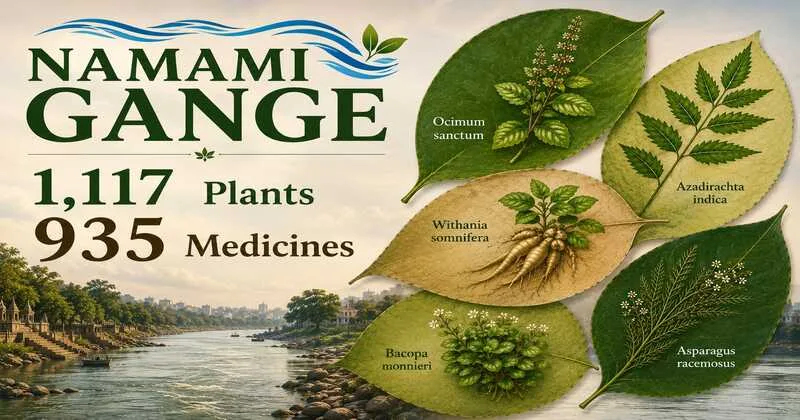
Namami Gange Mission, launched in 2014 under leadership of Prime Minister Narendra Modi, with a total outlay of Rs 20,000 crore has completed five years of field surveys across the entire 2,525-kilometre length of the river. The findings includes 1,117 plant species and 935 distinct medicinal applications have been documented within the Ganga basin alone. This is not a conservation statistic. It is the numerical proof of what Ayurvedic physicians or Vaidya’s has encoded in scripture for five millennia that the Ganga is not simply a river. Its life-giving river often known as Maa Ganga.
गंगा के किनारे 26 जगहों पर हुए floral survey में 1,117 plant species मिलीं। इनमें से 935 medicinal हैं, traditional और pharmaceutical दोनों।
यानी गंगा का किनारा एक outdoor pharmacy है। जो सदियों से इंसानों को ठीक करता आया है। नमामि गंगे इस विरासत को बचा रहा है। pic.twitter.com/QnXWOGf0xA
— Namami Gange (@cleanganganmcg) April 29, 2026
What the Ancient Texts Knew and What Science Has Now Confirmed
The foundational texts of Ayurveda the Charaka Samhita (circa 600 BCE) and the Sushruta Samhita were not composed in the abstract. Charaka wrote his pharmacological treatise in the upper Gangetic settlements. Sushruta the father of surgery, worked in Varanasi directly on the Ganga banks. The river was their laboratory as much as it was their inspiration.
The Ashtanga Hridayam, the great clinical manual of the 7th century CE, describes Ganga water as laghu (light), shita (cooling) and amratatulya (nectar) like. Modern science has not contradicted this characterisation rather it has confirmed it. A 2019 study by IIT Roorkee established that the Ganga retains a measurable self-purification capacity at twice the rate of any other major Indian river, a property attributed to its unique mineral composition from Himalayan glaciers, elevated dissolved oxygen and a high concentration of bacteriophages. As long ago as 1896, British physician E. Hanbury Hankin observed that cholera bacteria placed in Ganga water died within three hours in distilled water, they survived for days. He could not explain it. But science did a century later.
The Herbs That Were Here All Along
The Namami Gange survey 1,117 documented species represent the pharmacological ecosystem upon which Ayurveda built its entire material medica. What makes this revival significant is not just the number of species found it is the story of specific plants whose classical reputation is now being validated in laboratories across the world, decades after colonial neglect nearly stripped them from public consciousness.
Tulsi (Ocimum sanctum), described in the Charaka Samhita as a treatment for fevers and respiratory illness, grows wild on Ganga embankments. It was not taken seriously in formal medicine for most of the 20th century. During the COVID-19 pandemic of 2020-21, global demand for Tulsi supplements rose by 400%. CSIR research published in 2021 confirmed its adaptogenic, anti-viral and anti-inflammatory compounds. The Ganga basin turns out had been cultivating the solution long before the crisis arrived.
Ashwagandha (Withania somnifera), described in the Sushruta Samhita as the foremost rasayana for strength and longevity, thrives in the river’s alluvial soil, which produces its highest-potency varieties. The World Health Organisation formally recognised Ashwagandha for stress management in its 2019 Global Report on Traditional Medicine. Its global market value stood at $800 million in 2023, with projections reaching $2.4 billion by 2030. Brahmi (Bacopa monnieri), named in the Atharva Veda as the supreme brain tonic, grows in the shallow marshes and flooded edges of the Ganga. Between 2016 and 2024, multiple randomised controlled trials confirmed improvements in working memory, ADHD symptoms and cognitive ageing. A 2022 meta-analysis by the University of Wollongong, Australia covering 13 randomised controlled trials, stands as the most comprehensive global endorsement to date.
Then there is Neem (Azadirachta indica) present in every village along the Gangetic plain for over four thousand years. The Sushruta Samhita called it sarvaroga nivarini destroyer of all disease. Modern science has isolated over 130 biologically active compounds from it. The European Union registered neem extracts as certified biopesticides in 2012. CSIR India today holds 43 active patents on neem applications. The tree that colonialism dismissed as a village superstition is now a global intellectual property asset.
Deliberate Erasure, Global Stakes and India Strategic Position
It is important to be precise about what colonialism did to Ayurveda. It should not be neglected how Britishers and Muslim invaders destroyed herbs and life-giving plant knowledge through different means. The Nalanda University botanical gardens, located within the Ganga Basin and dating to 500 CE, were among the world’s first institutionalised medicinal plant repositories, which was burnt by Khilji. Even the Buddhist monasteries along the river-maintained the hospital gardens with documented therapeutic protocols. This infrastructure that remained best across the centuries in the making was dismantled within decades. What replaced it was a medical framework that recognised only what colonial institutions had certified. An entire civilisation’s pharmacological inheritance was rendered invisible.
The Namami Gange Mission in this sense more than an environmental programme. It is a systematic act of civilisational recovery. The Botanical Survey of India 2022 assessment, issues an urgent warning of the 1,117 documented species, 64 are now classified as threatened, 23 as endangered and 6 as critically endangered. Because of casualties of riverbank encroachment, sand mining and industrial effluents. The Mission of botanical survey is unprecedented in scope, but it arrives against a closing window.
The timing of this recovery effort is urgent. As synthetic pharmaceutical costs rise, antibiotic resistance spreads and lifestyle diseases reach epidemic proportions globally, the medical establishment is returning cautiously but decisively to plants that Ayurveda catalogued two thousand years ago. The WHO 2019 Traditional Medicine Strategy, its most comprehensive policy document on the subject, formally asked member states to integrate traditional medicine into their national health systems. The WHO also estimates that 80 per cent of the world’s population already relies on plant-based primary healthcare. Ayurveda is not an alternative to global medicine. It is a foundation of medical system.
The global herbal medicine market was valued at $83 billion in 2023. Grand View Research projects it will reach $178 billion by 2032. India’s response to this commercial and scientific opportunity runs through the Ganga basin. Several multinational pharmaceutical companies, including international players such as Naturex of France, have initiated dedicated ethnobotanical surveys within the basin since 2020. The intellectual property dimensions are significant. Indian Traditional Knowledge Digital Library has documented over 900 Ayurvedic formulations specifically to prevent biopiracy, the appropriation of traditional knowledge by external commercial interests without attribution or benefit-sharing.
The 1,117 species of the Ganga basin do not only constitute a medical archive. They feed soil microbiomes, regulate monsoon patterns, purify water for 600 million people and underpin the agricultural systems of the Indo-Gangetic Plain. To allow this ecosystem to continue degrading is not a question of sentiment or heritage. It is a question of public health, national security and economic strategy.
Reclaiming the Oldest Pharmacological Library on Earth
The Namami Gange Mission’s botanical documentation includes 1,117 plants, 935 medicines. One river is evidence of a relationship that structured human civilisation on this subcontinent for more than five thousand years. Ayurveda was not produced despite the Ganga geography. It was produced because of it. The river unique hydrology, its glacial mineral load, its bacteriophage concentration, the alluvial richness of its basin has created a condition for a pharmacological tradition unlike any other in the world.
The era that colonial history buried is now being unearthed, species by species and scripture by scripture. The plants disappearing from the Ganga banks do not represent biodiversity loss alone. They represent the erasure of verified, field-tested pharmacological knowledge that took generations of Ayurvedic physicians a millennium to accumulate and that no laboratory can recreate from scratch.
To protect the Ganga is therefore not an act of cultural sentiment. It is an act of strategic national intelligence, an investment in the most complete, continuously practised and botanically validated medical tradition the world has ever produced. For those who understand what was lost and what is now being reclaimed through Namami Gange Mission which is made for an environmental intervention. It is the restoration of a civilisation’s memory.