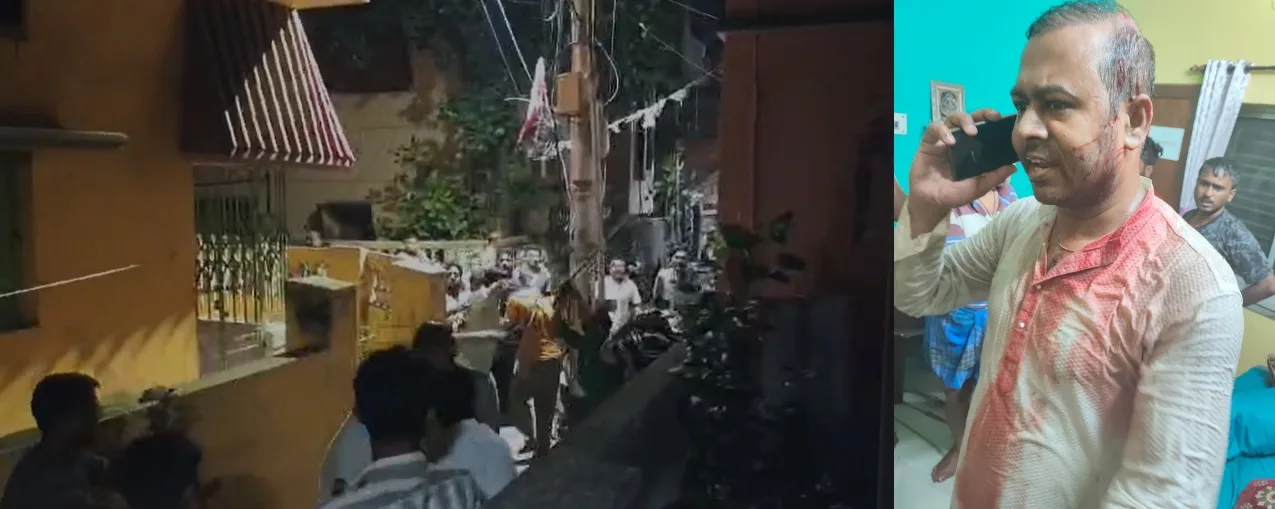
Kolkata: Fresh allegations of political violence unleashed by Trinamool Congress cadres have surfaced in West Bengal following the conclusion of polling, with an RSS worker seriously injured in an attack in Behala.
The incident in which the victim has suffered skull fracture has reignited concerns over the safety of opposition supporters and revived memories of past killings that had triggered statewide outrage.
Behala Attack Raises Fresh Alarm
According to reports, the residence of RSS swayamsevak Abhijit Brahma in Behala was allegedly attacked on the evening of April 29 by a large group of individuals said by locals to be linked to the All India Trinamool Congress. Abhijit Brahma’s brother Prasenjit Bramha was BJP polling agent in Booth number 154 of 160 Behala Paschim Assembly constituency.
https://twitter.com/eOrganiser/status/2049696051217748216?s=20
A group of 50 violent men led by Trinamool’s Anjan Das, Prabir Sarkar (Alias Bhola), Biswajit Das, Amit RoyChowdhury (Alias Lalu), Joy Das, Piklu Mitra
are said to have attacked the Brahma brothers’ house at 694 A/1 Mahendra Banerjee Road Kolkata 700060 (Ward No.129) in the late hours of 29 April after the second and last phase of Assembly polls wrapped up.
The attackers reportedly vandalised the house and assaulted several members of the household and acquaintances who were present at the scene. Abhijit Brahma, along with other RSS workers identified as Litan, Subha and Sumit Sahu, was allegedly beaten severely. Abhijit and Prasenjit are among those injured and are currently undergoing treatment.
Local accounts further allege that some of the victims (RSS Swayamsevaks, Litan, Subha and Sumit Sahu) were forcibly taken away during the violence, although these claims await official confirmation.
Allegations of Police Inaction
Serious questions have also been raised about the response of the West Bengal Police. It has been alleged that the Parnasree police station refused to register a complaint despite the severity of the attack.
There are also claims that a lady lawyer who was attempting to assist the victims faced intimidation at the police station. These allegations, if proven, could deepen concerns about institutional neutrality during politically sensitive periods.
Recurring Claims of Threats and Intimidation
The Behala incident comes amid continued accusations by opposition parties that their workers and supporters face systematic intimidation in parts of West Bengal.
Reports from multiple districts during elections have pointed to threats issued to voters, pressure on polling agents, and warnings against supporting non-ruling parties. Opposition leaders have repeatedly alleged that such tactics create a climate of fear that affects free political participation.
The ruling party has consistently denied these allegations and has accused its opponents of exaggeration and misinformation.
Murshidabad Triple Murder Still Haunts Bengal Politics
The latest violence has also brought back focus on the 2019 killings of Bandhu Prakash Pal and his family in Murshidabad. Pal, a school teacher, along with his pregnant wife and young son, was found murdered inside their home in a case that shocked the nation.
The killings became a major political flashpoint, with the BJP and RSS stating that Pal was associated with their organisation and alleging targeted violence. Investigators at the time also examined other possible motives, and the case remained a subject of intense political debate.
Despite the passage of time, the brutality of the incident continues to be cited in discussions around political violence in the state.
Central Forces Deployed, Yet Concerns Persist
The recent incidents come despite extensive deployment of central armed police forces during the elections under the supervision of the Election Commission of India.
The presence of central forces was intended to ensure peaceful polling and instil confidence among voters. However, critics argue that violence often occurs after polling concludes, when local dynamics take over and enforcement becomes less stringent.
A Continuing Political Flashpoint
West Bengal, under Chief Minister Mamata Banerjee, has witnessed repeated allegations of political clashes during and after elections. While the Trinamool Congress denies orchestrating violence, opposition parties continue to accuse it of fostering a hostile environment for dissent.
The Behala attack has once again placed the spotlight on law and order in the state and is likely to intensify political confrontation in the days ahead.