The political theatre of New Delhi has always thrived on carefully constructed illusions, but every illusion has a predetermined shelf life. What the nation is witnessing today is not merely another routine episode of political churn; it is the systematic and terminal unravelling of one of the most celebrated and manufactured narratives of the past decade. The Aam Aadmi Party (AAP), once marketed by the Lutyens’ ecosystem as the moral counterweight to the traditional political order, now finds itself confronting a crisis that transcends mere electoral setbacks. It is a crisis of soul, substance, and survival.
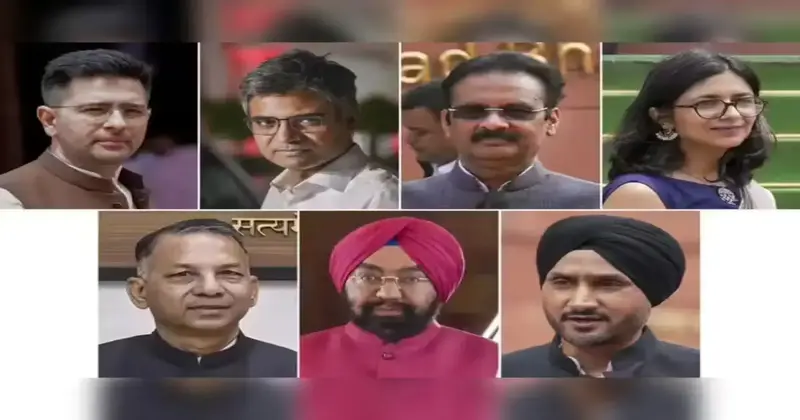
The recent seismic shift in the political landscape of Bharat, marked by the movement of seven prominent Rajya Sabha Members of Parliament toward the Bharatiya Janata Party, has sent shockwaves through the corridors of power. The transition of figures like Raghav Chadha, Swati Maliwal, Harbhajan Singh, Sandeep Pathak, Ashok Mittal, Vikramjit Singh Sahney and Rajinder Gupta represents more than a change in party symbols. It is a mass exodus from a sinking ship of regional authoritarianism toward a shore of national stability. Yet, the reaction from the entrenched Lutyens’ media and the digital cabals of the INDI alliance has been as predictable as it is hypocritical. Instead of introspection, there is vitriol; instead of analysis, there is a desperate attempt to rebrand former “revolutionaries” as “elites”.
For years, the Aam Aadmi Party was not merely a political organisation; it was a high-budget narrative, carefully curated, relentlessly amplified, and fiercely defended by a section of the intelligentsia that sought a convenient tool to stall the nationalist surge. It represented a rupture from conventional politics only in its rhetoric. However, narratives built on the foundation of moral exceptionalism and “anarchic activism” must eventually withstand the harsh light of administrative reality. The present moment suggests that this scrutiny has finally exposed structural contradictions and an inherent fascist nature that are increasingly impossible for even the most biased commentators to ignore.
The Rebranding: From ‘poster faces’ to ‘elites’
The speed with which the Lutyens’ ecosystem has turned on its own former darlings is a masterclass in political duplicity. What stands out is not the criticism itself, but the velocity and uniformity of the recharacterisation. Until very recently, the seven MPs currently in the eye of this storm were celebrated as the refined, educated, and credible faces of a “new political culture” that Bharat supposedly needed. Raghav Chadha was presented as the articulate, London-educated parliamentarian who brought “sophistication” to the house. Sandeep Pathak was hailed as the IIT-bred “genius strategist” who could decode the pulse of the masses with data. Swati Maliwal was the “fearless crusader” whose every protest was framed as a hallowed struggle for justice.
Industrialists such as Ashok Mittal, Vikramjit Singh Sahney and Rajinder Gupta were showcased as proof that the “Aam Aadmi” tent was wide enough to include professional excellence and philanthropic vision. However, the moment their political alignment began to shift toward the Bharatiya Janata Party, the script was rewritten with a vengeance. The same media houses that once sought exclusive interviews with these “visionaries” began recasting them in dismissive, even hostile, terms. The young reformer was suddenly an ambitious careerist; the strategist became a cynical opportunist; the activist was rebranded as a controversial renegade.
The most prominent label now being weaponised by the social media handles of the INDI alliance is “elite.” This raises a fundamental and uncomfortable question for the Lutyens’ cabal: if these leaders are now to be dismissed as disconnected elites, what exactly were they until yesterday? Their educational backgrounds, their professional success, and their lifestyles have not changed overnight. What has changed is their refusal to remain pawns in a political project that has abandoned its founding principles. This is not objective political analysis; it is a coordinated campaign of selective delegitimization targeting anyone who dares to embrace the vision of a Viksit Bharat.
The trivialisation of discourse: Politics by instagram metrics
Equally revealing of the intellectual bankruptcy within the anti-BJP ecosystem is the shift toward trivial metrics in public discourse. In the absence of substantive engagement with the ideological reasons behind this political realignment, sections of the commentary have retreated into the realm of digital voyeurism. We have seen the absurd spectacle of “national news” outlets focusing on Instagram follower counts, tracking who has unfollowed whom, and presenting social media fluctuations as if they were a substitute for democratic legitimacy.
The obsession with these digital scorecards reflects a deeper distortion in how the Lutyens’ class perceives Bharat. They believe that political legitimacy is manufactured in the echo chambers of X and Instagram, where bots and ideologically blinded influencers set the tone. Headlines scream about a few thousand followers leaving a profile, while conveniently ignoring the millions of voters on the ground who are disillusioned with the AAP’s governance model. When political analysis is reduced to counting “likes,” the discourse itself becomes shallow and detached from the aspirations of the common citizen.
The people of Bharat do not determine a leader’s worth through social media analytics; they assess them through the prism of governance, institutional integrity, and national direction. The attempt by the INDI alliance supporters to reduce this massive political shift to a mere “trending topic” reveals the limitations of a narrative ecosystem that is fundamentally incapable of engaging with the structural realities of a changing nation. It is a desperate attempt to shield the AAP leadership from answering the central question: why are its most capable and high-profile figures choosing to leave?
The Fascist Architecture: From idealism to absolute centralisation
The Aam Aadmi Party emerged from the womb of a decentralised anti-corruption movement that promised a new dawn of “Swaraj” or self-rule. It positioned itself as a radical alternative to the hierarchical and dynastic structures of the Indian National Congress and other regional players. Yet, over the last decade, a chilling pattern of authoritarianism has replaced that initial promise. The trajectory of the party increasingly resembles the very “High Command” culture it once critiqued, but with a more sinister, fascist undertone.
The exits of these seven MPs are not isolated incidents; they are part of a long and bloody history of internal purges. The political landscape is littered with the careers of those who helped build the AAP, only to be discarded the moment they questioned the singular authority at the top. The early exits of Prashant Bhushan and Yogendra Yadav, who were physically manhandled and expelled for demanding transparency, set the tone. This was followed by the sidelining of Kumar Vishwas, Shazia Ilmi, and Ashutosh, each of whom discovered that “Aam Aadmi” was a brand owned by an individual, not a philosophy shared by a movement.
The internal structure of AAP has evolved into a monolithic entity where dissent is treated as treason. The “High Command” operates through a small, unelected coterie that demands absolute subservience. This concentration of authority in the hands of Arvind Kejriwal has created a suffocating environment for any leader with independent thought or a genuine commitment to their constituents. When seven senior leaders, including the party’s strategic brain and its most vocal woman leader, decide to move on, it is a clear indictment of a party that has morphed into a private limited company. The facade of “people’s politics” has been replaced by a reality of centralised surveillance and dictatorial whims.
The Punjab paradox and the illusion of governance
The expansion of AAP into Punjab, under the leadership of Bhagwant Mann, was initially hailed as a milestone in its journey to becoming a national force. However, this expansion has only amplified the concerns regarding its dictatorial nature. There is a growing and pervasive perception that the Punjab government is being run via remote control from New Delhi, bypassing the constitutional mandate of the state’s own leadership.
Critics and political observers have frequently pointed out that major policy decisions, administrative appointments, and even day-to-day governance in Punjab are influenced by a non-constitutional hierarchy based in the national capital. This “Delhi Model” of interference has led to a sense of administrative paralysis and a lack of accountability. While the AAP leadership and its backers in the INDI alliance reject this characterisation, the persistence of such reports, even from within the Punjab unit, indicates a crisis of institutional balance. The leaders leaving the party have often hinted at this “extra-constitutional” interference as a primary reason for their disillusionment. They refuse to be part of a system where the mandate of the people is subverted by the whims of a central cult.
The Pan-Bharat Attack: A coordinated Lutyens’ strategy
The attack on these seven MPs is not limited to the borders of Delhi or the newsrooms of the capital. It is a Pan-Bharat operation coordinated by the broader Lutyens’ network, stretching from the intellectual circles of Kerala to the media hubs of Kolkata. In Kerala, where the left-liberal ecosystem maintains a fierce grip on academic and media discourse, the narrative against the defecting MPs has been particularly vitriolic. The “intellectuals” of the South, who are part of the INDI alliance ideological machinery, have been writing exhaustive critiques on the “betrayal of ideals,” while remaining conveniently silent on the political violence and administrative decay within their own states.
This coordinated effort serves a specific purpose: to prevent the emergence of a unified nationalist narrative that transcends regional boundaries. By attacking leaders like Harbhajan Singh or Swati Maliwal, the Lutyens’ gang wants to send a message that any professional or activist who joins the BJP will be subjected to a nationwide character assassination. They are terrified of the fact that the BJP is successfully integrating diverse voices from across Bharat, from the sporting world to the industrial sector, into its vision for the future.
The failure of the protest-driven model and the INDI Alliance
The Aam Aadmi Party’s political approach has historically relied on a “Protest-Driven Model.” This strategy, rooted in perpetual confrontation and the manufacturing of a “victimhood” narrative, proved effective during its insurgent phase. It allowed the party to dominate headlines and mobilise an urban middle class that was tired of the status quo. However, governance in a complex and vast nation like Bharat requires more than just high-decibel protests; it requires long-term institutional capacity, policy continuity, and strategic coherence.
As the party moved from being an agitator to a governor, the limitations of its model became glaringly obvious.
The constant friction with the Union Government, the use of taxpayer funds for aggressive self-promotion, and the lack of a clear ideological core beyond “anti-corruption” (which itself rings hollow today) have led to a stagnation of the AAP experiment. Its participation in the INDI alliance, a desperate conglomerate of dynastic parties and disparate ideologies, has further diluted its original identity. By aligning with the very forces, it once promised to destroy, AAP has lost its moral compass. The seven MPs who have moved toward the BJP have clearly recognised that the INDI alliance is a dead-end street, built on the singular agenda of opposition rather than a constructive vision for Bharat.
The realignment and the vision of Viksit Bharat
Bharat’s political landscape has undergone a tectonic shift, moving away from an era of administrative lethargy toward a future defined by stability and a long-term civilisational vision. The rise of the BJP, under the leadership of Prime Minister Narendra Modi, has fundamentally redefined national priorities. This movement replaces the era of coalition blackmail with an emphasis on rapid development and a clear roadmap for Viksit Bharat 2047. Political actors are no longer content with regional experiments; they seek to align with a national story that commands respect on the global stage.
The movement of senior leaders away from the Aam Aadmi Party signifies the final unravelling of a manufactured illusion. What began as the Anna Hazare movement has devolved into a shell governed by dictatorial authority and hollow rhetoric. This realignment is not a “selling out” but a “stepping up” toward a platform that matches nationalistic aspirations and professional calibre. The people of Bharat now distinguish between “Instagram metrics” and the “infrastructure for the future,” choosing a leader who demands service over one who demands sycophancy.
This transition represents a necessary stage in the maturation of Bharat’s democracy. As the Lutyens’ elite mourns the loss of its favourite political project, the nation moves forward with a realisation that political legitimacy rests on the consistency between principle and practice. The mask of the “Aam Aadmi” ideal has fallen, revealing that the revolution was a ruse. Consequently, the journey toward a developed nation has found new, capable hands, ensuring that the path to 2047 is built on a foundation of reality rather than digital optics.