Uttar Pradesh is steadily redefining its role in India’s national security architecture, transitioning from a traditionally agrarian and industrial state into a pivotal hub of defence manufacturing and strategic innovation. Anchored by the Uttar Pradesh Defence Industrial Corridor (UPDIC), the state is witnessing a convergence of large-scale investments, advanced manufacturing facilities, and indigenous technological breakthroughs that are reshaping India’s defence preparedness.
From missile production units and small arms manufacturing to next-generation drone technologies and electronic warfare systems, the state has become a focal point for both public and private sector participation. Strategic collaborations, including those involving global defence players, underscore a decisive shift towards self-reliance under the broader vision of Atmanirbhar Bharat. With multi-node infrastructure spanning cities like Lucknow, Kanpur, Jhansi, and Aligarh, the corridor is not merely an industrial project but a long-term strategic framework aimed at strengthening India’s defence ecosystem.
What makes this transformation particularly significant is the scale and diversity of developments. Massive land allocations, employment generation in tens of thousands, and cutting-edge research initiatives indicate a structural shift in how defence production is envisioned and executed in India. The integration of academia, industry, and government institutions further amplifies this momentum, positioning Uttar Pradesh at the centre of a rapidly evolving defence-industrial complex.
At a time when global geopolitical dynamics demand technological superiority and supply chain resilience, Uttar Pradesh’s emergence as a defence manufacturing nucleus signals India’s intent to secure its strategic autonomy. The developments unfolding across the state reflect not isolated projects but a coordinated national push towards indigenous capability building, innovation, and long-term security preparedness.
The detailed 9 Powerful Steps Positioning Uttar Pradesh at the Centre of India’s Defence Future, are given below.
1. Amitec Electronics Launches Electronic Warfare Manufacturing Unit at Aligarh Defence Corridor Node
Amitec Electronics has set up an electronic warfare system design and manufacturing facility at the Aligarh node of the Uttar Pradesh Defence Industrial Corridor with an investment of around Rs 30 crore. Phase-1 of the Aligarh node has been fully allotted, and Phase-2 development is underway.
Amitec Electronics Ltd. has started operating a dedicated unit for the design and manufacture of electronic warfare systems at the Aligarh node of the Uttar Pradesh Defence Industrial Corridor (UPDIC), marking a step in the region’s industrial development. The company’s facility, developed with a reported investment of approximately ₹330 crore, adds to the growing ecosystem of defence manufacturing activities across the multi-node corridor.
The Uttar Pradesh Defence Industrial Corridor, spanning six locations – Kanpur, Jhansi, Lucknow, Aligarh, Agra and Chitrakoot – is an initiative aimed at strengthening domestic defence and aerospace production. Under the framework of this project, land parcels have been allocated to companies setting up manufacturing units for a range of defence products, including ammunition, small arms, and advanced systems such as electronic warfare and satellite technologies.
At the Aligarh node, Phase-1 land allotments have been fully taken up by various firms, including Amitec Electronics and others involved in defence supply chains. The commencement of operations at Amitec’s electronic warfare and related systems unit reflects activity in the corridor, where companies are transitioning from land acquisition to production and testing. Phase-2 development in Aligarh is in progress, with additional land being prepared to accommodate more industrial units.
Electronic warfare systems, which include equipment designed to monitor, intercept, or disrupt signals for operational use, have become an area of interest for private and public sector firms as defence requirements evolve. Amitec’s investment places it among companies utilising the corridor’s infrastructure to produce specialised technologies.
The UPDIC has attracted multiple investors since its inception, with reported investment proposals amounting to tens of thousands of crores of rupees and several units in different stages of setup or operation. Some companies, including those in Kanpur and Lucknow, have begun producing ammunition, missile components, and other defence-related materials, indicating a diversification of manufacturing capabilities across the corridor.
As the corridor develops, progress at the Aligarh node indicates continued activity in defence manufacturing, with multiple phases of development aimed at accommodating additional investors and technologies.
2. UP Defence Industrial Corridor Advances with Rs 35,000 Crore Investment Plan and Over 52,000 Jobs Expected
The Uttar Pradesh Defence Industrial Corridor (UPDIC), a project under Chief Minister Yogi Adityanath, is progressing with land allotments to 62 companies, paving the way for nearly Rs 12,000 crore in investment and over 14,000 jobs, with additional investments and employment in the pipeline.
The corridor, launched to boost defence and aerospace manufacturing and promote self-reliance, is attracting investments and generating employment across the state. So far, more than 977.54 hectares of land have been allotted to 62 companies across different nodes of the corridor. These allotments have facilitated Rs 11,997.45 crore in investment and the creation of 14,256 direct jobs.
According to official data, a total of 197 Memorandums of Understanding (MoUs) have been signed for the Defence Corridor under the monitoring of Chief Minister Yogi Adityanath, of which 172 are industrial MoUs. These agreements propose a combined investment of Rs 34,844.49 crore and are expected to generate around 52,658 jobs across Uttar Pradesh. In addition, MoUs with 110 more companies are in the pipeline, which could bring nearly Rs 23,000 crore in investment and create over 38,000 jobs.
The Uttar Pradesh Expressways Industrial Development Authority (UPEIDA) has approved more than 2,097 hectares of land across six nodes of the corridor – Aligarh, Kanpur, Lucknow, Jhansi, Chitrakoot and Agra. Of this, land acquisition of over 2,040 hectares has been completed. Currently, about 1,598.92 hectares of land is available for allotment to new companies.
Among the nodes, Aligarh has the highest number of companies, with land allotted to 24 firms. Kanpur has received the highest land allocation, with 210 hectares allotted to five companies. Jhansi has seen 571 hectares allotted to 17 companies, while in Lucknow, 16 companies have been allotted more than 131 hectares. The land allotment process is set to begin in Chitrakoot, Aligarh Phase-2 and the Agra node.
The establishment of a BrahMos missile manufacturing unit at the Lucknow node has added to the strategic importance of the corridor. Officials stated that this reflects the state’s expanding role in defence manufacturing. UPEIDA Additional Chief Executive Officer H.P. Shahi said the corridor is progressing in line with the Chief Minister’s vision, aligned with initiatives such as Make in India and One District, One Product.
Officials indicated that Uttar Pradesh is competing with states such as Gujarat and Tamil Nadu in defence manufacturing. Further announcements are expected in the coming months, which may strengthen the state’s position as a defence manufacturing hub and support its long-term economic goals.
3. Government Allots 75 Hectares to Bharat Electronics in UP Defence Corridor
The Uttar Pradesh government has allotted 75 hectares of land to Bharat Electronics Limited (BEL) within the Uttar Pradesh Defence Industrial Corridor, according to official information.
The land allocation has been made at the Chitrakoot node of the corridor, where BEL is expected to establish an advanced manufacturing facility.
The proposed unit is intended for the production of defence electronics, including radar and air defence systems, as part of efforts to expand indigenous manufacturing capabilities.
The allotment was formalised with the handover of the land allocation letter, marking a development in the expansion of infrastructure under the defence corridor initiative.
The Uttar Pradesh Defence Industrial Corridor has been developed to attract investment in the defence sector, promote local production, and generate employment. Officials stated that the inclusion of BEL in the corridor is expected to contribute to these objectives.
4. Rajnath Singh Inaugurates BrahMos Missile Production Unit at UP Defence Corridor in Lucknow
Defence Minister Rajnath Singh virtually inaugurated the BrahMos supersonic cruise missile production unit at the Uttar Pradesh Defence Industrial Corridor in Lucknow on Sunday. The facility is designed to manufacture 80 to 100 missiles annually.
The production unit, built at a cost of Rs 300 crore, will manufacture BrahMos missiles with a range of 290 to 400 km and a top speed of Mach 2.8. Developed by BrahMos Aerospace, a joint venture between India and Russia, the missile can be launched from land, sea, or air and operates on a “fire and forget” guidance system.
From the newly launched Aerospace Integration and Testing Facility in Lucknow, 80 to 100 BrahMos missiles will be produced annually. In addition, 100 to 150 next-generation BrahMos missiles are also expected to be manufactured each year.
The next-generation missiles are to be delivered within one year. Currently, fighter jets such as Sukhoi can carry one BrahMos missile; however, they will be able to carry up to three next-generation BrahMos missiles.
The next-generation BrahMos missile will have a strike range of over 300 kilometres and weigh 1,290 kilograms, compared to the current BrahMos missile, which weighs 2,900 kilograms.
The production unit was announced under the Defence Industrial Corridor initiative launched by Prime Minister Narendra Modi during the 2018 Global Investors’ Summit, with the foundation stone laid in 2021.
BrahMos missiles are jointly developed by India’s Defence Research and Development Organisation (DRDO) and Russia’s NPO Mashinostroyeniya and are part of India’s defence system.
Alongside the manufacturing unit, the BrahMos Aerospace Integration and Testing Facility will handle assembly and testing of the missiles, according to an official statement.
Uttar Pradesh Chief Minister Yogi Adityanath is also scheduled to attend the event.
The Titanium and Super Alloys Materials Plant (Strategic Materials Technology Complex) will be launched at the same event to produce materials used in aerospace and defence manufacturing.
Additionally, the foundation stone for the Defence Testing Infrastructure System (DTIS) will be laid, which will be used for testing and certifying defence products.
The BrahMos production unit, built over 80 hectares of land provided by the Uttar Pradesh government, was completed in three and a half years.
The Uttar Pradesh Defence Industrial Corridor comprises six nodes – Lucknow, Kanpur, Aligarh, Agra, Jhansi, and Chitrakoot – and aims to attract defence investments. Uttar Pradesh is the second state after Tamil Nadu to establish such a corridor, according to the statement.
5. AK-203 Rifle to Be Fully Indigenised by End of 2025, Says IRRPL CEO
India’s standard-issue AK-203 assault rifle will be completely indigenous by the end of 2025, according to Indo-Russian Rifles Private Limited (IRRPL) Chief Executive Officer and Managing Director Major General S.K. Sharma. The rifle is currently being produced at IRRPL’s Korwa facility in Uttar Pradesh under a Rs 5,200 crore deal signed under the Make in India initiative.
Sharma stated that 50 per cent of the rifle’s components have already been localised. “Fifty percent indigenisation has been completed so far. This will reach 100% by the end of the year,” he said in an interview. He added that production rates will increase once full indigenisation is achieved, reducing delays caused by overseas testing and validation. “All testing is now indigenised. Earlier, parts had to be sent to Russia for validation,” he said. At full capacity, the Korwa factory is expected to produce up to 600 rifles per day, approximately one every 100 seconds. Sharma said that alternate sources for materials are now available within India.
The AK-203 is a fifth-generation version of the AK-47 and is intended to replace INSAS rifles as the frontline weapon of the Indian Army. It is planned to be deployed in operational zones including the Line of Control and the Line of Actual Control.
The rifles are being assembled in India through a joint venture between Russian firms Rosoboronexport and Kalashnikov Concern and Indian firms AWEIL and MIL. The venture was formed in 2019 under an intergovernmental agreement, with India holding a 50.5 per cent stake and Russia 49.5 per cent.
While the original delivery deadline was set for October 2032, IRRPL now plans to complete delivery of over six lakh rifles by December 2030. Sharma said the company has received an order of more than six lakh rifles from the Indian forces, of which 48,000 have been delivered so far. “By the end of this year, we will deliver a total of 70,000 rifles,” he said. He added that another 7,000 rifles will be delivered within two to three weeks and 15,000 more by December this year. From 2026, the facility is expected to produce 12,000 rifles per month.
The AK-203, known as ‘Sher’ in India, consists of 50 components and 180 sub-parts and is designed to fire up to 15,000 rounds. Sharma said each rifle “goes through 120 hands” as part of quality checks. So far, 60 critical components have been indigenised, with Indian vendors supplying parts for final assembly.
IRRPL currently employs over 260 staff and plans to increase its workforce to 537, with 90 per cent local hires. Permanent Russian experts are stationed at the Korwa facility.
Before the Korwa facility became operational, India had imported 70,000 AK-203 rifles to meet urgent requirements and had also procured 147,000 SIG Sauer 716 rifles from the United States for immediate deployment.
Sharma attributed the initial slow pace of delivery to the indigenisation process. “Then our rate of production will also increase, and we are planning to deliver all the rifles by the end of 2030, which is two years early as per the contract,” he said.
IRRPL is also planning to expand its product line beyond the AK-203. “There are efforts in that direction. The intergovernmental agreement was very clear that this company will also produce other parts of the Kalashnikov Concern and AK-203 is just the entry product,” Sharma said.
The company is preparing for its first international export order and is targeting friendly countries. “Nothing will affect the vendors irrespective of embargoes,” he said.
Sharma described the project as the “younger brother of BrahMos” and an example of India-Russia defence cooperation. He said Russian military products have been widely used by Indian Army personnel and described them as reliable.
He added that IRRPL aims to be among the top five small arms manufacturers globally by 2032.
Separately, India conducted successful flight tests of two short-range ballistic missiles, Prithvi-II and Agni-I, from the Chandipur range in Odisha. The Ministry of Defence stated that the tests were carried out under the Strategic Forces Command and confirmed that all operational and technical parameters were validated.
6. India’s First Drone Forensic Lab Established in Lucknow to Enhance Policing and Investigations
India’s first drone forensic laboratory has been established at the Uttar Pradesh State Institute of Forensic Science (UPSIFS) in Lucknow, in a development aimed at strengthening policing and forensic investigations in the state.
The facility was inaugurated by Chief Minister Yogi Adityanath and has been conceptualised and established by robotics and drone technology expert Milind Raj, who is associated with UPSIFS as a forensic drone expert.
According to Raj, the laboratory is designed to enable police to track, decode and investigate drones in real time. The system allows experts to determine the take-off location, flight path and payload capacity of a drone, and assess whether it is carrying hazardous materials such as explosives.
The lab also provides capabilities for conducting forensic analysis of drones to establish their origin, intent and potential threat.
In addition to investigative functions, the facility will operate as a training and skill development centre for police personnel and forensic experts, offering practical experience in handling unmanned aerial vehicles (UAVs). It is intended to support the development of a dedicated drone unit within the Uttar Pradesh Police for use in surveillance, crowd monitoring and response to drone-related incidents.
Officials stated that the laboratory is equipped with data acquisition tools, reverse-engineering systems, customised kits, high-performance computing systems and simulation setups to support drone forensics.
The facility is expected to support applications including monitoring sensitive locations such as borders, prisons and airports, as well as assisting in disaster management and search-and-rescue operations.
Authorities indicated that the establishment of the drone forensic lab is intended to address the increasing use of drones in criminal activities, including smuggling and unauthorised surveillance, and to strengthen law enforcement capabilities through technological integration.
7. Rajnath Singh, Yogi Adityanath Inaugurate Drone and Defence Manufacturing Facilities in Noida
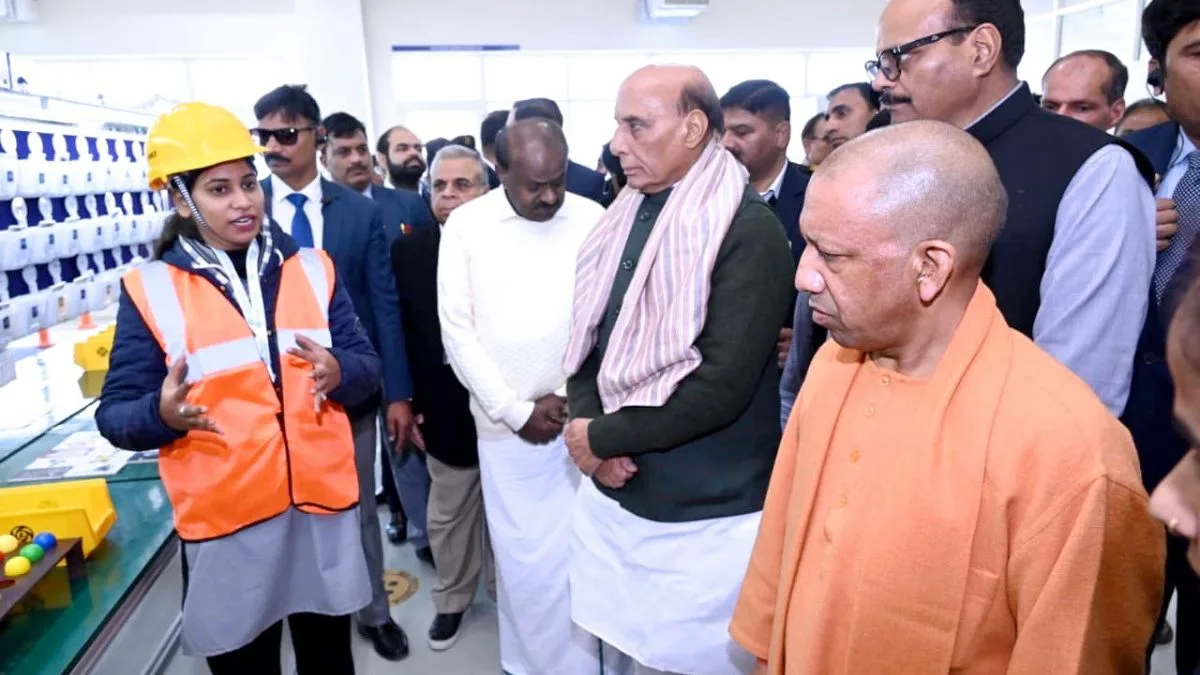
Defence Minister Rajnath Singh and Uttar Pradesh Chief Minister Yogi Adityanath inaugurated the Raphe mPhibr Drone Manufacturing Unit, Defence Equipment and Engine Test Facility in Noida on Saturday.
The facilities, built by Raphe mPhibr Pvt. Ltd. in Gautam Buddh Nagar, include a defence equipment and drone manufacturing unit, an aircraft engine facility, and what was described as the country’s largest aero engine test bed.
Rajnath Singh described the development as a step towards achieving self-reliance in the defence sector under the Atmanirbhar Bharat initiative. He praised the efforts of the company’s founders, Vishal Mishra and Vivek Mishra, stating that he had not seen young entrepreneurs build such a large and innovative establishment during his tenure as Defence Minister. He said that Indian drones have reached a level where they cannot be detected by the United States or China.
The Defence Minister highlighted the increasing role of drone technology in modern warfare, referring to the Russia-Ukraine conflict as an example. He said India is designing and manufacturing drones domestically and emphasised that self-reliance remains central to the country’s defence capabilities.
Raphe mPhibr, which began operations in 2017 with 10 employees, now employs over 600 scientists and engineers and is expected to generate more than 5,000 jobs in Uttar Pradesh. In collaboration with the Defence Research and Development Organisation (DRDO), the company has developed three products in 14 months that were deployed in Operation Sindoor.
During the visit, Singh described the engine test bed, additive manufacturing facility, composite polymer centre, payload drones and guided missile drones as advanced systems. He also stated that Uttar Pradesh has improved its business environment under the current administration, adding that Noida is emerging as a centre for startups, high-technology solutions and defence manufacturing.
He referred to central government initiatives such as the Technology Development Fund, National Research Foundation and iDEX Aditi, stating that these programmes support startups engaged in defence innovation. He added that such developments reflect the progress of India in defence technology.
Rajnath Singh also referred to Operation Sindoor, stating that it demonstrated the role of innovation and coordination between armed forces and scientific development.
Chief Minister Yogi Adityanath described the project as a milestone in the development of Noida as a defence hub. He said that the new facilities, including drone manufacturing, would contribute to national security and reduce dependence on foreign systems.
The Chief Minister referred to changes in warfare patterns since Independence and highlighted the need for preparedness for future challenges. He also mentioned the role of Uttar Pradesh in defence production, noting the presence of nine ordnance factories and several public sector units.
He stated that two new defence manufacturing centres have been sanctioned, including one in Uttar Pradesh, and that six nodes – Aligarh, Agra, Kanpur, Lucknow, Jhansi and Chitrakoot – are being developed over 12,500 acres under the Defence Industrial Corridor.
Referring to the BrahMos missile facility in Lucknow, Adityanath said the project has strengthened the state’s role in defence manufacturing. He also cited other projects, including the Defence Land Development centre in Jhansi, the AK-203 unit in Amethi and the Escort facility in Hardoi.
Chief of Defence Staff General Anil Chauhan, Defence Secretary Rajesh Kumar, Defence Production Secretary Sanjeev Kumar, Member of Parliament Mahesh Sharma and other senior officials were present at the event.
8. IIT Kanpur Develops AI-Enabled Kamikaze Drones with 100 km Strike Capability
The Indian Institute of Technology (IIT), Kanpur has developed an indigenous version of a Kamikaze drone capable of carrying a warhead of up to 6 kg over a distance of 100 km.
Subramaniam Sadrala, Assistant Professor in the Aerospace Department at IIT Kanpur, stated that the drones are equipped with stalled technology that enables them to evade radar identification. He said the development has been underway since the previous year under the Defence Research and Development Organisation’s Young Scientist Laboratory (DYSL-CT) project.
The drones are expected to undergo target destruction trials in the next six months as part of the next phase of development.
The indigenously developed drone measures 2 metres in length and features a foldable fixed-wing design. It can be equipped with cameras and infrared sensors and can be launched from a catapult or a canister launcher.
The drones are capable of neutralising targets without Global Positioning System (GPS) support using an artificial intelligence-enabled visual guidance system. The battery-operated unmanned aerial vehicles can deliver a payload over 100 km in 40 minutes.
The UAV is designed to operate autonomously during flight and can make decisions based on an algorithm. It can also be operated remotely and transmit images of target areas using an onboard high-resolution camera.
The drone is designed for all-weather, day-and-night operations and is capable of evading radar using stealth technology. It has a maximum operating ceiling of 4.5 km.
Professor Sadrala stated that funding support, including that received through the defence corridor, is important for the development of such systems.
9. Tata Group and Airbus Sign Rs 22,000 Crore Deal to Manufacture C-295 Aircraft in Uttar Pradesh
Tata Group and Airbus have signed a Rs 22,000 crore agreement with the central government to manufacture C-295 military transport aircraft in India, with the production facility proposed to be set up in Uttar Pradesh.
Under the agreement, a total of 56 C-295 aircraft will be delivered to the Indian Air Force. Of these, 40 aircraft will be manufactured in India, while 16 will be developed in Spain.
The manufacturing plant, expected to be located in Uttar Pradesh, is part of efforts to expand the aerospace ecosystem in the country and support the Make in India initiative. The companies have agreed to supply all 56 aircraft within a period of 10 years.
The C-295 aircraft is used by the military as a transport aircraft for carrying equipment and weapons. The deal has been described as one of the largest private manufacturing orders in the defence sector.
The agreement is part of broader initiatives by the central government to promote private sector participation in defence manufacturing. Airbus, in collaboration with Tata Group, has also planned to establish a final assembly line in India for the C-295 aircraft, intended to replace the Indian Air Force’s Avro aircraft fleet.
Airbus has previously collaborated with the Indian Space Research Organisation (ISRO) on projects including the design and construction of communication satellites such as Eutelsat W2M in 2008 and HYLAS-1 in 2010.
Separately, Tata Group has submitted a financial bid in the disinvestment process of Air India. A Tata Sons spokesperson stated that the company had placed a bid for the national carrier. Reports indicated that SpiceJet was also considering participation in the bidding process.
The central government is planning to sell a 100 per cent stake in Air India and its subsidiary Air India Express, along with a 50 per cent stake in Air India SATS Airport Services Private Limited (AISATS). Other assets, including the Air India building in Mumbai and Airlines House in Delhi, are also part of the proposed disinvestment.
Uttar Pradesh’s transformation into a defence manufacturing and innovation hub reflects a broader structural shift in India’s strategic priorities. The convergence of large-scale investments, indigenous production capabilities, and advanced technological development across sectors such as missiles, small arms, drones, and aerospace manufacturing signals a decisive move towards long-term self-reliance.
The scale of employment generation, infrastructure expansion, and participation of both domestic and global players shows the seriousness with which this transition is being pursued. From foundational agreements like the C-295 aircraft deal to cutting-edge advancements in drone warfare and electronic systems, the trajectory points towards a deeply integrated and future-ready defence ecosystem.
What emerges clearly is not a series of isolated developments, but a coordinated, multi-layered push that aligns policy, industry, and innovation. Uttar Pradesh is no longer just participating in India’s defence story; it is increasingly shaping it. The state’s rise as a central node in defence production reinforces national security objectives while also contributing to economic growth and technological advancement.
In the years ahead, the continued expansion of the Uttar Pradesh Defence Industrial Corridor and the scaling of indigenous capabilities are likely to define India’s position in the global defence landscape. The developments outlined above collectively mark a significant step in that direction.