Pakistan, a state-sponsor of terrorism is lately gaining global limelight as a puppet mediator in the US-Iran war. Islamabad is aiming to mask its internal political misdeeds, economic fissures and terror atrocities by acting as an advocate of peace in the geopolitical contest. However, terrorism runs in the blood, veins and decades of policy discourses of Islamabad to fulfill its notorious and hegemonic motive. Apparently, Pakistan is glorifying itself as a peace-maker, when India is mourning one year of the Pahalgam terror attack, where terrorists who infiltrated from the western border, killed 26 innocent civilians and tourists purely based on their cultural and religious affiliations.
India is thus consistently and explicitly exposing the illicit intentions and hidden agenda of Pakistan who espoused the Pahalgam terror attack on April 22, 2025. The inhuman terrorists shot down innocent civilians. Let us decode how India uncovered strong Pakistani links to the Pahalgam incident, whose soil has sprouted hundreds of terrorists to act against India since partition. Let us also decode how New Delhi is consolidating the security architecture in Kashmir and beyond over the past year against the misadventures of state-sponsored terrorism. The consistent efforts of the intelligence units and security personnel of the country has infact led to the gradual resurgence of tourism in Pahalgam and Kashmir at large, dismantling from the nightmare and harsh memories of the terror attack of the previous year.
Pahalgam attack: A calculated terror motive of Pakistan targeting Hindus
As India mourns one year of the terror attack, which was specifically targeted to kill the innocent Hindu civilians, intelligence units exposed how the attack was a calculated atrocity from Pakistan. The terrorists were affiliated to The Resistance Front(TRF) terror network which is a proxy of the Lashkar-e-Taiba(LeT) terror network. The terrorists who unleashed firing in the valley confirmed the religious affiliation of the tourists and shot only the male members, thus aimed to escalate an emotional loop for India. By espousing targeted and well-calculated terror attacks the terrorists from Pakistan intended to reiterate the scars on Indian souls for ages. However, government turned grief into national grit with the goal of eradicating terrorism.
Lashkar-e-Taiba(LeT) is the notorious mastermind behind major terror attacks that hit India. It includes, 26/11 Mumbai terror attack, Mumbai train bombings of Mumbai, Delhi bombings in 2005, 2001 Parliament attack and the Red Fort Attack in 2005. However, the Pahalgam terror strike was a catalyst that transformed the comprehensive counter terrorism policy of India against Pakistan both in terms of kinetic and non-kinetic means. The terror attack and the aftermath witnessed an overarching assertiveness by India to consolidate national security against the terror atrocities of Pakistan.
Pahalgam attack and the aftermath: India’s swift counter-terrorism resolve
There was a fundamental shift in the counter-terrorism strategy of India via both diplomatic and military manoeuvring, post the Pahalgam terror attack. India further articulated a responsible statecraft to script strong strategic deterrence against the terror motives of Pakistan. New Delhi embarked on a multi-vectoral approach to counter terrorism nurtured by Pakistan.
Indus Water Treaty in abeyance: Blood & water will not flow together
The very first strategic deterrence tool unleashed by India was to keep the Indus Water Treaty in abeyance. This treaty, signed in 1960 is pertaining to the cross-border river sharing mechanism between India and Pakistan. By keeping the international treaty in abeyance, India firmly reiterated that it is not accountable to Islamabad while deciding the utility of its water. India now has complete control over the east flowing rivers of the Indus basin which are Ravi, Beas and Sutlej. New Delhi can now construct dams, generate hydro-electricity and regulate the flow of the water without being answerable to Pakistan. This is a clear strategic edge achieved by India that can cause drought, flood and water uncertainty to the lower basins of Pakistan, its agricultural ecosystem and livelihood as a whole.
Prime Minister Modi also exclaimed that a country which sucks the blood of the innocent Indians doesn’t deserve to have its water. Blood and water will not flow together and the Indus Water Treaty will remain in abeyance as long as Pakistan supports cross-border terrorism, PM Modi affirmed. Thus, India used water as a strategic asset to fortify national security. Now, Pakistan remains at the mercy of India, as its water flow and the entire livelihood dependent on it, is in the custody of India amidst unpredictability of water flow.
Operation Sindoor: India strikes epicentre of terror networks
In a strong kinetic response, India launched Operation Sindoor during which, New Delhi struck the terror headquarters and epicentres in not just Pakistan-occupied Jammu & Kashmir(PoJK) but also deep inside the Pakistan mainland. On May 7, India hit the nerve centres of Lashkar-e-Taiba(LeT) and Jaish-e-Mohammad(JeM) terror organisations. With 24 precision missile attacks in a span of 25 minutes, Indian missiles went deep inside Pakistan and destroyed terror epicentres in Muzaffarabad, Kotli, Muridke, Bahawalpur etc.
Striking these terror bases in the heartland of Pakistan exposed the true face of Islamabad and how it nurtures strong terror networks. This is indeed a decisive strategic edge etched by India. Post the operation, for months videos surfaced from Pakistan and the terror centres evidently depicted how India fractured the roots of terrorism, where even the high-ranking terrorists of JeM and LeT were removed. Operation Sindoor also illustrated the bold and stellar offensive and defensive capabilities of the Indian military ecosystem.
No nuclear blackmail policy: A doctrinal shift
India has always adopted the “no-first use” nuclear doctrine. Pakistan being a nuclear weapon-equipped state, always used it as a blanket to threaten India against escalating any military action. Nuclear weapons were used as a deterrence strategy by Pakistan to conceal its terror motives. However, post the Pahalgam terror attack, India clearly asserted that Pakistan cannot sell its nuclear blackmail or bluff against India. Threatening with a nuclear escalation is no longer feared and India will consolidate its national security and give a befitting reply incase of any terror misadventure.
External Affairs Minister Dr. S. Jaishankar reiterated that Pakistan cannot shield its terror motives and gain immunity from its atrocities by asserting its nuclear status. India and Pakistan both being nuclear states, the world feared of a nuclear war and persistently compelled India to de-escalate or have a pacifying approach. However, New Delhi, post the Pahalgam attack clearly measured that nuclear blackmail is an outdated strategy and nothing can halt India from shielding its national security. India embraces the policy of zero-tolerance to terrorism in all its forms and manifestations.
Series of counter terrorism operations in Kashmir
Operation Mahadev: In the aftermath of the Pahalgam terror attack, for months India conducted swift counter-terrorism operations across Kashmir and in the border districts. In Operation Mahadev Indian security personnel eliminated three Pakistan-linked terrorists who were directly linked to Pahalgam terror attack. Indian intelligence units with their sharp vigilance continuously tracked terror movements in the forests of South Kashmir and encountered the terrorists. The explosives, identity cards and other materials recovered from those terrorists, evidently exposed that they were infiltrators from Pakistan.
Operation Trashi 1: In January 2026, Indian Army conducted an intense counter-terrorism operation in the remote forest areas of the Kishtawar district of Jammu & Kashmir that led to the encounter of the Jaish-e-Mohammad(JeM) terrorists.
Operation Amrit: This intelligence based terror operation in South Kashmir terror recruitment, logistics supply and the local support network. A comparative analysis illustrates that post the Pahalgam attack, India’s fierce crackdown on Pakistan-espoused terror activities has escalated at a drastic scale and the number of terrorists encountered is at an all time high. This reflects the unparalleled resolve of the government to uproot terrorism and bolster national security apparatus against the illicit motives of Pakistan.
PRAHAAR: India’s maiden comprehensive counter-terrorism policy
With the vision of the PM Modi government to eradicate cross-border terrorism and foster national security, India has unveiled PRAHAAR, which is the country’s maiden comprehensive counter-terrorism policy. Released in February 2026, by the Ministry of Home Affairs, the policy is a holistic, nation-wide and integrated approach to uproot terrorism. It is a strategic doctrine that fosters inter-departmental synergy to fight state-sponsored terrorism in all its forms and manifestation including novel terror deeds such as cyber attack, ideological indoctrination and other illicit means which can be popularly dubbed as techno-terrorism.
Through PRAHAAR, India has heralded a new chapter in its fight against terrorism, as the policy is a multi-layered strategic structure to counter the horrors of terror outfits and defend national security. PRAHAAR reiterates that counter-terrorism is not just the task of the government and the military, but the action must fuel from every strata of the society. Community awareness against terror indoctrination has to be espoused. Legal experts, academicians, state police system etc. should be the stakeholders in scripting a nation-wide counter-terrorism resolution. Thus, in the long-run, PRAHAAR with a whole-of-the-nation approach aims to consolidate a coordinated, systematic, standardized counter-terrorism action with a multi-layered synchronisation saga across the country.
Heightened security and vigilance system for the well-being of tourists in Kashmir
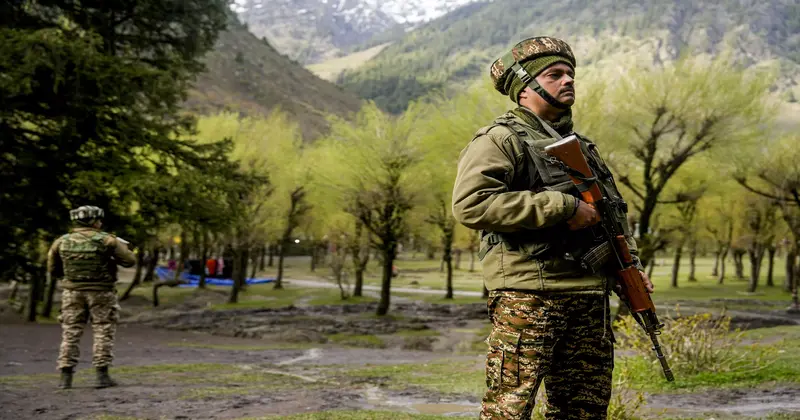
Post the Pahalgam terror attack, the security apparatus has been highly upgraded in Kashmir, especially for the safety of the tourists. A vast vigilance system is in place. Across the tourist destinations, a special security system has been deployed and a QR code based verification system has been introduced for the service providers in the tourist spots. Vendors, horse riders and others from the hospitality industry have to undergo an intense security scrutiny prior to establishing the business.
Officials said that people who aspire to establish business in the tourist destinations of Kashmir have to undergo police verification upon which a unique QR code system will be generated containing their personal and professional data including Aadhaar number, business number, police verification status etc. Tourists can scan the QR code and assess the authenticity of their service providers. The government is thus striving to enhance the morale and confidence of the visitors and revive the tourism industry of Kashmir, which is the lifeline of the Union territory’s economy.
Post the Pahalgam terror attack, India has embarked on a relentless journey to dismantle terror roots in the country and fortify national security. This effort is beyond conventional military action and is comprehensive in approach. From keeping Indus Treaty in abeyance to propelling PRAHAAR, New Delhi is articulating every tool to accelerate national security against the terror risks posed by Pakistan, where terrorism is a state-sponsored policy and a deed to thrive economy, political ambitions and hegemonic geopolitical goals. If analysed Pakistan uprooting terrorism is vague, a policy it has embraced since its formation. But what is unambiguous is India, striving hard to protect the country and its people.