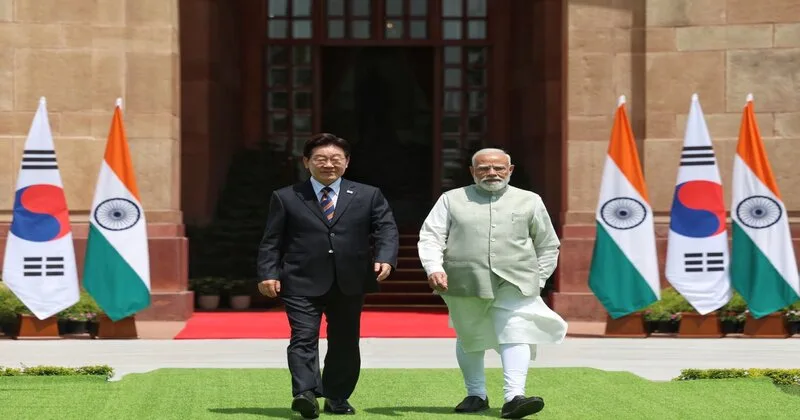
The President of South Korea Lee Jae-myung is on a historic visit to India accompanied by the largest ever business delegation to fortify strong strategic partnership with India. Two largest and emerging economies of Asia and the Indo-Pacific aims to seal solid relations for bilateral benifit. The visit by the South Korean leadership is deemed as beyond a routine diplomatic visit and it is an endeavour to articulate a solid strategic pathway with a credible player such as India for bilateral prosperity and to successfully navigate the gridlocks posed by the unpredictable geopolitical upheavals of the decade. During the bilateral meeting between Prime Minister Narendra Modi and the President of South Korea Lee Jae-myung, both countries etched a series of Memorandum of Understanding(MoUs) with multidimensional and comprehensive aspirations.
This includes trade, technology, industrial cooperation, defence, digital domain, climate action, cultural partnership, strengthening maritime prowess etc. These multivectoral deals reflect the fact that how New Delhi and Seoul aim to consolidate maritime security, economic security and national security at large in the backdrop of escalating ambiguous geopolitical trajectory. It also illustrates how India and South Korea consider each other as credible and trustworthy partners to fortify national priorities and collective security across the Indo-Pacific which is emerging as increasingly contentious.
Addressing the joint press meet with President Lee Jae Myung of the Republic of Korea.@Jaemyung_Lee https://t.co/NpU97z4dzB
— Narendra Modi (@narendramodi) April 20, 2026
Cooperation on maritime security & adopting Korean expertise to develop Indian ports
During the bilateral meeting, India and South Korea inked an MoU on maritime and port cooperation. The agreement intends to adopt advanced Korean expertise in the development of Indian ports. This involves port logistics and embracing green maritime technologies to ensure a sustainable and healthier port system. The cooperation also includes exchange of knowledge with respect to port engineering, construction, smart port development and operations. The port and maritime cooperation between India and South Korea also adds leverage to the Make-in-India vision of the PM Modi government. MoU was also inked to enhance interoperability and ensure collective security across the Indo-Pacific.
Further PM Modi and his South Korean counterpart also agreed to foster the maritime heritage of both the nations. An MoU was sealed to build the National Maritime Heritage Complex in Lothal. The museum will be designed and upgraded with advanced Korean expertise. It not just helps to preserve India’s rich maritime heritage but also cherishes and strengthens the ancient maritime link shared between India and South Korea. This also helps to promote tourism between both the countries.
Industrial cooperation to power MSMEs & propel strong supply chain
The MoU forged between New Delhi and Seoul entails greater cooperation in trade, investment and larger industrial development. Accordingly, both countries agreed to work on eradicating the barriers that are acting as a roadblock to propel greater investment opportunities and market access. Both nations also agreed to strengthen collaboration in critical minerals, semiconductors, electronic batteries etc.
India and South Korea also acknowledged to fortify cooperation in strengthening the supply chain with respect to steel and other vital commodities. MoUs were sealed to foster greater partnership between the MSMEs of India and South Korea, which will facilitate promotion of startups and other innovation measures. Heightened bilateral investment in the MSME sector was also accepted.
Our talks today covered ways to deepen cooperation in various sectors ranging from chips to ships, from talent to technology, from entertainment to energy. We have taken numerous important decisions to take bilateral trade to fifty billion dollars by 2030. pic.twitter.com/a6Xht02GaO
— Narendra Modi (@narendramodi) April 20, 2026
Science and Technology cooperation: A key pillar
The key highlight of the bilateral meeting was the vast stretch of cooperation agreed in the domain of science and technology. This includes consolidating cooperation in biotechnology, quantum technology, Artificial Intelligence, cyber security, e-governance and semiconductors. Both nations agreed for joint research, innovation, knowledge sharing etc. India’s vast pool of skilled manpower, visions such as Make-in-India coupled with South Korea’s technological superiority acts as a perfect blend.
We had detailed discussions on expanding our cooperation in AI, semiconductors, steel and ports. We also spoke about adding momentum to cultural and people-to-people linkages. pic.twitter.com/q9P4atEFyF
— Narendra Modi (@narendramodi) April 20, 2026
Cooperation on climate action and ambition for greener planet
Another key highlight of the India-South Korea bilateral summit was the ambitious pathway carved towards climate action and building a greener, healthier earth accompanied with sustainable development methods. In this direction, both countries agreed to strengthen cooperation in pollution control and biodiversity preservation. They agreed for joint projects, information and expertise exchange and training. They agreed to upgrade environmental governance and disaster management techniques.
In the path of strengthening the steel supply chain, both countries agreed to promote sustainable and low-carbon steel production. They also urged to cooperate to fulfill the goals of the UNFCCC Paris Climate Agreement which includes collaboration on enhancing carbon credits and supporting low carbon technology. This cooperation helps to achieve the 2070 net-zero goal of India. Bilateral dialogues will be organised on climate change concepts and maritime cooperation.
Both countries agreed for enhanced collaboration for arctic and polar research which is the need of the hour as the regions are emerging as contentious zones amidst their vast resource potential. India & South Korea also agreed to foster sustainable fisheries practices, exploring offshore renewables
Agreement to upgrade CEPA
India and South Korea had inked a Comprehensive Economic Partnership Agreement(CEPA) in 2009. However, it had reached a stalemate and was not proactive. Thus, during the latest meeting both leaders agreed to revive and upgrade the CEPA to suit current needs. Accordingly, the negotiations will focus on strengthening the cross-border value chain and escalating bilateral trade in both the merchandise and service sector. This will also help to create huge employment opportunities in both the nations.
Smoother cross-border payment system
India and South Korea also agreed to facilitate smooth, swift and hassle free cross border financial transactions. Accordingly, a MoU was signed between National Payment Corporation of India(NPCI) and its South Korean counterpart KFTC. This integrated payment system aids Indian students, tourists, professionals and the diaspora. This also strengthens the Digital Public Infrastructure(DPI) model of India, across the globe. This aids financial regulation and eradicates cross border financial irregularities and malpractices.
These series of MoUs signed between New Delhi and Seoul thus reflect the strategic depth shared between India and South Korea in the geopolitical calculus to fulfill national priorities and accelerate collective security across the Indo-Pacific.