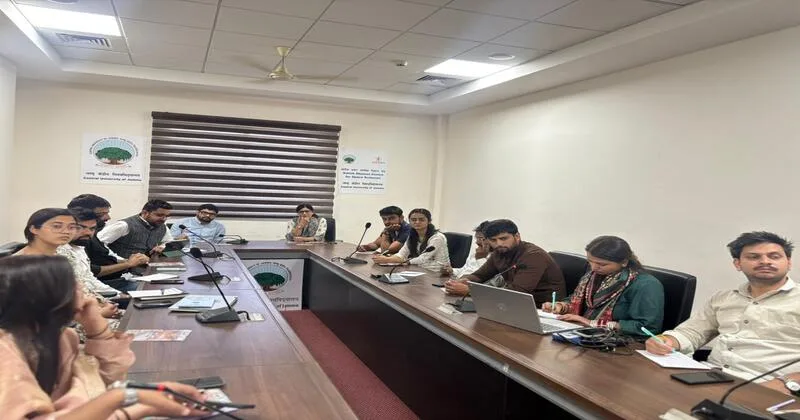
The inaugural ‘Sindhu Samvad’—a groundbreaking flagship conversation centered on intellectual discourse and policy—was successfully conducted at the Central University of Jammu (CUJ). This event was organized by the J&K-based Paramrshniti Foundation with Central University of Jammu acting as the host institution alongside Sindhu Central University. Drawing inspiration from the civilizational, strategic, and ecological significance of the Sindhu (Indus) river system, Sindhu Samvad aims to foster a structured, interdisciplinary dialogue that spans history, policy, and geopolitics, as part of a nationwide project. The program commenced with an engaging session led by Prof. Ritu Bakshi, Dean of Students’ Welfare at CUJ, who praised the Paramrshniti Foundation for launching this initiative and characterized ‘Sindhu Samvad’ as a historic stride forward. Dr Shweta Yadav, emphasized the ecological dimensions of the Sindhu river system and underscored the importance of collaboration with Sindhu Central University.
Dr Ajay Singh delved into the civilizational significance of the Sindhu River, emphasizing its historical and cultural importance as a vital lifeline of the ancient Sapt Sindhu civilization. This civilization, known for its advanced urban planning, trade networks, and rich cultural heritage, flourished along the banks of the Sindhu River and its tributaries. During his discussion, Dr. Singh highlighted how the Sindhu River served not only as a source of sustenance but also as a medium that facilitated trade and cultural exchanges among various communities in the region. He elaborated on the river’s role in shaping social structures, promoting agricultural practices, and fostering artistic expressions that are still evident in contemporary Indian culture. Furthermore, Dr. Singh engaged in insightful interactions with scholars from various fields.
They discussed the archaeological findings along the river, which provide significant insights into the life and times of the Sapt Sindhu civilization. This collaborative exchange of ideas illuminated how the river has been a witness to the evolution of human societies and has significantly influenced the cultural landscape of the Indian subcontinent..The dialogue is pioneered with the blessings of the Honourable Vice-Chancellor, Professor Sanjeev Jain. He remarked on the Central University of Jammu’s ongoing commitment to promoting knowledge, research, and cultural dialogue, stating: “The Central University of Jammu has remained committed to promoting knowledge, research, and cultural dialogue. We must carry forward the continuity of Indian knowledge and culture, much like the flowing stream of the Indus.” First Session Was moderated by Siddharth Mahajan & Shubham Raina.
Dr Tilak Raj Sharma underscored the dual strategic and ecological significance of the Indus River system’s tributaries, particularly in the context of Jammu and Kashmir. He emphasised that these watercourses are not only vital for sustaining regional biodiversity but also for ensuring water security for local communities. The tributaries contribute significantly to the livelihoods of the inhabitants, supporting domestic needs.The ongoing dialogue is especially pertinent as it will address the culture, climate, and civilizational significance of the Indus River, particularly in light of the Indus Waters Treaty (IWT), which remains in abeyance following the terrorist attack in Pahalgam last year.