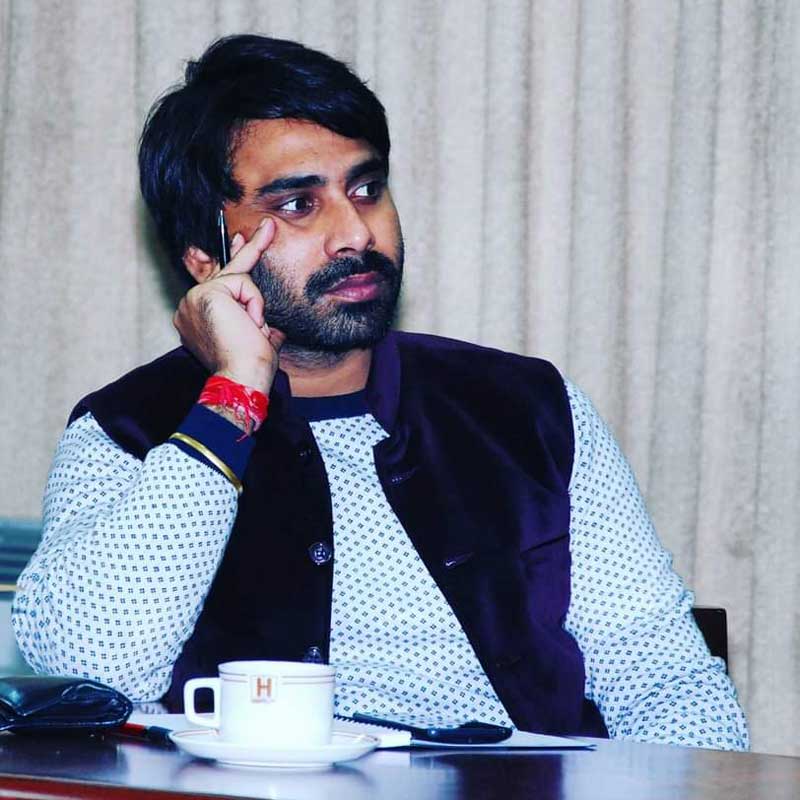

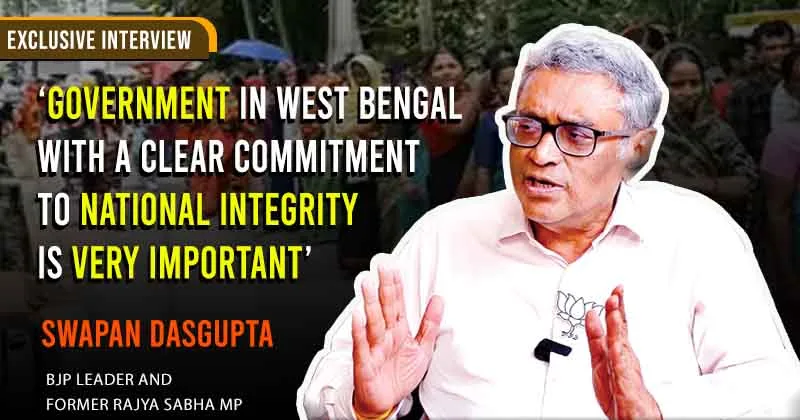
As West Bengal heads into a crucial Assembly election, political discourse in the State is increasingly dominated by debates around voter lists, identity politics, infiltration, and governance. In this detailed conversation with Organiser Sr Assistant Editor Nishant Kumar Azad, BJP leader and former Rajya Sabha MP Swapan Dasgupta, who is contesting from the Rashbehari constituency, speaks at length on the controversies surrounding deletion of voters names politics of fear, syndicate raj and the larger question of whether Bengal is ready for a change. Excerpts:
TMC claims that names of Muslim voters have been largerly deleted. But reports suggest that more than 60 per cent of the names deleted from voter lists after SIR are Hindus. How do you see this?
I will give you the answer based on my own experiences in the Rashbehari constituency, where there were a sizable number, about 45,000 to 50,000, names which were deleted. It is quite clear that most of these names were people who have died. A very large number were registered both in West Bengal as well as either Bihar or Uttar Pradesh, so they have been told to choose one, and most of them have chosen Bihar or Uttar Pradesh. The third category is people who have moved away from the constituency. So these three categories account for most of the deletions.
In all my visits to various places, I could not have counted more than five people who said their names were left out and that they deserved to be included.
Mamata Banerjee has used this SIR issue to do two things. One, she wanted the 2024 lists to be intact because there were so many non-voters, people who were not genuine voters, who used to end up voting in the later hours of polling.
That advantage which the electoral rolls gave them has been taken away. That is why she is raising this issue. In the process, she is also trying to create a feeling that Bengali asmita has been affected. But actually, a big number of deletions have been from the Muslim community, some of whom have not been able to produce credible documents. I think Mamata Banerjee has made a big political mistake in choosing the SIR as her main campaign plank rather than talking about anything else.
What are the key issues you are raising in your constituency – Rashbehari?
This is not only an urban seat, it is also a seat with probably the highest per capita income in West Bengal. So there are a large number of people who are reasonably prosperous. My challenge is to make them come out and vote. The larger issues of West Bengal are playing out here. But there are also local issues.
“If on one side of the fence, state government says, ‘come and replenish our vote bank,’ then you’re bound to get infiltration”
One of the most important is the Kalighat temple. It falls under this constituency. It is one of the most important Shakti Peethas and draws about 60,000 people daily. Given its importance, there has been no development in that area. There are no facilities for pilgrims. Because of this, the local economy, which depends on the temple, has suffered.
Second is the syndicate raj. Real estate in particular has been taken over by mafia elements. Kalighat and nearby areas are under their control. There have been incidents of violence even near major institutions. This is a serious concern.
Demographic change and infiltration have been core issues raised by BJP for many years. Since BJP has highlighted infiltration in its Bengal manifesto, is this just an election issue, or does the party have a concrete plan to deal with it?
Yes, the management of the borders belongs to the Border Security Force and the central forces. But the reality is that the border between West Bengal and Bangladesh is not a natural border. One side of a field is Bangladesh, the other side of the field is India. One pond is India, the other side is Bangladesh, it’s like that. These are artificial borders. So it is very difficult to police it.
And if you have an administration on this side which is not cooperative, then you will find it very difficult. So this is the big problem. If you have one side of the fence where people are willing to say, “you come and replenish our vote bank,” then you’re bound to get infiltration.
So regardless of how much the central forces are there, unless that political management is also there along with border management, it will be very difficult.
And that’s one of the reasons why I think having a Government in West Bengal which has a clear commitment to protecting the national integrity of the people of India – is very important.
In recent years, especially after 2019 and 2021, politics in West Bengal has often revolved around the outsider versus insider debate. How do you analyse this?
West Bengal, and particularly the area around Kolkata, has always been a home for people from all over India who have come here in search of opportunities.
This outsider narrative was brought in by Mamata Banerjee around 2021. That was the first time it was used in this way, because she suddenly felt that BJP had emerged as a threat.
So what is the best way of hitting out at BJP? To build them as outsiders – bahari. They say “ye bahari log hain” and they are playing that game.
There has always been a little bit of an “anti-Centre” sentiment in Bengal politics—this idea that we go our own way. That exists everywhere and will continue.
What has happened now is that Mamata Banerjee wants to fight with the Centre on everything, whether it is the Election Commission, ED, or any central agency. That is the situation she has created.
Several threatening videos have gone viral, where TMC leaders are seen intimidating voters. Given Bengal’s history of political violence, especially after the 2021 polls, there is a lot of fear among voters. How is BJP planning to deal with this?
There is a lot of fear in voters’ minds. At present, we are basically telling people to overcome fear.
But one thing is to say something, to give them confidence, but what is very necessary is that the Election Commission has to create conditions whereby people will get a degree of confidence. As I keep talking about, this election has to become a normal election.
If that idea seeps in, then I think a lot of things will happen. Or as the elections go by, as the campaign mounts, if people start talking openly, then also you will see the atmosphere changing.
Finally, do you think Bengal is ready for a change?
For 50 years, Bengal has gone from being on top to going to the bottom. I think Bengal deserves much better.
Now, whether that change happens or not – we will see when the results come.