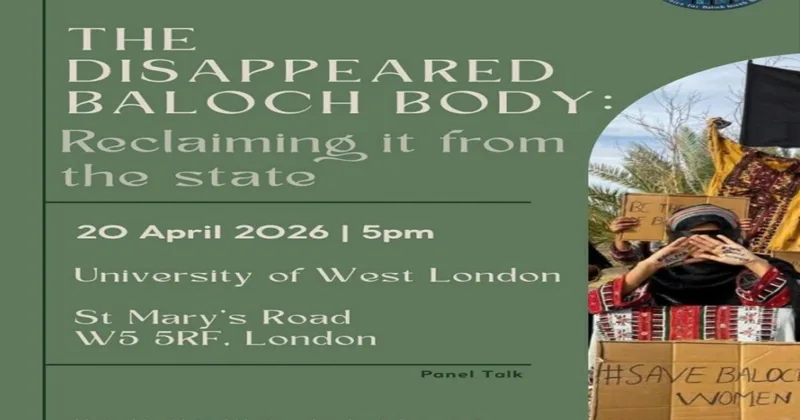
A major conference focusing on the issue of enforced disappearances in Balochistan is set to take place at the University of West London on April 20 (Monday). The aim of the conference is to bring international attention to a long-standing human rights concern. The two-hour conference is scheduled to start at 5 PM (local time).
The International Voice for Baloch Missing Persons (IVBMP) is organising the event in collaboration with the United Nations Academic Impact. It aims to raise global awareness about the growing number of enforced disappearances in the region and foster dialogue among key stakeholders. Incidentally, the phrase “enforced disappearances’’ is unique to Balochistan where it is an everyday affair.
Human rights experts, academics, students and activists from diverse backgrounds are expected to attend. Speakers will present documented cases of enforced disappearances, shedding light on the legal complexities and humanitarian consequences associated with the issue, according to reports of balochwarna.com.
Organisers say the conference will also highlight the challenges faced by families of the disappeared, many of whom continue to seek justice and accountability. By sharing firsthand testimonies, the event seeks to humanise the crisis and underscore its urgency. It is very difficult for the family members what to expect as some people may remain in custody of Pakistani security forces to be released far off from they may have been “forcibly disappeared’’.
Beyond raising awareness, the conference aims to encourage meaningful engagement from the international community. Academic institutions and human rights organisations will discuss/explore potential pathways toward accountability and long-term resolution, if there is any.
Participants will have the opportunity to engage directly with some affected individuals and experts. This will contribute to a broader conversation on how global cooperation can help address one of the most pressing human rights issues facing the region today.
Meanwhile, Nasrullah Baloch, Chairman of the Voice of Baloch Missing Persons (VBMP), has expressed deep concern over the second enforced disappearance of Jan Muhammad Kurd, describing it as a grave violation of human rights and the Constitution of Pakistan. He has demanded the immediate and safe recovery of Jan Muhammad Kurd.
According to family sources, Jan Muhammad Kurd, son of Abdul Rahim, was forcibly taken from his home in the Killi Lur Karez area of Quetta by security forces on the night of April 13, 2026. He was transferred to an unknown location, and since then, no information has been provided regarding his health or the reasons for his detention.
The family is enduring severe psychological distress and fear, especially given that Jan Muhammad Kurd had previously faced enforced disappearance for nine years before his recent re-arrest. Such extraordinary stories of remaining in illegal custody of Pakistani forces for prolonged periods are real and distressing.
The VBMP has formally appealed to the Chief Justice of the Balochistan High Court to take immediate notice of the matter and ensure that Jan Muhammad Kurd is safely returned to his family without delay. It needs to be stressed here that more often than not, the courts remain a mute spectator to what all illegalities are being committed by the Pakistani security forces in Balochistan.
To mobilise Baloch diaspora, the Free Balochistan Movement (FBM) held a public awareness campaign in Hanover (Germany) a fortnight ago on March 28. This was to mark the 78th anniversary of the illegal occupation of the eastern part of Balochistan by Pakistan in 1948. March 27 is an annual event which the Baloch nation observes as “Black Day” across Balochistan and abroad.
The event aimed to inform the German public about the Baloch people’s historical and ongoing struggles. Activists highlighted March 27, 1948, when the sovereign state of Balochistan was forcibly annexed. They emphased that the day remains a symbol of national mourning and resistance against decades of systemic marginalisation and human rights abuses in Balochistan.
The members of FBM handed out hundreds of flyers in German and English detailing the history of the 1948 occupation, ongoing human rights violations and the continued fight for Balochistan’s sovereignty. Activists also engaged directly with residents and visitors to raise awareness about enforced disappearances and the exploitation of the region’s natural resources.
Banners and posters urged international bodies, including the European Union and the United Nations, to acknowledge the plight of the Baloch people.
“Our goal is to educate and inform the international community and common citizens of European nations that Balochistan was once an independent state. By marking 27 March as ‘Black Day’, we reaffirm our commitment to regaining our national identity and freedom from colonial powers.”
The Free Balochistan Movement continues to call on the international community to hold the occupying powers accountable and support the Baloch people’s ongoing struggle for independence.