Nuclear Leap: Bharat’s PFBR Signals New Era of Energy Independence
June 9, 2026
  • Read Ecopy
  • Circulation
  • Advertise
  • Careers
  • About Us
  • Contact Us
Android AppiPhone AppArattai
Organiser
  • ‌
  • Bharat
    • Assam
    • Bihar
    • Chhattisgarh
    • Jharkhand
    • Maharashtra
    • View All States
  • World
    • Asia
    • Europe
    • North America
    • South America
    • Africa
    • Australia
  • Editorial
  • International
  • Opinion
  • RSS @ 100
  • More
    • Op Sindoor
    • Analysis
    • Sports
    • Defence
    • Politics
    • Business
    • Economy
    • Culture
    • Special Report
    • Sci & Tech
    • Entertainment
    • G20
    • Azadi Ka Amrit Mahotsav
    • Vocal4Local
    • Web Stories
    • Education
    • Employment
    • Books
    • Interviews
    • Travel
    • Law
    • Health
    • Obituary
  • Subscribe
    • Subscribe Print Edition
    • Subscribe Ecopy
    • Read Ecopy
  • ‌
  • Bharat
    • Assam
    • Bihar
    • Chhattisgarh
    • Jharkhand
    • Maharashtra
    • View All States
  • World
    • Asia
    • Europe
    • North America
    • South America
    • Africa
    • Australia
  • Editorial
  • International
  • Opinion
  • RSS @ 100
  • More
    • Op Sindoor
    • Analysis
    • Sports
    • Defence
    • Politics
    • Business
    • Economy
    • Culture
    • Special Report
    • Sci & Tech
    • Entertainment
    • G20
    • Azadi Ka Amrit Mahotsav
    • Vocal4Local
    • Web Stories
    • Education
    • Employment
    • Books
    • Interviews
    • Travel
    • Law
    • Health
    • Obituary
  • Subscribe
    • Subscribe Print Edition
    • Subscribe Ecopy
    • Read Ecopy
Organiser
  • Home
  • Bharat
  • World
  • Operation Sindoor
  • Editorial
  • Analysis
  • Opinion
  • Culture
  • Defence
  • International Edition
  • RSS @ 100
  • Magazine
  • Read Ecopy
Home Bharat

Nuclear Leap: Bharat’s PFBR Signals New Era of Energy Independence

Amid rising global geopolitical tensions involving Israel, United States, and Iran, the urgency of energy self-reliance has come into renewed focus for major economies like India. In a landmark achievement underscoring this strategic priority, India’s indigenously developed Prototype Fast Breeder Reactor (PFBR) at Kalpakkam attained its first criticality on April 6, marking a decisive leap in the nation’s nuclear energy programme

Dr Pankaj Jagannath JayswalDr Pankaj Jagannath Jayswal
Apr 12, 2026, 09:30 pm IST
in Bharat, World, Sci & Tech
Follow on Google News
Representative Image

Representative Image

FacebookTwitterWhatsAppTelegramEmail

The ongoing confrontation between Israel, America, and Iran has opened eyes wide, particularly for large nations such as Bharat and China. Self-sufficiency in fuel should be a key priority because substantial reliance on other countries might drag the country down in difficult times, such as war, which is why the Modi government has worked relentlessly since 2014 to develop in-house skills. Solar and wind energy, nuclear power, and so on. The 6th of April 2026 is particularly significant for Bharat’s energy program, because Bharat’s scientists showed their skills. The indigenously designed and built Prototype Fast Breeder Reactor (PFBR) at Kalpakkam in Tamil Nadu has reached its first criticality. This PFBR is a 500 MWe (MegaWatt electrical) reactor built by Bharatiya Nabhikiya Vidyut Nigam Limited (BHAVINI) at the Kalpakkam Nuclear Complex. Thorium is important to Bharatiya’s nuclear programme due to its unique position with large thorium and modest uranium resources. Bharat is the second nation after Russia to achieve this incredible feat. America, Japan, France, and Germany spent more than $50 billion but achieved nothing, but Bharat spent less than $900 million and is successful. Bharatiya scientists demonstrate scientific and technological capabilities in all fields.

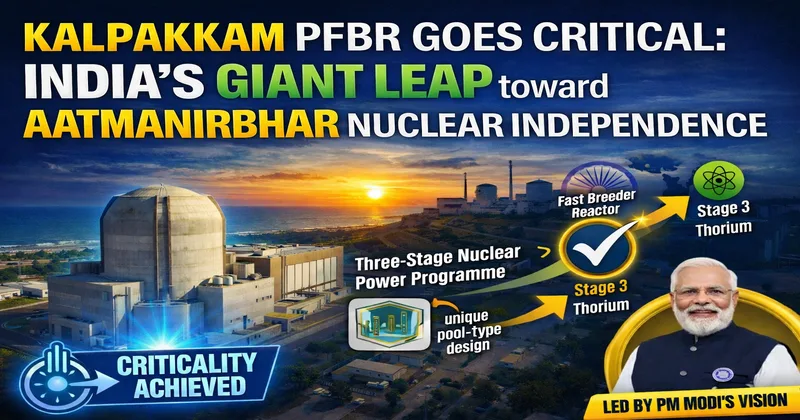
For a huge nation like Bharat, the long-term strategy for energy supply must be built on indigenous resources and require an optimal balance of energy sources. Aside from the environmental challenges associated with large-scale coal consumption, it is important to note that coal deposits are finite. Solar and other non-conventional renewable energy sources play a vital role and should be utilised to the greatest extent possible. However, multiple high-power base-load power plants are essential to ensure grid stability and meet the demands of industries and metropolitan areas. As a result, nuclear energy plays a significant role in terms of sustainability. In the context of the Bharatiya Nuclear Power Programme (INPP), thorium plays an important role due to its unusual resource profile: large thorium deposits but low uranium stocks. This not only increases the motivation for large-scale thorium use but also necessitates the implementation of thorium-based systems considerably earlier than other countries anticipate. The start of a controlled nuclear fission chain reaction at the Prototype Fast Breeder Reactor moves Bharat into the second stage of a three-stage nuclear program that eventually seeks to complete a closed fuel cycle using the country’s abundant thorium.

With this feat, Bharat has officially reached the second stage of its three-stage nuclear power program, which was first envisioned by Dr Homi Jehangir Bhabha, India’s nuclear programme architect. The milestone has significant worldwide implications. Once fully operational, India will be only the second country in the world, after Russia, to operate a commercial fast-breeder reactor.

“This unique capability significantly enhances the utilisation of nuclear fuel resources and enables the country to extract far greater energy from its limited uranium reserves while also preparing for large-scale use of thorium in the future,” BHAVINI stated. The fast breeder program “strengthens strategic capabilities in nuclear fuel cycle technologies, advanced materials, reactor physics, and large-scale engineering,” and the knowledge and infrastructure developed through the program “will support future reactor designs and next-generation nuclear technologies”.

This achievement is the result of decades of scientific research led by the Department of Atomic Energy. It also represents a key milestone in Bharat’s clean energy journey, reaffirming the country’s commitment to dependable, low-carbon power. Furthermore, it pushes Bharat closer to its objective of reaching net zero emissions by 2070, as announced by Prime Minister Narendra Modi. The PFBR reflects decades of indigenous research, design, and engineering. The Indira Gandhi Centre for Atomic Research (IGCAR), which is part of the Department of Atomic Energy, created the technology.

Advantages of Thorium and the associated three-stage method

Thorium has some physical and chemical advantages over uranium, which may justify its usage as a ‘future nuclear fuel’. Thorium oxide has a greater melting point (3300ᴼC) than uranium oxide (2865ᴼC). It also has better thermal conductivity, a lower rate of fission gas release, and good radiation resistance.  Thorium is much more prevalent in the Earth’s crust than uranium, hence the use of thorium in power reactors has been discussed since the beginning of nuclear energy in the 1950s.

Fuel and Design: Unlike conventional thermal reactors, the PFBR uses Uranium-Plutonium Mixed Oxide (MOX) fuel. The fissile material used is recovered from the reprocessing of spent fuel from Pressurised Heavy Water Reactors, closing the loop on Stage 1.

Breeds More Than It Burns: The core of the PFBR is surrounded by a blanket of Uranium-238. Fast neutrons convert this fertile material into fissile Plutonium-239, enabling the reactor to produce more fuel than it consumes.

Bridge to Stage 3: The reactor is designed to eventually use Thorium-232 in the blanket. Through transmutation, Thorium-232 will be converted into Uranium-233, the fuel that will power India’s third stage of nuclear energy based on thorium.

Closed Fuel Cycle: The spent fuel generated by the PFBR will be reprocessed and recycled back into the reactor. This closes the second-stage fuel cycle and paves the way for large-scale use of India’s abundant thorium reserves in Stage 3.

Bharat’s nuclear capability

Bharat presently generates around 7,900 MW of nuclear energy from 24 operational nuclear power plants and is contemplating a significant expansion of its nuclear capacity. According to the government, 17 nuclear power reactors with a combined capacity of 13,100 MW are either under construction (7) or in pre-project activities (10). As part of its Viksit Bharat development strategy, it aims to achieve a nuclear energy capacity of approximately 100 GW by 2047.

The achievement of criticality at the Prototype Fast Breeder Reactor is more than just a technical milestone. It demonstrates the maturity of Bharat’s long-held nuclear goal as well as the strength of its domestic capabilities. From limited uranium resources to a future powered by thorium, Bharat’s three-stage project is progressively progressing from design to delivery. The success of the Kalpakkam Nuclear Complex demonstrates confidence in advanced reactor technologies and highlights the importance of institutions like the Department of Atomic Energy in promoting this transformation. As capacity grows and new technologies emerge, nuclear energy is expected to play an increasingly important role in Bharat’s energy mix. As a result, this moment is both an accomplishment and a watershed moment, cementing the country’s road to energy security, technological self-reliance, and its net zero pledge by 2070.


Topics: PM Narendra ModiBHAVINIBharatiya Nabhikiya Vidyut Nigam LimitedPrototype Fast Breeder Reactor
ShareTweetSendShareSend
✮ Subscribe Organiser YouTube Channel. ✮
✮ Join Organiser's WhatsApp channel for Nationalist views beyond the news. ✮
Previous News

West Bengal Assembly Polls: Democracy or Mamatacracy

Next News

EAM Jaishankar thanks UAE for ensuring diaspora welfare during conflict; Reiterate to strengthen strategic partnership

Related News

Prime Minister Narendra Modi during an overseas visit, greeting members of the Indian diplomatic and community delegation upon arrival. (File Photo)

Trade, Defence and Diaspora: PM Modi eyes Indo-Pacific reset with three-nation tour

Twelve Years of Resolve: How Modi Rebuilt India's Security from the Ground Up

Twelve Years of Resolve: How Modi Rebuilt India’s Security from the Ground Up

Rahul, Kharge and Jairam vs. India's Great Nicobar Vision (This is an AI generated image)

Great Nicobar Project: Why Congress is opposing Modi government’s strategic mega plan

Fire-fighting officials at the site of the restaurant in Delhi Malviya Nagar

Fire at Delhi restaurant in Malviya Nagar claims 21 lives, 40 rescued; PM Modi expresses grief, announces relief

Telangana Foundation Day

Telangana statehood day: Remembering historic movement & celebrating new era; President Murmu, PM Modi extend greetings

Uttar Pradesh CM Yogi Adityanath warns those of dire consequences if they disrespect gau mata

Uttar Pradesh CM Yogi Adityanath says “Gaumata is Rashtramata”, warns against cow slaughter posts

Load More

Latest News

Union Defence Minister Rajnath Singh

Uttar Pradesh: Defence land goes green; Rajnath Singh clears 250 MW solar project in Sitapur

Afghanistan Foreign Minister Amir Khan Muttaqi and External Affairs Minister Dr. S. Jaishankar(File Photo)

India extends gratis long-term business visas to Afghan traders; Slams Pakistan for “trade & transit terrorism”

How Modi's Zero-tolerance doctrine reshaped India's anti-terror policy (This is an AI generated image)

Twelve Years of Modi Government and the rise of India’s zero-tolerance doctrine against terrorism

Press Conference organised by Janjati Suraksha Manch at the Press Club, Ranchi, National Convener Dr Raj Kishore Hansda

Success of Janjati Sanskritik Samagam symbolises unity and cultural pride: Dr Raj Kishore Hansda

India delivered a historic performance at the inaugural World Yogasana Championships, finishing at the top of the medal tally with an astounding 114 medals, including 102 golds

World Yogasana Championships: India scripts historic triumph with 114 medals and 102 gold medal wins

Protest erupts in POJK

Why is PoJK protesting? JAAC ban, anti-Pakistan slogans and public anger against Pakistan Army — Read here

India slams Pakistan over its Fatna al Hindustan narrative

India tears Pakistan at UN over ‘Fitna al Hindustan’ narrative; Exposes Islamabad as an ‘organised factory of hate’

India's Permanent Representative to United Nations Ambassador Harish Parvathaneni

India & Afghanistan are “civilisational states”: Indian Envoy at UN reaffirms health, education & humanitarian aid

Bulldozer action on houses linked to drug traffickers in Rourkela's Meenapada area

Odisha: Major crackdown on drug traffickers in Rourkela; Bulldozers demolish houses of Farida, Imran & other accused

Prime Minister Narendra Modi with Agri Minister Shivraj Singh Chouhan

India’s Agricultural Revolution: Rising output, record procurement and expanding farmer support since 2014

Load More
  • Privacy
  • Terms
  • Cookie Policy
  • Refund and Cancellation
  • Delivery and Shipping

© Bharat Prakashan (Delhi) Limited.
Tech-enabled by Ananthapuri Technologies

  • Home
  • Search Organiser
  • Bharat
    • Assam
    • Bihar
    • Chhattisgarh
    • Jharkhand
    • Maharashtra
    • View All States
  • World
    • Asia
    • Africa
    • North America
    • South America
    • Europe
    • Australia
  • Editorial
  • Operation Sindoor
  • Opinion
  • Analysis
  • Defence
  • Culture
  • Sports
  • Business
  • RSS @ 100
  • Entertainment
  • More ..
    • Sci & Tech
    • Vocal4Local
    • Special Report
    • Education
    • Employment
    • Books
    • Interviews
    • Travel
    • Health
    • Politics
    • Law
    • Economy
    • Obituary
  • Subscribe Magazine
  • Read Ecopy
  • Advertise
  • Circulation
  • Careers
  • About Us
  • Contact Us
  • Policies & Terms
    • Privacy Policy
    • Cookie Policy
    • Refund and Cancellation
    • Terms of Use

© Bharat Prakashan (Delhi) Limited.
Tech-enabled by Ananthapuri Technologies