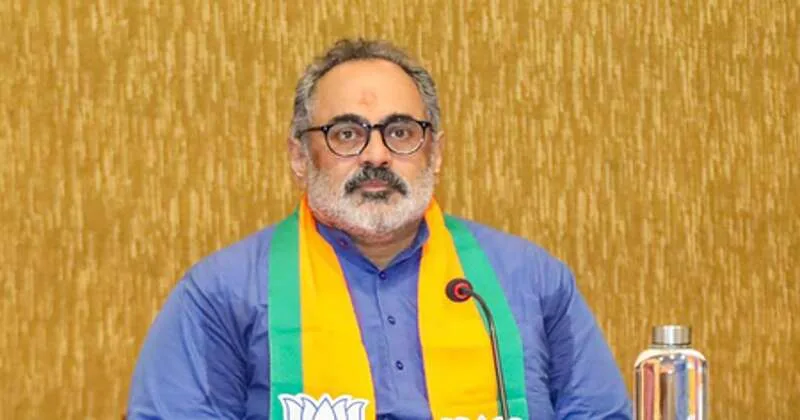
Thiruvananthapuram: BJP state president Rajeev Chandrasekhar alleged that there exists a political understanding between the Indian National Congress and the Indian Union Muslim League, claiming that if a Congress-led government comes to power, the Muslim League is seeking the post of Deputy Chief Minister along with six ministerial positions. He further remarked that the Muslim League acts as a “remote control” guiding the Congress. Chandrasekhar also alleged that there are separate arrangements between the Congress and Jamaat-e-Islami, as well as among the Muslim League, Jamaat-e-Islami and the PFI-linked Social Democratic Party of India (SDPI). He demanded that these parties come forward and disclose the nature of such alleged agreements, speaking at a press conference.
Allegations of political alliances and control
He also stated that the Communist Party of India (Marxist) and the Congress are aligned across 27 states and eight Union Territories under the banner of the INDI Alliance. According to him, the Congress’s accusation that there is a tacit understanding between the CPI(M) and the Bharatiya Janata Party (BJP) is baseless. He asserted that it is the BJP that strongly opposes the CPI(M) in Keralam, adding that the BJP has previously secured victories by defeating the CPI(M) in local bodies, including corporations.
Chandrasekhar criticised the Congress party’s current leadership, stating that a party once led by stalwarts such as Sardar Vallabhbhai Patel and Lal Bahadur Shastri has lost its direction. Referring to Rahul Gandhi, he said that the party today lacks accountability and is not committed to a clear vision of national development. He accused the Congress of resorting to falsehoods for political gain and claimed that while the BJP is conducting a positive campaign centred on building a developed Keralam, the Congress is issuing “false guarantees” in the name of Indira Gandhi.
Drawing attention to the Congress government in Telangana, Chandrasekhar said that similar promises made there have largely remained unfulfilled. He stated that 7.5 million farmers were promised Rs 15,000 per acre, but alleged that no one has received the amount so far. Likewise, he pointed out that a promise of a Rs 500 bonus per quintal for paddy has not been implemented. He also noted that the Congress had announced a waiver of loans for 4 million farmers but has since backed away from the commitment, citing financial constraints.
He further claimed that Telangana’s total debt has now crossed Rs 10 lakh crore, describing the situation as evidence of what he termed the Congress’s “politics of false promises.” According to him, the Chief Minister of such a state is now campaigning in Keralam while spreading misinformation.
Chandrasekhar also accused the Congress of attempting to create fear among certain communities. Referring to the Foreign Contribution Regulation Act (FCRA), he said Union leaders, including Amit Shah, have made it clear that the law will not harm any community. He added that Kiren Rijiju had personally interacted with community leaders and assured them that any concerns would be addressed before implementing provisions of the law. Despite this, he alleged that the Congress is spreading misinformation by portraying the FCRA as anti-Christian. He urged voters not to fall prey to what he described as Congress’s divisive and misleading politics and called for its rejection in the elections.
Campaign closes with high-voltage finale
The month-long election campaign formally concluded on Tuesday, with Wednesday designated as a day of silent campaigning. As polling day approaches on Thursday, voters across constituencies are set to determine their next representatives once the sun rises.
The campaign saw all three major fronts actively presenting their narratives. The Left Democratic Front (LDF) focused on highlighting the development achievements of the state government, while the United Democratic Front (UDF) emphasised the hardships faced by people under continued Left rule. Meanwhile, the National Democratic Alliance (NDA) showcased the accomplishments of the central government.
All three fronts ensured that their manifestos reached households across constituencies. From the outset, campaigns were designed to connect emotionally with voters. Party leaders and workers engaged in extensive door-to-door outreach, meeting people directly and addressing their concerns. Candidates also organised large-scale roadshows to mobilise public support. As the campaign entered its final phase, prominent state and national leaders joined the trail, intensifying the political atmosphere.
The final days of campaigning witnessed heightened activity, culminating in the traditional Kotti Kalasam (Final campaign procession). Candidates and leaders led roadshows from the morning, travelling through various centres within their respective mandals. These processions eventually converged at designated venues where the Kotti Kalasam was held. The event concluded with the ceremonial lowering of party flags, accompanied by music, dance and band performances, marking the end of an intense and closely contested election campaign.