Supreme Court Warns West Bengal Over Threat to SIR Officials
August 10, 2026
  • Read Ecopy
  • Circulation
  • Advertise
  • Careers
  • About Us
  • Contact Us
Android AppiPhone AppArattai
Organiser
  • ‌
  • Bharat
    • Assam
    • Bihar
    • Chhattisgarh
    • Jharkhand
    • Maharashtra
    • View All States
  • World
    • Asia
    • Europe
    • North America
    • South America
    • Africa
    • Australia
  • Editorial
  • International
  • Opinion
  • RSS @ 100
  • More
    • Op Sindoor
    • Analysis
    • Sports
    • Defence
    • Politics
    • Business
    • Economy
    • Culture
    • Special Report
    • Sci & Tech
    • Entertainment
    • G20
    • Azadi Ka Amrit Mahotsav
    • Vocal4Local
    • Web Stories
    • Education
    • Employment
    • Books
    • Interviews
    • Travel
    • Law
    • Health
    • Obituary
  • Subscribe
    • Subscribe Print Edition
    • Subscribe Ecopy
    • Read Ecopy
  • ‌
  • Bharat
    • Assam
    • Bihar
    • Chhattisgarh
    • Jharkhand
    • Maharashtra
    • View All States
  • World
    • Asia
    • Europe
    • North America
    • South America
    • Africa
    • Australia
  • Editorial
  • International
  • Opinion
  • RSS @ 100
  • More
    • Op Sindoor
    • Analysis
    • Sports
    • Defence
    • Politics
    • Business
    • Economy
    • Culture
    • Special Report
    • Sci & Tech
    • Entertainment
    • G20
    • Azadi Ka Amrit Mahotsav
    • Vocal4Local
    • Web Stories
    • Education
    • Employment
    • Books
    • Interviews
    • Travel
    • Law
    • Health
    • Obituary
  • Subscribe
    • Subscribe Print Edition
    • Subscribe Ecopy
    • Read Ecopy
Organiser
  • Home
  • Bharat
  • World
  • Operation Sindoor
  • Editorial
  • Analysis
  • Opinion
  • Culture
  • Defence
  • International Edition
  • RSS @ 100
  • Magazine
  • Read Ecopy
Home Politics

SC warns Bengal Govt over threat to SIR officials, signals intervention if law & order fails

Supreme Court warns West Bengal government of intervention if law and order fails after judicial officers were gheraoed in Malda during SIR process. NIA probe suggests possible pre-planned protests

Shashank Kumar DwivediShashank Kumar Dwivedi
Apr 7, 2026, 11:00 am IST
inPolitics, Bharat, Law, West Bengal
Follow on Google News
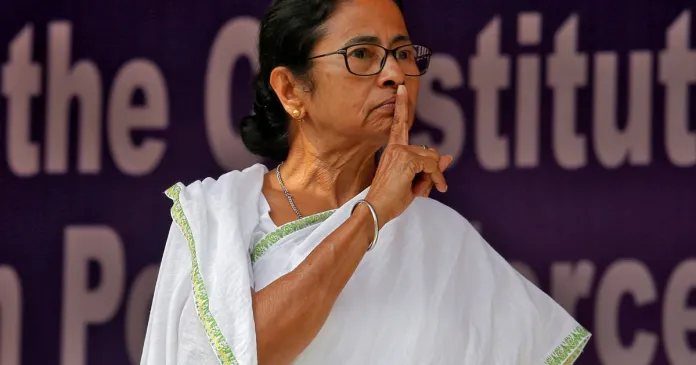
Chief Minister of Bengal, Mamata Banerjee

Chief Minister of Bengal, Mamata Banerjee

Facebook
Twitter
WhatsAppTelegramEmail

There was a sense of unease in the courtroom when the issue came up. The Supreme Court of India did not mince words on April 6, 2026, Monday, as it looked at what had unfolded in poll-bound West Bengal. The judges were clearly troubled, not just by the incident itself, but by what it seemed to reveal about the state of governance on the ground.

Chief Justice Surya Kant, who was presiding over the hearing on petitions challenging the Special Intensive Revision (SIR) of electoral rolls, made a remark that stood out for its directness and gravity. “If state machinery fails, then we will see what to do,” he said.

The statement, though brief, carried a clear warning. It noted that the court was not merely observing from a distance but was prepared to step in if the situation warranted intervention.

The immediate trigger for these strong observations was the incident that unfolded in Malda, which has since become a focal point in the ongoing political and legal discourse. What happened there was not a fleeting disruption or a minor protest. It was a prolonged and tense standoff that raised serious questions about administrative preparedness and the safety of officials entrusted with conducting election-related duties.

According to reports, seven judicial officers who were engaged in the SIR process found themselves surrounded by a group of protesters. What followed was a nearly nine-hour-long gherao. For those inside, it was an ordeal marked by uncertainty and vulnerability. These were not political figures or law enforcement personnel trained for confrontation. They were officials performing a constitutional duty, suddenly caught in a situation where their safety could not be guaranteed.

As the hours passed, the situation outside grew increasingly volatile. Roads in the district were blocked, disrupting normal life and movement. A police vehicle was vandalised, signalling a breakdown of restraint among sections of the crowd. Clashes between protesters and security forces further escalated tensions. The trigger for the unrest was reportedly anger over alleged discrepancies in voter rolls, an issue that often carries emotional and political weight, especially in the run-up to elections.

Also Read: Bengal and SIR: TMC’s onslaught on constitutional institution

However, what might have begun as localised anger soon took on a broader and more alarming dimension. The scale and intensity of the protests, combined with their timing, raised suspicions that this was not entirely spontaneous. For the Supreme Court, the implications were significant. If officials involved in a critical electoral exercise could be held hostage for hours, it raised fundamental concerns about the integrity and safety of the democratic process itself.

The entry of the National Investigation Agency into the matter added another layer of seriousness. The agency began a detailed probe, seeking to understand not just what happened, but how and why it unfolded the way it did. Preliminary inputs, as indicated by sources, suggest that investigators are exploring the possibility of pre-planning behind the protests. One of the key aspects under examination is the near-simultaneous emergence of demonstrations across different locations, something that often points to coordination rather than coincidence.

Investigators have reportedly questioned a wide range of individuals in an attempt to piece together the sequence of events. They are looking at communication patterns, local mobilisation, and the role of various actors who may have contributed to the escalation. At the same time, the probe is not limited to the actions of protesters alone. It is also examining the response, or the lack of it, from the local administration.

This aspect has drawn particular attention from the Supreme Court. There are indications that the administrative response to the gherao was delayed, allowing the situation to persist for several hours without effective intervention. In a scenario where officials were effectively trapped, such delays become difficult to justify. The court has already expressed its displeasure over this, making it clear that accountability will be a central issue going forward.

The questions being raised are straightforward but critical. Why did it take so long for authorities to act? Were there lapses in communication or coordination among different arms of the administration? Could the situation have been defused earlier with a more timely response? These are the issues that now lie at the heart of both the judicial scrutiny and the investigative process.

Adding to the complexity of the situation is the political dimension. West Bengal Chief Minister Mamata Banerjee has taken a clear position, distancing her government from the unfolding events. Speaking at a rally in Murshidabad, she argued that after the announcement of Assembly elections, the control over law and order had effectively shifted away from the state government.

In a statement that has sparked debate, she claimed that key officials, including the Chief Secretary and the Director General of Police, were no longer in communication with her. “Everything has been taken away from me,” she said, suggesting that the authority to manage the situation now lay elsewhere. She placed the responsibility squarely on the Election Commission of India, accusing it of assuming control over administrative and police machinery by deploying its own officers.

Her criticism of the Election Commission was sharp and unambiguous. She said she had never seen the institution function in this manner before and accused it of failing to ensure the safety of judicial officers involved in the SIR process. These remarks have added a layer of political confrontation to an already sensitive situation, with questions now being raised about the division of responsibilities during the election period.

The unfolding developments have, in many ways, brought multiple fault lines into focus. On one hand, there is the immediate concern of law and order, highlighted by the Malda incident. On the other, there is a broader institutional question about who is responsible for maintaining that order during elections. Overlaying both is the role of the judiciary, which has signalled its readiness to intervene if necessary.

For now, the situation remains fluid. The investigation by the National Investigation Agency is ongoing, and its findings are likely to shed more light on the nature and causes of the unrest. The Supreme Court, meanwhile, continues to monitor the developments closely, its earlier remarks serving as a clear indication that it will not hesitate to act if the circumstances demand it.

As West Bengal moves closer to elections, the stakes are only getting higher. What happened in Malda is no longer being seen as an isolated incident. It has become a test case, one that will likely influence how institutions respond to challenges in the coming days.

Topics: SIR electoral rollsjudicial officers gheraoMamata BanerjeeWest BengalSupreme CourtNIA ProbeMalda Violence
Share
Tweet
SendShareSend
✮ Subscribe Organiser YouTube Channel. ✮
✮ Join Organiser's WhatsApp channel for Nationalist views beyond the news. ✮
Previous News

Keralam Election 2026: “Muslim League remote-controls Congress, seeks Deputy CM & six ministries,” says Chandrasekhar

Next News

Keralam Polls 2026: Christian Association and Alliance for Social Action backs NDA, slams UDF, LDF appeasement politics

Related News

Two decades after Mamata Banerjee drove Tata out of Singur, Bengal is now seeking the industrial giant's return. (AI-generated Image)

From ‘Tata go back’ to ‘Tata come back’: Bengal begins undoing Mamata’s Singur disaster

Uttar Pradesh Cabinet has approved amendments to the Madrasa Education Act, ending the recognition of Kamil and Fazil degrees

Uttar Pradesh: Yogi government ends recognition of Kamil and Fazil degrees in line with Supreme Court ruling

Exiled Bangladeshi writer Taslima Nasrin speaks during a citizens felicitation programme titled 'Returning to a Free West Bengal After 19 Years'

‘One of the longest nights of my life’: Taslima Nasreen recalls forced exit from Kolkata after 2007 protests

Tamil Nadu: Supreme Court refuses to stay HC order on Thiruparankundram Deepam; TVK govt faces legal setback

Bengal CM Suvendu Adhikari assures exiled Bangladeshi author Taslima Nasrin of security

‘Come as many times as you want’: Bengal CM Suvendu Adhikari assures Taslima Nasreen of full security

Representative Image

India to set up 40 Intelligence Bureau units in Bangladesh border; Shield against infiltration & organised crimes

Load More

Latest News

A program organised under the aegis of the Vidwat Parishad of Shishu Shiksha Samiti Assam

Vande Mataram is not merely an emotional expression, but declaration of national consciousness: Avneesh Bhatnagar

Our aim is to ensure India ranks among top 10 medal-winning countries at 2036 Olympics: Dr Mansukh Mandaviya

President of the Indian Olympic Association President P. T. Usha holds the Commonwealth Games flag alongside Gujarat Deputy Chief Minister Harsh Sanghavi and Neeraj Chopra during the closing ceremony of the Commonwealth Games 2026 at the OVO Hydro in Glasgow

Commonwealth Games 2026: Over to Amdavad

Turkey’s President Recep Tayyip Erdogan, Saudi Crown Prince Mohammed bin Salman, and Pakistan Prime Minister Shehbaz Sharif

Islamic NATO or Sunni Bloc? Saudi-Pakistan-Turkey pact faces question over Islam and sectarian divide

MEA condemns defacement of the Indian Embassy premises in Slovenia

India condemns attack on Embassy in Slovenia; MEA invokes Vienna Convention, affirms diplomatic premises as inviolable

(Left) RSS Sarsanghchalak Dr Mohan Bhagwat (Right) RSS Sarkaryavah Dattatreya Hosabale

RSS Akhil Bharatiya Samanvay Baithak to be held in Visakhapatnam from August 19–21, 2026

US President Donald Trump seals executive order restricting birthright citizenship

Trump Restricts Birthright Citizenship: US constitution & SC rulings vs President’s protectionism amid fierce backlash

Kerala's Left-Liberals Manufactured 'Rape Call' Lie Against TG Mohandas: What He Actually Said About CJP NEET Protest?

Kerala’s Left-Liberals Manufactured ‘Rape Call’ Lie Against TG Mohandas: What He Actually Said About CJP NEET Protest

Two decades after Mamata Banerjee drove Tata out of Singur, Bengal is now seeking the industrial giant's return. (AI-generated Image)

From ‘Tata go back’ to ‘Tata come back’: Bengal begins undoing Mamata’s Singur disaster

T G Mohandas

Keralam’s Witch Hunt Against TG Mohandas? Weekend arrest, media drama & Congress’ political spectacle

Load More
  • Privacy
  • Terms
  • Cookie Policy
  • Refund and Cancellation
  • Delivery and Shipping

© Bharat Prakashan (Delhi) Limited.
Tech-enabled by Ananthapuri Technologies

  • Home
  • Search Organiser
  • Bharat
    • Assam
    • Bihar
    • Chhattisgarh
    • Jharkhand
    • Maharashtra
    • View All States
  • World
    • Asia
    • Africa
    • North America
    • South America
    • Europe
    • Australia
  • Editorial
  • Operation Sindoor
  • Opinion
  • Analysis
  • Defence
  • Culture
  • Sports
  • Business
  • RSS @ 100
  • Entertainment
  • More ..
    • Sci & Tech
    • Vocal4Local
    • Special Report
    • Education
    • Employment
    • Books
    • Interviews
    • Travel
    • Health
    • Politics
    • Law
    • Economy
    • Obituary
  • Subscribe Magazine
  • Read Ecopy
  • Advertise
  • Circulation
  • Careers
  • About Us
  • Contact Us
  • Policies & Terms
    • Privacy Policy
    • Cookie Policy
    • Refund and Cancellation
    • Terms of Use

© Bharat Prakashan (Delhi) Limited.
Tech-enabled by Ananthapuri Technologies