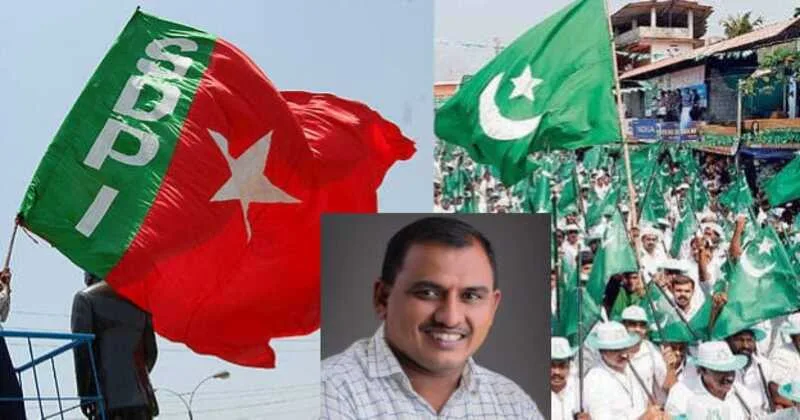
Kasaragod: Manjeswaram’s UDF candidate (Muslim League) AKM Ashraf has stirred a political controversy by expressing his willingness to accept and consolidate votes from the PFI-linked SDPI in the fiercely contested Manjeswaram constituency, where a triangular fight has intensified. Ashraf’s remarks come in direct contradiction to the position taken by the Congress’ Leader of the Opposition, V. D. Satheesan, who had clearly stated that the United Democratic Front (UDF) would not accept SDPI support in any constituency. Rejecting this stance, Ashraf went a step further by asserting that the SDPI should not be viewed as a communal outfit, but rather as a secular party.
Responding to a query from a media house, the Muslim League candidate maintained that defeating the BJP requires the consolidation of votes from all secular forces. He reiterated that while the BJP represents communal politics, the SDPI, in his view, operates within a secular framework. His statement has triggered a wave of political debate, particularly because it marks a significant departure from the official UDF line.
Contradictions within UDF and electoral calculations
The Manjeswaram constituency has historically witnessed a tightly fought triangular contest involving the UDF, the BJP, and the Left Democratic Front (LDF). In such a competitive environment, even marginal vote shifts can significantly alter electoral outcomes. The SDPI, though not a dominant force, holds influence in select pockets, making its support potentially decisive. Ashraf’s divergence from Satheesan’s position has therefore drawn considerable attention from political observers. His remarks suggest a pragmatic electoral strategy aimed at consolidating minority votes, even if it means softening earlier ideological positions. The timing of his statement, as the election approaches, indicates that the UDF candidate is prioritising winnability over internal consensus.
Previously, the withdrawal of an SDPI candidate from the constituency was reportedly influenced by pressure from the Indian Union Muslim League (IUML), a key constituent of the UDF. This move was seen as an attempt to prevent the division of minority votes, which could otherwise benefit the BJP.
Changing political equations and strategic realignments
In earlier local body elections, Ashraf and the Muslim League had strongly opposed both the BJP and the SDPI, often criticising the latter’s political stance. It was in this context that the SDPI had fielded its own candidate, K.M. Ashraf, in Manjeswaram, leading to a split in minority votes. This division had raised concerns within the League that it might indirectly aid the BJP’s prospects.
Subsequently, several League leaders reportedly engaged with the SDPI leadership, expressing apprehensions about vote fragmentation. This eventually led to the withdrawal of the SDPI candidate, signalling a tactical adjustment in response to electoral realities.
Although the SDPI has not officially declared its support for any front in the current election in Manjeswaram, there is growing speculation that it may back the Muslim League candidate to counter the BJP. Ashraf’s latest remarks appear to reinforce this possibility, raising questions about whether a gradual political rapprochement is underway between the two parties.
At the same time, his statement has invited criticism from political opponents, who argue that describing the SDPI as a secular entity contradicts earlier positions held by the League. Critics allege that such a shift reflects opportunistic politics driven by electoral compulsions rather than ideological clarity. The issue has also reignited debates about the consolidation of minority votes in Manjeswaram, a factor widely regarded as crucial in determining the election outcome.