In Union Territory Puducherry, the stakes are high. Here, the All-India NR Congress (AINRC), the Congress-DMK alliance, and Vijay’s TVK are in the race. It goes to poll in the phase of April 9 along with Kerala. Banking on its welfare measures, the NDA is confident of getting a second term. There is no visible anti-establishment mood among voters, and there is turmoil in the Congress and DMK camp over identifying and allotting seats.
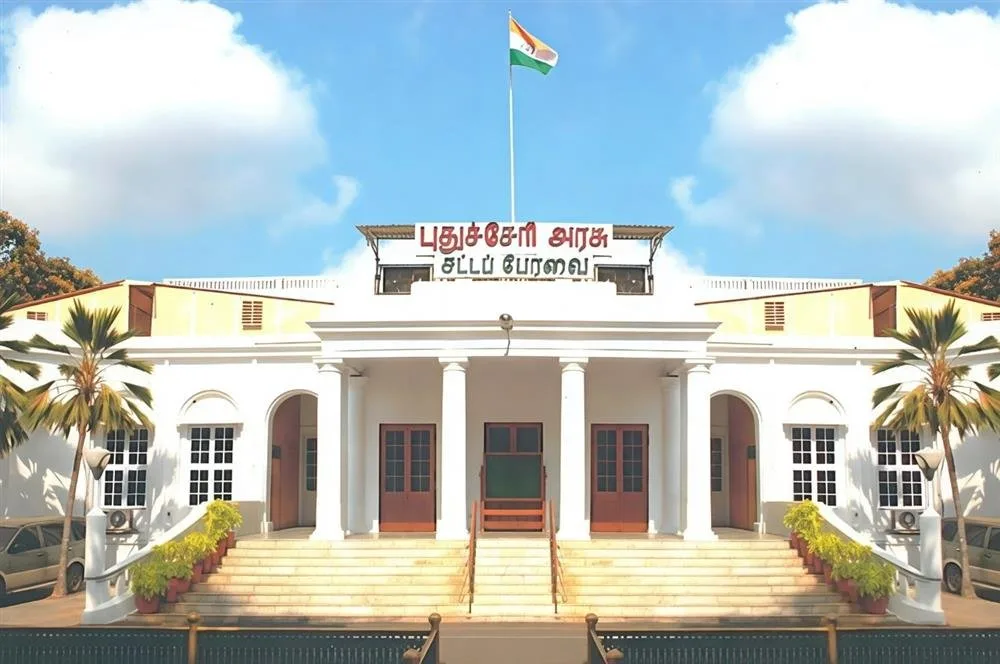
Puducherry Legislative Assembly elections, where polling for the 30-member house is scheduled in a single phase on April 9, with counting of votes to be conducted by the Election Commission of India (ECI) on May 4.
Though the seat finalisation between Congress and DMK was not as per talks, as per the agreement, DMK was to contest in 14 constituencies, while Congress in 16. The DMK has also said it will share some of its seats with the Communist Party of India and VCK, but the nominations by and withdrawals of Congress leaders and DMK went ahead, breaking the talks.
Despite the Congress and DMK alliance, parleys at the constituency level appeared to be unresolved and stalemated. The situation has escalated to the point where “friendly contests” have emerged as a likely scenario in several constituencies.
The seat-sharing arrangement between the parties was reportedly finalised only after the nomination process ended, resulting in both parties fielding candidates across multiple constituencies.
Without waiting for finalising seat arrangements, both Congress and DMK have filed nominations in all constituencies and assured to withdraw once the seats are identified and allotted to each partner.
According to local journalists, “the lack of consensus on seat allocations by the deadline of March 25 allowed the DMK to capitalise on the situation. They proceeded to nominate candidates in six constituencies held by Congress and an additional seven that Congress had their eyes on.
The Ozhukarai constituency was allocated to the Viduthalai Chiruthaigal Katchi (VCK), an ally of the DMK, leaving Congress with limited options, prompting them to assign 22 candidates, which is six more than their initially agreed quota.
This surge has resulted in numerous ‘friendly fights’ that complicate the electoral landscape for both parties. Congress has publicly declared its intention to support only the officially designated 16 candidates and cautioned against disciplinary actions for those deviating.”
Prime Minister Narendra Modi on March 30 interacted with booth-level party workers in Puducherry during the ‘Mera Booth, Sabse Mazboot Samvaad’ initiative ahead of the Assembly polls. He praised their dedication and emphasised the key role they play in the party’s grassroots outreach.
Addressing the workers, PM Modi said he looks forward to learning from their on-ground experiences and efforts in poll preparation. He took a swipe at the opposition. He said, “The Congress and DMK know that the people of Puducherry will not give them a chance, yet they continue fighting among themselves. Congress-DMK stands for family first, whereas the BJP stands for Puducherry first.”
PM Modi said “a double-engine governance ensures faster completion of projects, particularly in the tourism sector”. He urged party workers to engage with individuals involved in tourism and hospitality, sharing that tourist inflow in India has doubled over the past five years. Modi said that India’s policy of free visas or visas on arrival for several countries will benefit Puducherry, crediting these developments to enhanced connectivity under a double-engine administration.
Sources said “a clear but measured verdict appears to be emerging from the ground. Far from any sweeping wave, the contest is shaping up as a hard-fought, constituency-by-constituency battle in the 30-member elected Assembly (within the 33-seat house—3 nominated ones), where micro-level factors and local dynamics in at least 8 to 10 marginal seats could prove decisive.”
Local journalists say “pre-poll survey conducted by Peoples Pulse organisation predicts the formation of an NDA-led government, enabling Chief Minister N. Rangasamy to return for a fourth term”.
Reports point out “the SPA is grappling with multiple setbacks—public perception of disarray, challenges in ticket allocation, and visible internal discord. The decision of six Congress leaders to file nominations in constituencies allotted to alliance partner DMK, without withdrawing them, has further strained cohesion”.
The survey reveals that the NDA enjoys a clear lead across multiple parameters—development performance, welfare measures, community preference, choice of Chief Minister, and overall party preference—a lead that cuts uniformly across age groups and gender.
It says “the VCK has walked out of the Secular Progressive Alliance (SPA) after being allotted only one seat and is now contesting independently in Oussudu (SC), Thirubhuvanai (SC), Ozhukarai, and influencing Nettapakkam (SC). This move is splitting Dalit votes and is expected to directly aid BJP candidates in reserved constituencies”.
The survey says “the NDA remains largely Hindu-oriented but has made strategic accommodations for Christians, besides fielding notable Muslim candidates in Karaikal district.
However, the SPA retains a robust traditional base among both Christians and Muslims. NTK, in line with its 2026 policy shift, has fielded Brahmin and minority candidates even in general seats to project a broader ‘Tamil identity’ beyond narrow caste considerations”.
Referring to differences among various parties of the INDIA bloc over seat-sharing for the polls in Puducherry, Chief Minister and AINRC founder N. Rangasamy said that the governance of the Union Territory (UT) cannot be entrusted to parties that cannot even work together to decide which seats to contest.
He said that most of the promises made to the voters during the 2021 polls and the assurances given on the floor of the Assembly have been fulfilled. The CM assured, “We will come out with new assurances and promises”, indicating plans to release the party’s manifesto for the 2026 elections.
According to the final electoral rolls, the Union Territory has a total of 9,44,211 voters across 30 constituencies. Of these, 5,00,477 are women, compared to 4,43,595 men, while 139 voters are from the third gender category. The gap of nearly 57,000 more women voters than men marks a significant shift in the electoral landscape of this Union Territory.