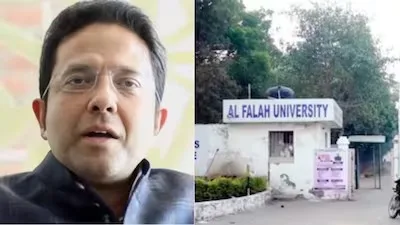
The Haryana government has assumed control of Al-Falah University in Faridabad. The action comes after an inquiry reportedly flagged multiple statutory violations, financial irregularities, and compliance failures in the functioning of the private institution.
At the centre of this intervention is Amit Kumar Agrawal, a 2003-batch IAS officer, who has been appointed as the administrator to oversee the university’s administrative and financial affairs. Officials described the step as necessary to stabilise the institution while ensuring that the academic future of nearly 1,700 students remains unaffected.
Who is Amit Kumar Agrawal?
Amit Kumar Agrawal is a seasoned bureaucrat with a diverse administrative background. Born on January 4, 1977, he initially pursued a career in medicine and holds an MBBS degree. However, he later shifted his focus to civil services, successfully clearing the UPSC Civil Services Examination in 2003.
Over the years, Agrawal has held several key positions within the Haryana administration, particularly in departments such as Industries & Commerce and Information & Public Relations. At present, he serves as Commissioner and Secretary in the Industries & Commerce Department.
His appointment to oversee Al-Falah University is being seen as a significant responsibility, given the scale of challenges facing the institution. Known for his administrative experience, Agrawal has now been tasked with restoring order, ensuring compliance, and rebuilding institutional credibility.
Within a day of assuming charge, Amit Kumar Agrawal initiated a comprehensive restructuring of the university’s administrative framework.
A new leadership team, largely drawn from JC Bose University of Science and Technology, has been deputed to manage key functions:
Ajay Ranga appointed as Vice-Chancellor
Dr Rajeev Kumar Singh appointed as Controller of Examinations
Ravi Kumar Sharma appointed as Chief Finance and Accounts Officer
Meha Sharma appointed as Registrar
Additional administrative staff have also been assigned to support daily operations. According to official orders, these officers will manage the university’s functioning “in the larger interest of the institution.”
Importantly, authorities have clarified that the teaching faculty will remain unchanged, ensuring that academic activities continue without disruption.
Why was Al-Falah University taken over?
The state’s intervention follows an inquiry that reportedly uncovered several violations of statutory norms. Officials indicated that regulatory lapses, administrative irregularities, and gaps in compliance mechanisms had gone unchecked for years.
Established in 2013, Al-Falah University has yet to secure accreditation from the National Assessment and Accreditation Council, raising concerns about its academic standards and regulatory adherence.
Authorities believe that earlier regulatory gaps allowed these issues to persist, necessitating stronger oversight and corrective action.
Shadow of the Red Fort blast investigation
The controversy surrounding the university intensified after its alleged links to the Red Fort blast November 2025 came under investigation.
The high-intensity blast near the Red Fort Metro station in November 2025 resulted in at least 15 deaths and several injuries. Investigations into the incident uncovered what agencies described as a “white-collar terror module” spanning multiple states, including Haryana, Uttar Pradesh, and Jammu & Kashmir.
Shockingly, several individuals linked to Al-Falah University were found to be connected to the case:
Dr Umar Nabi, identified as the suspected suicide attacker, was an assistant professor at the university’s medical college
Dr Muzzamil Shakeel and Dr Shaheen Shahid, arrested with arms and explosives, were also associated with the institution
The network was reportedly linked to terror outfits such as Jaish-e-Mohammed and Ansar Ghazwat-ul-Hind.
These revelations placed the university under intense scrutiny, prompting both investigative and administrative action.
Enforcement Directorate attaches assets worth Rs 140 crore
Earlier this year, the Enforcement Directorate took a major step by provisionally attaching assets worth approximately Rs 140 crore belonging to the university under the Prevention of Money Laundering Act.
The attached properties include around 54 acres of land in Dhauj, Faridabad, along with administrative buildings, academic blocks, and hostels. The agency has classified these assets as “proceeds of crime.”
Investigators have alleged that the university’s management, including its chairman Jawad Ahmed Siddiqui and the Al-Falah Charitable Trust, generated nearly ₹493 crore through fraudulent means. According to the ED, the institution allegedly misled students and parents by falsely claiming accreditation from the National Assessment and Accreditation Council and recognition from the University Grants Commission.
The Haryana government’s intervention is also backed by recent legislative changes. Amendments to the Haryana Private Universities Act have introduced stricter provisions to deal with maladministration, misleading disclosures, and regulatory violations.
Under the revised law, the government now has the authority to:
Impose penalties ranging from Rs 10 lakh to Rs 1 crore
Halt admissions in specific courses
Order phased dissolution of institutions failing to comply within a stipulated timeframe
Officials say these provisions have strengthened the state’s ability to act decisively in cases like Al-Falah University.
Despite the serious nature of the allegations, the Haryana government has emphasised that its primary objective is to safeguard the interests of students.
Authorities have assured that there will be no disruption in academic activities and that existing faculty members will continue their roles. The administrative overhaul is aimed at ensuring transparency, compliance, and stability while maintaining continuity in education.
A test case for private University regulation
The developments at Al-Falah University are likely to have far-reaching implications for the regulation of private universities in India.
Reports note that the case highlights systemic issues such as lack of oversight, delayed accreditation, and governance lapses. It also underscores the need for stronger regulatory mechanisms to prevent misuse of educational institutions.
At the same time, the alleged links to terror activities have added a serious national security dimension, making this one of the most high-profile cases involving a private university in recent years.
As Amit Kumar Agrawal takes charge, the focus will be on restoring credibility, ensuring compliance, and rebuilding trust in the institution.
The coming months will be crucial in determining whether the administrative intervention can successfully address the deep-rooted issues and set the university on a path of reform.
For now, the takeover stands as a strong message from the state government that regulatory violations and institutional lapses will not be tolerated, particularly when they intersect with larger concerns of financial misconduct and national security.