JAMMU: A Division Bench of the High Court of Jammu & Kashmir and Ladakh has disposed of a bunch of writ petitions filed by various hoteliers of Gulmarg after the petitioners sought withdrawal to pursue the settlement of the dispute with the government. These petitions called into question the constitutional validity of the J&K Land Grant Rules, 2022, enacted under the instructions of Lieutenant Governor Manoj Sinha.
“In the wake of the position sketched out above and in terms of the statement made by learned counsel for the respective parties, we are not required to delve any further into the merits. Accordingly, all these petitions are disposed of in the above terms,” the Bench headed by Chief Justice Arun Palli stated.
The new land rules were formulated after it was brought to Sinha’s attention that thousands of kanals of government land were illegally held by private parties. One major reason for the illegality was that many lease deeds had expired. Those holding land on lease had stopped paying rent as per the lease deeds and were in huge arrears.
The new rule introduced by the LG’s administration in 2022 discontinued the practice of automatically extending land leases after expiry. Properties built on land with an expired lease will be auctioned through open bidding, in which non-locals can participate.
Nedous Hotel
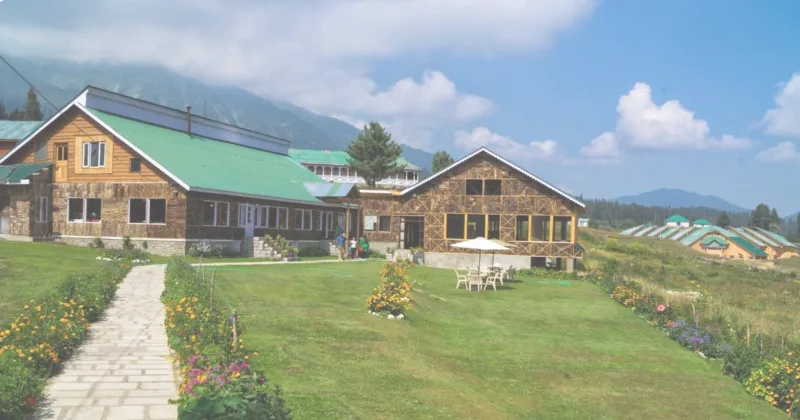
Last year, the Jammu and Kashmir government took control of the 137-year-old Nedous Hotel, one of Kashmir’s most significant tourist-cum-political landmarks, for operating without a valid lease. The hotel was founded by Michael Adam Nedou, a hotelier from Dubrovnik, Croatia, and the great-great-grandfather of Omar. The hotel was founded as early as 1888, at least 138 years ago. A senior tourism department official leading a Gulmarg Development Authority (GDA) team had taken possession of the property.
Nedous’s son, Michael Henry, had converted to Islam to marry Mir Jehan, a local Gujjar woman. Their daughter, Akbar Jahan, married Sheikh Mohammad Abdullah, the present Chief Minister Omar Abdullah’s grandfather and founder of the National Conference party. Close family connections with the leading political family of Abdullahs were alleged to be the reason for throwing all norms to the wind. But it seems to have become a question of legacy versus law, and a glaring illegality has come to the fore.
It needs to be stressed here that Nedous is not the only hotel found to be in violation of the established legal norms. Only that there is more buzz about this case than about those of other hoteliers. Land lease issues are being faced by several hoteliers in other locations also.
Land Lease Expiry
At the famous tourist resort of Gulmarg, leases of at least 55 out of 59 hotels have expired. Besides, many of these hotels have encroached upon land adjacent to their properties, far in excess of the land allotted to them under their leases. In one particularly glaring case, one hotel has been found to be in possession of almost 100 kanals of land illegally. Originally leased just two kanals and 13 marlas, the iconic Nedous hotel expanded so much that it was in possession of 98 kanals and 11 marlas (roughly 12 acres) without any legal sanction.
Besides, even the lease agreement of less than three kanals had expired in 1985. Since then, it has continued all its commercial operations illegally, without any regular payment of rent.
In 2018, a Division Bench of the J&K High Court ruled against the hotel’s plea for lease renewal, holding that no rent had been paid since 1990 and that the hotel’s operations lacked a legal basis. The court emphasised that submitting a renewal application does not entitle anyone to an automatic extension of the lease.
It is said that the hotel failed to get any relief from the Supreme Court, as there was no legal point on which it could allege bias or discrimination against itself.
Writs Withdrawn
A Division Bench of Chief Justice Arun Palli and Justice Rajnesh Oswal allowed the withdrawal after senior counsel Zaffar Ahmed Shah, at the very outset, submitted that the petitioners wished to withdraw their applications. He said that it would be expedient if the petitioners were permitted to withdraw the petitions, enabling them to move the democratically elected government in the first instance to resolve the dispute.
In response to the submission, senior AAG Mohsin Qadri, on instructions from the government, submitted that the government, too, was not averse to any fair, equitable and viable solution to the whole dispute.
The senior AAG submitted that in the event the petitioners move any representation(s) within two weeks, the same would be taken cognisance by the competent authority, according to the Court order of March 5.
“And the same shall be considered in the right earnest and before any formal decision is reached, the petitioners shall also be adequately heard. Whereupon, a decision taken by the competent authority shall be conveyed to all the petitioners individually”. The Court observed that the counsel appearing in the petitions had already concluded their arguments, and the matter was posted to hear the senior AAG on behalf of the Government.
“In the wake of the position sketched out above and in terms of the statement made by learned counsel for the respective parties, we are not required to delve any further into the merits,” the court said and disposed of the petitions accordingly.
“But before we part with the matter, we may hasten to record that we had heard these petitions at length on numerous occasions and invested considerable judicial time to take the matter to its logical end. And but for the changed position that has emerged before the Court, possibly we would have concluded the proceedings today itself” the Court said.
New Land Laws
In 2022, the Union Territory administration led by LG Manoj Sinha had introduced the J&K Land Grant Rules. The Rules were issued purportedly in exercise of the powers under Section 4, read with Section 9, of the Jammu and Kashmir Land Grants Act, as notified by the Government vide SO 668 of 2022 dated 09.12.2022.
Under the new framework, the practice of extending leases after their expiry was discontinued, and such properties are to be put up for auction through open bidding, making them accessible to any Indian citizen.
The impact is particularly evident in the tourist resort of Gulmarg, where a majority of hotels are built on leased land. 55 of 59 hotels have expired, leaving proprietors at risk of eviction and auction.