
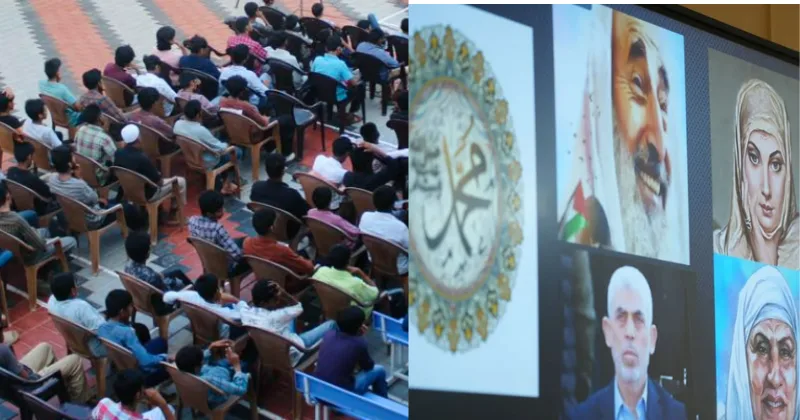
Controversy has emerged in Kerala after reports that newly added chapters in the curriculum of certain schools and madrassas run by Jamaat-e-Islami include profiles of figures associated with the globally outlawed organisation Muslim Brotherhood, along with content that appears to glorify the militant outfit Hamas. The material reportedly presents Hamas founder Sheikh Ahmed Yasin as a “renaissance leader”, raising concerns over the ideological messaging being introduced to students.
These institutions are managed by the Majlis Education Trust, based in Kozhikode, which oversees several schools and madrassas run by Jamaat-e-Islami across the state.
The syllabi for these institutions are prepared by the Integrated Educational Council of India, a body functioning under Jamaat-e-Islami.
The controversy centres on the madrassa textbook Hadees prescribed for Class 7 students, particularly its seventh chapter titled “Navodhana Nayakar” (Leaders of the Renaissance). The chapter reportedly introduces students to leaders linked to the Muslim Brotherhood, portraying Hasan al-Banna, the organisation’s founder, and his successor Sayyid Qutb as renaissance figures while also providing detailed references to Syed Abul A’la Maududi, founder of Jamaat-e-Islami.
Within the same chapter, critics say, the militant group Hamas is mentioned in a manner that praises its founder Sheikh Ahmed Yasin as a renaissance leader.
The controversy deepens with the reported inclusion in the syllabus of “Vazhiyadayalam”, a book that had earlier been banned under Kerala Police Rule 163. The Kerala government had taken action against the book after concluding that it promoted religious animosity.
During the investigation, authorities raided the office of Nanma Books, the publisher, and arrested Abdul Rahman, the translator of the book, who had previously served as the Ernakulam district president of the banned organisation SIMI (Students Islamic Movement of India).
Reports at the time also alleged that the book contained ideological narratives echoing themes associated with extremist organisations such as ISIS and Al-Qaeda, including slogans such as “Allah is our lord, Quran is our Constitution and Jihad is our path,” while similar ideological messaging is also said to appear in the Hadees textbook prescribed for Class 9 students.
The issue has gained further political significance in the backdrop of recent developments in Kerala politics, where certain Congress leaders indicated openness to accepting Jamaat-e-Islami’s support in Assembly elections, even as Jamaat leaders publicly maintained that they continue to adhere to their core ideological positions.
In this context, critics argue that educational institutions can become powerful instruments of ideological influence, particularly among young students who may not yet possess the tools to critically evaluate complex historical and political narratives. They warn that such content, if left unchecked, could shape perceptions and beliefs at an early stage, potentially affecting rational understanding and broader societal harmony.