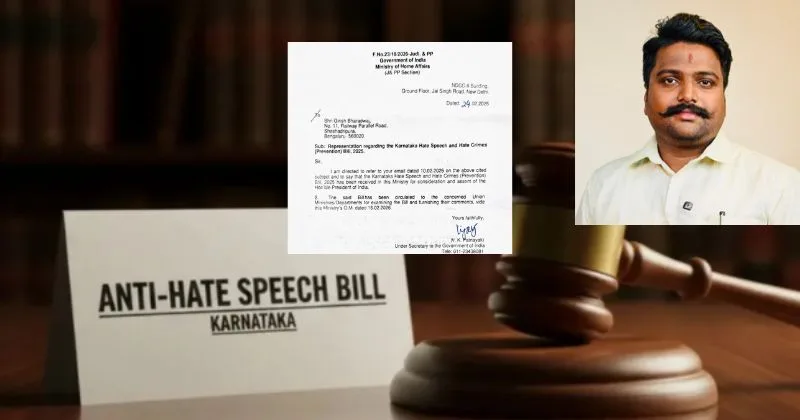
.BENGALURU: A fresh political and constitutional debate has erupted over the proposed Karnataka Hate Speech and Hate Crimes (Prevention) Bill, 2025, with social activist Girish Bharadwaj formally urging the President of India to withhold assent, alleging that the legislation is vague, overbroad and susceptible to political misuse.
The development comes after the Governor of Karnataka declined to grant assent to the Bill and reserved it for the consideration of the President under Article 201 of the Constitution. In his representation, Bharadwaj argued that the proposed law suffers from “serious constitutional, legal, and democratic infirmities” that threaten fundamental rights, particularly freedom of speech and expression guaranteed under Article 19(1)(a).
“It became imperative to place on record the grave constitutional concerns surrounding this legislation. The Bill is vague in its definitions, excessively broad in its sweep, and open to misuse by the ruling establishment to silence dissent,” Bharadwaj stated in his submission.
The Bill proposes stringent penalties ranging from one to seven years’ imprisonment for first offenses and two to ten years for repeat offences, along with substantial fines. It also introduces the concept of “collective liability,” making office-bearers of organisations criminally liable if hate speech is committed in the name of the organisation. Offences under the Bill are cognizable and non-bailable.
Bharadwaj contended that such provisions risk criminalising legitimate political criticism, satire, academic debate and journalistic commentary. “The fear of arrest without warrant and non-bailable provisions can create a chilling effect on free speech. In a democracy, the remedy for offensive speech cannot be disproportionate criminal sanction,” he argued.
The Karnataka government, however, has defended the Bill, stating that India currently lacks a standalone statute defining hate speech. At present, law enforcement relies on scattered provisions of the Bharatiya Nyaya Sanhita, such as Section 196 (promoting enmity between groups), Section 299 (outraging religious feelings), and Section 353 (incitement affecting public order). These provisions primarily aim to preserve public order rather than address hate speech as a distinct offense.
Critics point out that conviction rates under these sections remain low. According to NCRB data cited in public discussions, convictions under the predecessor of Section 196 stood at just over 20% in 2020, raising questions about enforcement rather than legislative gaps.
The debate also revives memories of Section 66A of the Information Technology Act, which was struck down by the Supreme Court of India in 2015 for being vague and unconstitutional. The apex court held that the provision’s imprecise language enabled arbitrary arrests and infringed free expression.
In recent years, the Supreme Court has taken a shifting stance on hate speech enforcement. In 2022 and 2023, it directed police across states to act suo motu against hate speech. However, in 2025, the court observed that it was not inclined to monitor every incident and emphasized that existing legal mechanisms, including the 2018 Tehseen Poonawalla judgment on preventing mob violence, must be effectively implemented.
Bharadwaj’s representation argues that instead of introducing a sweeping new state law, authorities should strengthen enforcement of existing provisions and ensure accountability. “The Bill’s power to block or remove online content deemed hateful grants excessive discretionary authority to the executive, without adequate safeguards. Such regulatory overreach risks suppressing legitimate dissent and political opposition,” he submitted.
The representation concludes by urging the President to withhold assent “in the larger interest of constitutional governance, rule of law, and democratic freedoms,” warning that unchecked expansion of criminal law into speech could erode civil liberties.
With the Bill now awaiting presidential consideration, the controversy has intensified debates over the delicate balance between combating hate speech and preserving freedom of expression in India’s constitutional democracy.