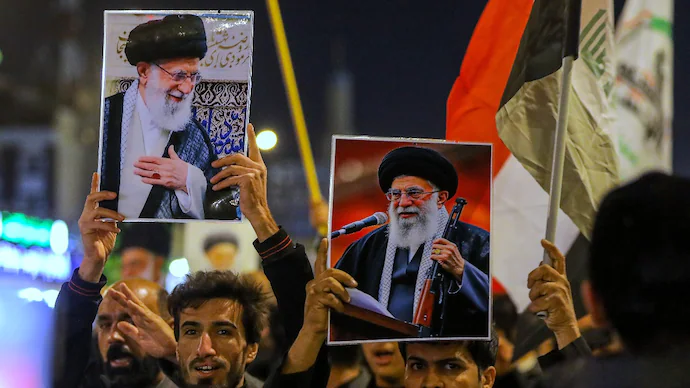
As missiles lit up the skies over Iran, another battle unfolded silently in the palms of millions of citizens. Within hours of the airstrikes that killed Khamenei, users of the widely used Bade Saba Calendar app were greeted with a push notification carrying a political message disguised in the familiar tone of a routine prayer alert.
The message read: “Help has arrived.”
For years, Bade Saba had functioned as a simple religious utility, providing prayer times, Islamic calendar dates and Adhan notifications. Now, it appeared to have been transformed into a vehicle for psychological operations, in what reports describe as a highly coordinated cyber offensive attributed to Israel.
What is Bade Saba?
Bade Saba is among Iran’s most downloaded Islamic applications, with over five million official downloads on Google Play and additional distribution through domestic platforms such as Cafe Bazaar and other third-party app stores.
The app provides daily prayer reminders for Fajr, Dhuhr, Asr, Maghrib and Isha, while also marking significant Islamic occasions including martyrdom anniversaries and religious holidays. For millions of users, it is checked multiple times a day, embedded in routine and trusted implicitly.
Its religious function made it uniquely powerful. Unlike foreign social media platforms that are often restricted or filtered inside Iran, Bade Saba operates freely within the country’s tightly controlled internet environment.
That trust and accessibility may have made it the ideal instrument for cyber-psychological warfare.
The message that shocked millions
According to analysis by India Today’s OSINT, the Persian-language notifications sent on the morning following the strikes carried direct political appeals.
Disguised in the app’s standard alert format, the first message declared, “The time for revenge has come. The regime’s repressive forces will pay for their cruel and merciless actions against the innocent people of Iran. Anyone who joins in defending and protecting the Iranian nation will be granted amnesty and forgiveness.”
A follow-up notification reportedly urged security forces to “lay down your weapons or join the forces of liberation.”
The wording suggested a deliberate attempt to target members of Iran’s armed forces and encourage defections from the Islamic Revolutionary Guard Corps (IRGC).
No official claim of responsibility has been made. However, the timing synchronised with kinetic airstrikes has led analysts to attribute the operation to Israel as part of a broader coordinated campaign.
Why the app was the perfect vehicle
The cyber intrusion did not occur in isolation. It coincided precisely with the military strikes that eliminated Khamenei, amplifying psychological impact.
When citizens are disoriented by breaking news and military escalation, trusted information channels become critical. By infiltrating a religious app rather than a news platform the attackers bypassed skepticism.
Unlike state media, which many Iranians approach with caution, a prayer app is rarely questioned. Its notifications are routine, predictable and personal. That familiarity may have increased the credibility and shock value of the message.
Moreover, internet monitoring group NetBlocks reported a 36-hour disruption in connectivity across parts of Iran following the strikes. With access to external news sources restricted, many users had limited ability to verify the authenticity of what appeared on their screens.
In that information vacuum, a push notification from a domestic religious app may have been one of the few digital messages capable of cutting through.
A broader information assault
The Bade Saba breach was reportedly only one component of a wider information campaign. Major Iranian media outlets, including IRNA, ISNA, Tabnak and Asr-e Iran, experienced disruptions around the same time.
Taken together, the pattern suggests a coordinated strategy:
– Strike military leadership physically.
– Disrupt state media channels.
– Penetrate trusted civilian digital platforms.
The objective, analysts say, was not only to weaken command structures but to destabilise public confidence.
Psychological warfare in the digital age no longer relies solely on radio broadcasts or leaflet drops. It exploits everyday applications embedded in civilian life.
Cyber warfare meets religious space
The use of a prayer app adds a new dimension to cyber conflict. Religious platforms traditionally exist outside overt political contestation, functioning as tools of devotion rather than debate.
Reports note that this tactic reflects a shift in modern warfare, where digital infrastructure from banking apps to navigation tools can become battlegrounds.
In this case, the symbolism was particularly potent. A notification associated with prayer times moments of spiritual reflection instead delivered a call for political resistance.
Psychological shockwaves and strategic messaging
Inside Iran, the full scale of public reaction remains opaque due to state-controlled information flows. But the objective of the operation was never simply to deliver a provocative message, it was to send a signal. By penetrating a widely used domestic app, the attackers demonstrated that even platforms assumed to be routine and insulated are not beyond reach.
The real impact lies not in the wording of the notification but in the exposure of systemic vulnerability. If a religious utility used daily by millions can be infiltrated at a critical political moment, it shows the fragility of Iran’s digital infrastructure. The breach transforms a familiar tool into proof that control over information is not absolute.
The use of Bade Saba highlights the multi-domain character of modern conflict. Airstrikes targeted command structures. Cyber operations targeted perception. Information disruption targeted narrative control. The sequencing suggests integration rather than coincidence, a calibrated effort to combine kinetic force with psychological leverage.
By eliminating senior leadership while simultaneously injecting destabilising messages into civilian devices, the operation appears designed to compound pressure on both the political establishment and the security apparatus. It reflects the logic of hybrid warfare, where physical strikes are amplified through cyber penetration, digital disruption and information warfare.
This is not an isolated tactic but part of a broader global pattern in which military campaigns are paired with cyber operations to maximise strategic effect. Control over the battlefield increasingly includes control over screens.
What comes next?
Iranian authorities have not publicly detailed how the app was compromised, whether through backend servers, developer-level access or distribution channels. That uncertainty itself adds to the strategic message: vulnerability can exist at multiple points.
The incident stands as a clear example of how domestic digital platforms can become conduits in geopolitical conflict. In contemporary warfare, influence operations are not limited to media outlets or social networks; any widely trusted platform can become a delivery system.
Missiles may capture immediate attention, but in this confrontation, a single push notification demonstrated how psychological operations can travel faster than rockets and reach deeper into daily life.