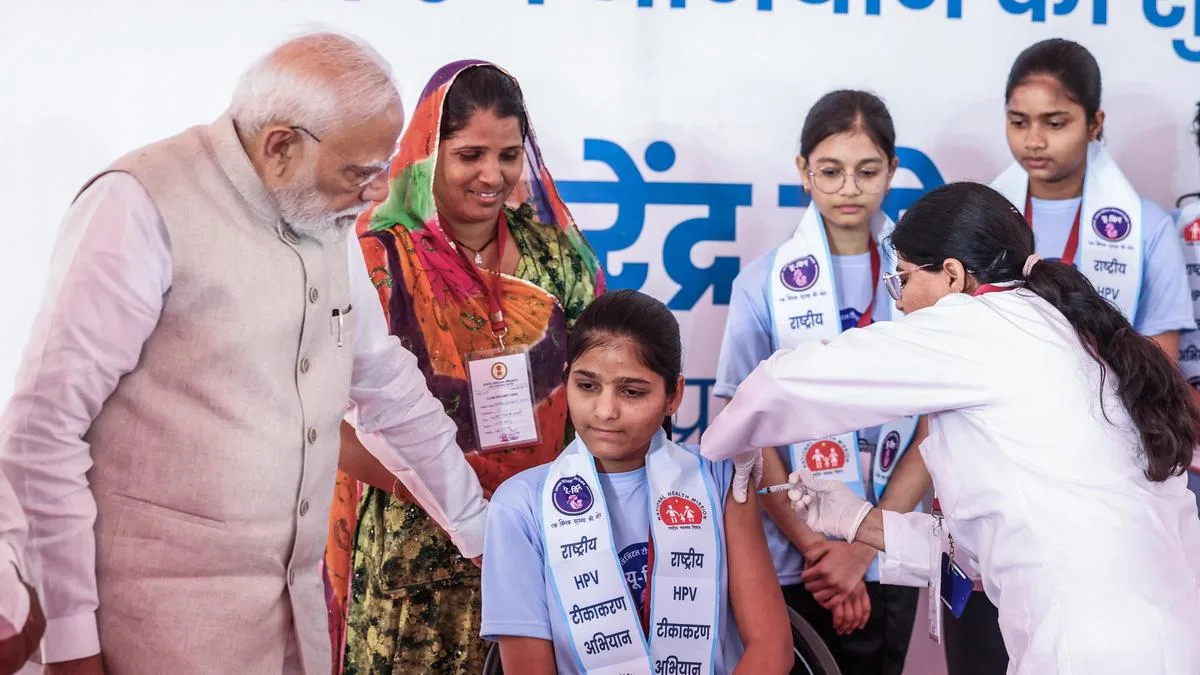
On February 28, at a public event in Ajmer, Prime Minister Narendra Modi formally launched India’s nationwide Human Papillomavirus (HPV) vaccination campaign for adolescent girls. The initiative, spearheaded by the Ministry of Health and Family Welfare (MoHFW), aims to provide free HPV vaccination primarily to 14-year-old girls as part of a preventive strategy against cervical cancer.
Cervical cancer remains one of the most common cancers affecting women in India. Persistent infection with high-risk strains of the Human Papillomavirus (HPV) is responsible for nearly all cervical cancer cases. According to public health data, India reports over 120,000 new cervical cancer cases every year and approximately 80,000 related deaths. Unlike many other cancers, cervical cancer is largely preventable through vaccination and regular screening.
The scientific rationale behind vaccinating young adolescent girls is straightforward: HPV vaccines are most effective when administered before exposure to the virus, which typically occurs after the onset of sexual activity. Immunising girls at around 14 years of age ensures protection well before potential exposure, significantly reducing future cancer risk.
With this rollout, India joins over 160 countries that have integrated HPV vaccination into their immunisation schedules. More than 90 countries have adopted simplified single-dose schedules to enhance coverage and affordability.
Backlash and conspiracy narratives
Even as medical associations and oncologists welcomed the nationwide rollout, a wave of online misinformation began circulating. Several social media users claimed the vaccine is “unsafe,” alleged that it is part of a “foreign corporate project,” or framed it as an experiment on Indian girls. Some narratives specifically linked the campaign to philanthropist Bill Gates, portraying the vaccination drive as a sinister international agenda.
These claims are not new. Many stem from past controversies surrounding HPV vaccine studies conducted in India over a decade ago. Others draw from broader global anti-vaccine rhetoric that gained traction during the COVID-19 pandemic.
Public health experts warn that such fear-mongering can undermine one of the most significant preventive health measures introduced for Indian women in decades.
Revisiting the PATH study controversy
Much of the online criticism references a study conducted between 2009 and 2010 involving two HPV vaccines, Gardasil, manufactured by Merck/MSD, and Cervarix, produced by GlaxoSmithKline (GSK).
The project, implemented by PATH (Program for Appropriate Technology in Health) in collaboration with the Indian government, the state governments of Andhra Pradesh and Gujarat, and the Indian Council of Medical Research (ICMR), was not a traditional clinical trial. By that time, both vaccines had already completed clinical trials and had been licensed and commercially available in India since 2008.
The demonstration project aimed to assess feasibility, coverage, and logistical preparedness for potential large-scale introduction into public immunisation programmes. Approximately 14,000 girls in Andhra Pradesh received Gardasil, while around 16,000 girls in Gujarat received Cervarix.
However, controversy erupted when reports emerged that seven girls who had received the vaccine later died. Activist groups alleged a connection between the deaths and the vaccination drive. Additionally, concerns were raised about consent procedures, as in some instances hostel wardens or school authorities had signed consent forms rather than parents.
In 2013, a Parliamentary Standing Committee criticised procedural lapses and regulatory oversight. The language of the report was strongly worded and accused implementing agencies of failing to adhere to ethical standards.
What did the investigation reveal?
Following public outcry, the Indian Council of Medical Research conducted a detailed investigation into the reported deaths. The inquiry examined autopsy findings, medical records, and timelines.
The conclusion was clear: none of the seven deaths were causally linked to the HPV vaccines.
In Andhra Pradesh, the causes included suspected pesticide ingestion, accidental drowning, malaria, typhoid, and other unrelated medical conditions. In Gujarat, one death was attributed to snakebite and another to malaria combined with severe anaemia.
While procedural lapses in documentation and consent processes were acknowledged, scientific review found no evidence that the vaccines themselves caused the fatalities.
Public health experts argue that conflating ethical irregularities with vaccine safety creates confusion. Regulatory oversight failures, if any, must be addressed administratively but they do not constitute evidence that a vaccine is inherently dangerous.
Globally, over 500 million doses of HPV vaccines have been administered since 2006. Extensive safety surveillance systems in multiple countries have consistently shown strong safety profiles, with mostly mild side effects such as injection-site pain and rare serious adverse events.
Why Gardasil for the National Rollout?
Questions have also arisen about why the nationwide campaign is using Gardasil instead of Cervarix or India’s indigenous HPV vaccine.
One primary reason is dosing efficiency. Gardasil has robust evidence supporting a single-dose schedule, endorsed by the World Health Organisation in many contexts. A single-dose strategy simplifies logistics, improves coverage, and reduces program costs.
India has secured Gardasil supplies through a partnership with Gavi, the Vaccine Alliance, ensuring quality-assured doses, cold-chain integrity, and uninterrupted supply nationwide.
The Indigenous Alternative: Cervavac
India is not solely dependent on imported vaccines. The Serum Institute of India has developed Cervavac, a domestically produced quadrivalent HPV vaccine that has been commercially available since 2023.
Cervavac currently requires a two-dose schedule. The ICMR is conducting immunobridging studies to evaluate whether a single-dose regimen is equally effective. If proven non-inferior, Cervavac is likely to be incorporated into the national immunisation programme, offering a cost-effective, indigenous option.
National Technical Advisory Group on Immunisation (NTAGI) has already approved Cervavac for inclusion in the national programme under a two-dose schedule, and policy discussions continue regarding expanded rollout.
The Stakes: Who loses when misinformation spreads?
HPV is responsible not only for cervical cancer but also for significant numbers of anal, vulvar, vaginal, penile and oropharyngeal cancers. Preventing infection early dramatically reduces lifetime cancer risk.
Public health officials warn that vaccine misinformation disproportionately harms economically vulnerable families. An affluent household can, at any point, choose to purchase a commercially available HPV vaccine for their daughter. However, for low-income families, the free doses provided under a national campaign may represent the only realistic opportunity for protection.
If misinformation leads to hesitancy among disadvantaged communities, the burden of preventable cancer may fall hardest on those least able to afford treatment.
The Bill Gates factor and global vaccine politics
Some online narratives tie the HPV rollout to Bill Gates and the Bill & Melinda Gates Foundation, particularly in light of renewed scrutiny over Gates’ past association with Jeffrey Epstein.
It is true that the foundation played a foundational role in launching Gavi in 1999-2000 with an initial commitment of USD 750 million. To date, it has contributed billions of dollars toward global immunisation efforts. Gavi has supported vaccination of over a billion children worldwide.
However, public health experts in reports caution against conflating controversies in a philanthropist’s personal life with the scientific integrity of global vaccine programmes. Vaccines undergo multi-phase clinical trials, regulatory review, and continuous post-marketing surveillance. Decisions to introduce them into national programmes are based on cumulative scientific evidence, not individual personalities.
Governments, WHO, UNICEF and multiple independent scientific bodies evaluate vaccine data before adoption. Suggesting that over 160 countries are collectively endangering adolescent girls under a hidden agenda lacks supporting evidence.
India’s HPV vaccination drive represents a critical opportunity to reduce one of the country’s deadliest but preventable cancers. The scientific consensus on HPV vaccine safety and efficacy is extensive and spans more than 15 years of global data.
At the same time, the rapid spread of misinformation through social media underscores a new challenge in public health communication. In the digital era, vaccine rollouts are no longer just logistical operations, they are information battles.