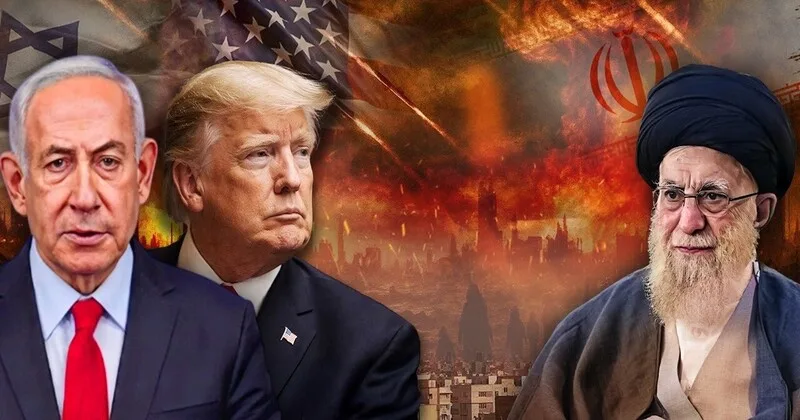
Iran’s Supreme Leader, Ayatollah Ali Khamenei, has been killed in a joint attack by the United States and Israel. Iranian state media officially confirmed that his office and residential complex in Tehran were targeted, resulting in the deaths of the Supreme Leader and several members of his family. The country has declared 40 days of national mourning and seven days of public holidays, while scenes of celebration, anger and grief are simultaneously being witnessed on the streets.
Panic in Tehran after missile attack
It was early morning in Tehran when the sound of explosions shook the city. According to eyewitnesses, several missiles struck a high-security area of the capital. A few hours later, Iran’s official news agency, Islamic Republic News Agency(IRNA), released a statement saying that “the Supreme Leader of the Islamic Revolution, Ayatollah Khamenei, was martyred on in an attack carried out by the Israel and the United States.” Soon after, the government channel Press TV turned its logo black in mourning and an anchor tearfully announced the news to the nation. The channel reported that Khamenei’s daughter, son-in-law, daughter-in-law and a grandchild were also killed in the attack.
More than three decades of political influence
It is noteworthy that Khamenei had served as Iran’s Supreme Leader since 1989. He assumed the position after the death of the founder of the Islamic Republic, Ruhollah Khomeini and maintained decisive influence over the country’s politics, foreign policy and security structure for more than three decades. During his tenure, Iran-U.S. relations remained tense, global pressure over Iran’s nuclear program intensified and Iran played an active role in regional conflicts. Iran’s strategic presence in Syria, Lebanon and Yemen has often been attributed to policies shaped under his leadership.
Strong response from the IRGC
Following the attack, Iran’s powerful security organization, the Islamic Revolutionary Guard Corps(IRGC), issued a sharp statement. It said that “the Iranian nation has lost a great leader who was unmatched in courage against arrogant powers and in his struggle in the path of Allah”. The statement described the attack by the United States and the Zionist regime as a criminal and terrorist act that clearly violates religious, moral, legal and traditional principles. Iran vowed to avenge the killing and warned that those responsible would not go unpunished. The IRGC explicitly stated that “the killers of the Imam of the Ummah will face a punishment that will make them regret their actions”.
Retaliatory attacks on Israeli and U.S. positions
According to a report by Iran’s Tasnim News Agency, in response to what it called American-Israeli aggression, Iranian armed forces have launched large-scale missile and drone attacks on Israeli-occupied territories and U.S. military bases across the Middle East. Regional media reports say that several military bases have been placed on high alert and security has been tightened across the Gulf region.
Nationwide mourning, anger and protests
Inside the country, a mixture of grief and anger is visible. In cities such as Tehran, Mashhad, Qom and Isfahan, thousands of people have gathered in mosques to offer prayers. At the same time, large crowds have taken to the streets chanting slogans against the United States and Israel. Security forces have imposed near-curfew conditions in the capital and there are reports of disruptions to internet services. Iran’s Parliament has convened an emergency meeting, while the National Security Council continues to review the situation.
Ahmad Vahidi named new Commander-in-Chief
In a significant political development, just hours after Khamenei’s death, Iran’s Supreme Council announced the appointment of a new commander-in-chief. Ahmad Vahidi has been named the new commander-in-chief and has been given responsibility for the Islamic Revolutionary Guard Corps.
Strategic motive behind the attack
So far, reports suggest that the military operation conducted by the United States and Israel was aimed at weakening Iran’s “strategic structure”. Israel has long described Iran’s nuclear program and its regional influence as a threat to its security, while the United States had intensified attacks on Iran-backed groups in recent months.
Turmoil in oil markets and global politics
Meanwhile, Khamenei’s death has triggered volatility in global oil markets. Fears of a potential war in the Gulf region have led to a surge in crude oil prices. The international community has called for restraint and there is speculation that the United Nations Security Council may hold an emergency meeting. Russia and China have expressed concern over regional stability, while India and the European Union have urged all sides to de-escalate tensions.
Major challenges for the new leadership
Political analysts believe that Khamenei’s death is unlikely to bring immediate changes to Iran’s foreign policy, as the country’s power structure remains firmly controlled by the religious establishment and the IRGC. However, the new leader will face significant challenges in controlling internal dissent and dealing with external pressures. The country with a young population, economic crisis, inflation and unemployment serious issues persist that could worsen if the threat of war increases.
Rising risk of a regional war
This moment is being viewed as decisive for West Asia. While Iran is talking about retaliation, Israel and the United States are strengthening their security strategies. If the situation spirals out of control, the conflict could escalate into a broader regional war. Khamenei’s long political journey has now become part of history, but the fire ignited by his death may be felt for months and years to come.
Iran moving towards an uncertain future
The slogans echoing on Tehran’s streets, prayers rising in mosques, waves of grief and celebration among different groups and diplomatic movements on the international stage all indicate that Iran is entering a period of uncertainty. The world’s attention is now focused on Iran and its new leadership, whose decisions will determine whether this crisis remains a limited confrontation or turns into a wider conflict. Meanwhile, Israel has said that several of the 30 key leaders targeted in the initial strikes of the joint military operation with the United States have been killed.
Israeli Prime Minister Benjamin Netanyahu stated that the military operation will continue until the people of Iran are free. It is worth noting that the first public information about Khamenei’s death was shared by U.S. President Donald Trump. Posting on Truth Social, Trump wrote: “Khamenei, one of the worst people in history, is dead”.