BHUBANESWAR: Emphasising the need for a paradigm shift in policymaking, Prafulla Ketkar, Editor of Organiser, stated on Friday that we must shed the “hangover of colonialism” and move beyond a “one-size-fits-all” approach to achieve the goals outlined in the Odisha State government’s ambitious document Vision Odisha 2036 and 2047.
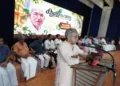
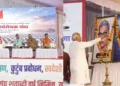
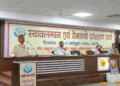
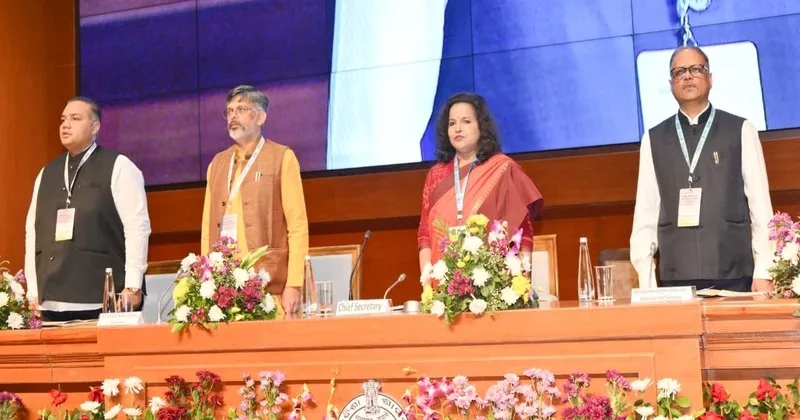
Speaking at the inaugural session of the two-day state-level policy consultation titled “Vikash Manthan 1.0” at the Convention Centre of Lok Seva Bhavan in Bhubaneswar, Ketkar noted that while the vision document is both comprehensive and dynamic, its success hinges on adopting an approach grounded in Odisha’s own civilisational ethos.
“The approach required to achieve the targets of Vision Odisha 2036 and 2047 must be based on ‘self’ (swa) our own strengths, traditions, and contemporary needs. We must move away from borrowed frameworks and colonial-era mindsets. A uniform template cannot address the diverse aspirations of our society,” he emphasised.
Ketkar further asserted that, when implementing any scheme or policy, it is crucial to understand the unique ethos and cultural consciousness of every region and community to facilitate development accordingly. Development should be based on the traditional knowledge systems of local societies, rather than imposing an external model of development.
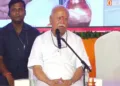
He recalled that two years ago, Mohan Bhagwat, the Sarsanghchalak of the Rashtriya Swayamsevak Sangh, remarked that although Bharat gained political independence on August 15, 1947, its journey towards Swa Tanta continues. Describing this as a significant observation, he pointed out that, in terms of systems, mindset, and psychology, we are still not entirely free.
Bharat has faced continuous onslaughts from the Greeks, Shakas, Huns, Kushans, Turks, Mughals, Mongols, the Dutch, and the British. In countries like America and Australia, the indigenous populations were drastically reduced within a few years of foreign invasions. Despite centuries of foreign incursions, Bharat remains a cohesive nation, thanks to its strong sense of selfhood. Bharat has existed as a nation for thousands of years.
From Kailash to Kanyakumari, there is a shared concept of Shiva and Shakti. The cultural and spiritual significance of the Ganga, Puri, and Rameswaram is recognised across the country. The Rath Yatra has been celebrated on Ashadha Shukla Dwitiya for countless generations. Throughout history, no ruler in India has altered the Panchang (traditional calendar).
Ketkar noted that while the West views time as linear, Bharatiyas perceive it as cyclical. Even an uneducated person in Bharat asserts that although Kaliyuga is ongoing, Satya Yuga will eventually return.
He further explained that in Bharat, geography is referred to as “bhugol,” which suggests that people here have long understood that the Earth is spherical. Those who once believed the Earth to be flat are today claiming to impart knowledge to us.
He added that Bharat’s conceptual framework differs from that of the West. While Western thought tends to compartmentalise ideas, Bharat approaches them from an integral perspective. In the West, relationships are often framed as man versus nature, with the belief that man must conquer nature. In contrast, the Bharatiya perspective recognises that human beings are an integral part of nature.
The noted Indian thinker Deendayal Upadhyaya asserted that Western thought tends to function in binaries, whereas the Bharatiya worldview is integral and holistic. According to him, in the Bharatiya perspective, the individual does not exist in isolation; rather, the family is greater than the individual and serves as the fundamental unit of society. He also emphasised the interconnectedness among Vyasti (the individual), Samasti (the collective), Srishti (creation), and Parameshti (the Supreme), highlighting the integral nature of existence.
Speaking at the program, Chief Secretary Anu Garg stated that the State government had sought opinions from all sections of society while preparing the Vision document. She emphasised that the government does not want people to remain mere beneficiaries of schemes but to actively participate in the development process.
She noted that Odisha possesses significant strengths, as well as certain challenges, both of which must be considered as it moves forward. “Our Vision document also outlines how Odisha can contribute more substantially to the overall development of the country,” she said.
Development Commissioner Deoranjan Kumar Singh remarked that Bharat is not an ordinary nation like many others. He noted that research is ongoing to determine the antiquity of Bharatiya civilisation, highlighting its deep historical roots. Referring to Narendra Modi, he mentioned that the Prime Minister has articulated the principle of “Vikas Bhi, Virasat Bhi” (development along with heritage).
Singh further observed that many Sanskrit terms cannot be fully translated into English, as they carry layered civilizational meanings. He stressed that in India, Rajdharma the moral duty of governance has always been paramount. Although there is no monarch today, those who run the government and administration must remain mindful that their own welfare lies in the welfare of the people. He asserted that the interests of the citizens must remain supreme.
Rana Prithviraj Singh, the Organising Secretary of OCID (Knowledge and Research Partner), delivered the vote of thanks.