The Pakistan-Afghanistan hostility that was brewing beneath the soil for years has ruptured the threshold and has erupted into an intense escalation as Islamabad has declared an open war against Kabul and has targeted multiple military posts & civilian spaces across the Durand Line. An atmosphere of hostility, suspicion and a cloud of conflict has been encompassing the frontiers of Pakistan and Afghanistan since the takeover of Kabul by the Taliban-led government. Both Islamabad and Kabul repeatedly exchanged fierce words, warnings and occasional firing across the border. The latest escalation has also dismantled the fragile ceasefire between Islamabad and Kabul mediated by Qatar to stop cross-border firing.
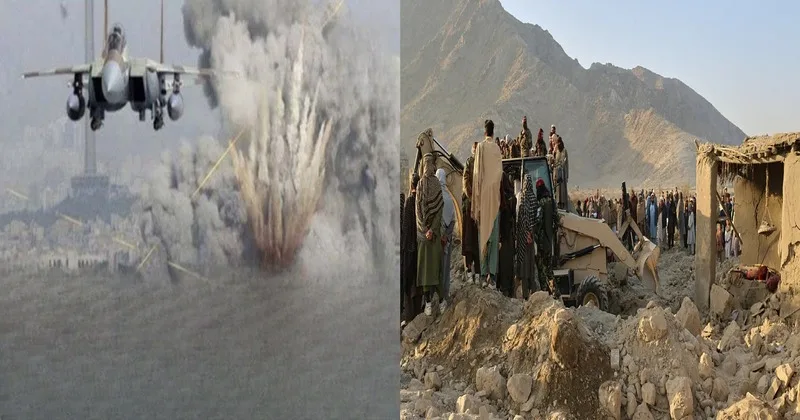
However, on the night of February 27, Pakistan launched a massive attack on Afghanistan across the border. The Defence Minister of Pakistan, Khawaja Asif, declared an “open war” against Afghanistan. Pakistan carried out airstrikes targeting the Afghan provinces of Kabul, Kandahar, Paktia, Nangarhar etc. The sound of fighter jets, massive bomb explosions and fierce gun firing was heard in the Kabul and Kandahar provinces that lasted for more than two hours. As a big irony, the Interior Minister of Pakistan asserted that it will not compromise on peace and territorial integrity. Apparently, a nation infamous across the globe for being a state-sponsor of terrorism and cross-border infiltration, speaks about peace and territorial integrity.
Kabul launches retaliatory strikes against Op Ghazab-Lil-Haq
In retaliation, Afghanistan also launched massive strikes targeting the military posts of Pakistan across the border of the Durand Line. However, the Pakistani forces assert that Afghanistan escalated the firing, and Islamabad responded to an unprovoked firing from Kabul. Pakistan responded to the repeated provocation of Afghanistan. Meanwhile, the people and refugees residing near the border areas have been evacuated owing to intense firing and bombing from both sides.
The latest confrontation between Pakistan and Afghanistan not just involves airstrikes but also intense artillery exchanges and ground invasion or assault as well across multiple fronts on the Durand Line, targeting key military installations and civilian regions. Pakistani sources reiterated that during the overnight firing, it eliminated more than 133 Taliban fighters and Tehreek-e-Taliban Pakistan(TTP) members. However, the official numbers and credibility of these claims by Pakistan remain doubtful.
Pakistan has titled the latest strikes targeting Afghanistan as ‘Operation Ghazab Lil Haq’. Afghanistan claims that it has given a befitting reply to this operation of Islamabad and has inflicted heavy casualties on the Pakistani military establishments. The Taliban government in Kabul asserts that during the retaliatory strikes, 55 Pakistani security personnel have been killed and 17 others have been taken hostage. Also, the bodies of 23 Pakistani soldiers were taken into custody, the Taliban government stated.
Kabul also exclaimed that two Pakistani Frontier Corps Headquarters have been destroyed and 19 military outposts have been captured by the Afghan soldiers. Also, military equipment and weapons have been seized from the Pakistani soldiers, Afghan government sources added. The Taliban government in Afghanistan have also widely circulated the video pertaining to these claims. The Afghan military has launched strikes targeting the Pakistani region of Khyber, Bajaur, Shawal, Waziristan, Khurram, Mohmand, Chitral, Angoor Adda and Torkham, along with other sectors in Khyber Pakhtunkhwa and parts of Balochistan. Taliban spokesperson Zabiullah Mujahid also warned that Afghanistan would continue its retaliatory strikes against Pakistan.
An effort to counter terrorism or conceal terrorism?
The repeated Pakistani strikes on Afghanistan is claimed by Pakistan as a counter-terrorism effort. The Duran Line, the international boundary between Pakistan and Afghanistan, has been historically disputed between the two countries since the British colonial era. Both Kabul and Islamabad have overlapping territorial claims, and Afghanistan in particular doesn’t recognise the Durand Line as the official boundary. However, this is not the sole friction point between Islamabad and Kabul.
Pakistan further asserts that the latest strikes is a counter-terrorism operation. Islamabad claims that Afghanistan is entertaining and providing a stronghold, nurturing the militant groups of Balochistan and the Tehreek-e-Taliban Pakistan(TTP) terrorists from its soil. These militants are channelised against Pakistan by Kabul, which apparently harms the peace and territorial integrity of the nation, claims Pakistan. This is deemed as the biggest hypocrisy of Pakistan. It is infamous for being a state-sponsor of terrorism, and the world’s most notorious terror organisations enjoy a safe haven in Pakistan. This was also exposed by India during Operation Sindoor when JeM and LeT headquarters were hit and destroyed. But Pakistan accelerates massive strikes and bombardments on Afghanistan or any other country, in the name of counter-terrorism.
On the other hand, Pakistan is also domestically and politically disintegrated, with separatist movements spiking in Balochistan, Sindh and other provinces, coupled with a steep economic crisis. This raises a pivotal apprehension about whether Pakistan aims to cover up its internal misdeeds, terror motives and political bankruptcy under the veil of counter-terrorism operations. Recently, reacting to Pakistan’s strikes on Afghanistan, the Ministry of External Affairs in India also asserted that by breaching Afghan sovereignty, Pakistan is aiming to externalise its internal failures. Thus, is the counter-terrorism operation a covert strategy of Islamabad to conceal its illicit terror motives and administrative failures? Is Pakistan trying to divert global attention away from its terror strategy and other systemic failures by dictating fake narratives in the name of counter-terrorism, doubts geopolitical analysts.