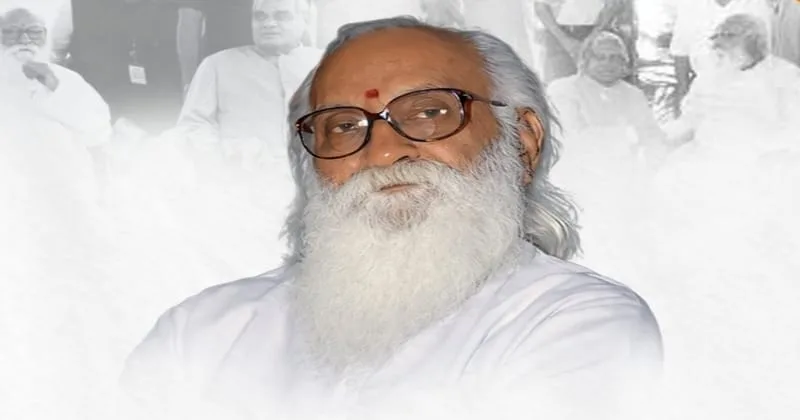
Today, on the death anniversary of ‘Bharat Ratna’ Nanaji Deshmukh, India remembers a visionary leader, social reformer, and nation-builder whose life was a shining example of selfless service. A founding member of the Jana Sangh, Nanaji Deshmukh’s journey was not defined by political ambition but by an unwavering commitment to the welfare of the people, especially the marginalised. Revered as the Rashtra Rishi, his legacy continues to guide generations in the pursuit of social justice, rural development, and national progress.
Nanaji Deshmukh’s philosophy was rooted in the principles of Antyodaya and Gramodaya, the upliftment of the poorest citizens and the holistic development of villages. For him, the true measure of a nation’s prosperity lay in the empowerment of its most vulnerable sections. He firmly believed that India’s strength emanated from its villages, and therefore, the progress of the nation could only be achieved when every village became self-reliant, educated, and healthy.
Through the Deendayal Research Institute, Nanaji Deshmukh implemented programs that transformed this vision into reality. He initiated educational schemes for rural children, health programs for underserved communities, and economic initiatives that enabled villagers to achieve self-sufficiency. His hands-on approach, often working alongside the people he aimed to serve, reflected his deep conviction that leadership is about serving, not commanding.
Nanaji Deshmukh’s contributions extended beyond social work. In politics, he maintained a rare blend of moral integrity and strategic vision. As a member of the Jana Sangh, he played a pivotal role in shaping policies that prioritised the welfare of ordinary citizens. Despite holding public office, he remained a simple, grounded leader who lived by the values he espoused. His life was a testament to the idea that politics, when combined with dedication and ethics, can be a powerful instrument for nation-building.
Recognised with the Bharat Ratna, India’s highest civilian award, Nanaji Deshmukh’s influence continues to resonate in contemporary social and political discourse. He inspired countless individuals to take up the mantle of service, emphasising that the welfare of the last person in society should always be a priority. His dedication to Antyodaya, which literally means “rise of the last person,” remains a guiding principle for policymakers, social workers, and citizens alike.
On this solemn day, as we remember Nanaji Deshmukh, it is essential to reflect on the enduring relevance of his ideals. In a rapidly changing India, where urbanisation and technological advancement often overshadow grassroots development, his vision reminds us that true progress is inclusive. Building strong villages, empowering the poor, and promoting ethical leadership are not just lofty ideals; they are practical necessities for a prosperous and just society.
Nanaji Deshmukh’s life, marked by humility, sacrifice, and unwavering commitment to the nation, serves as a beacon for all. The values he stood for, service, integrity, and dedication to the people, remain as vital today as they were during his lifetime. As we pay homage to the Rashtra Rishi, we reaffirm our pledge to uphold his vision and continue the journey of Antyodaya and Gramodaya, ensuring that his legacy shapes the India of tomorrow.