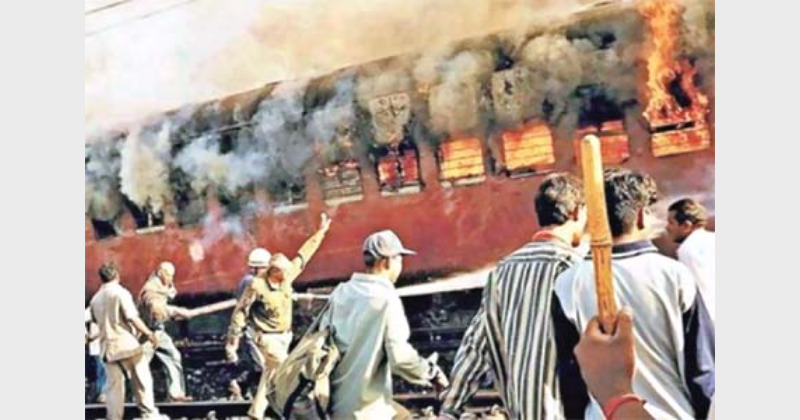
The events surrounding the burning of the Sabarmati Express near Godhra on February 27, 2002, remain among the most disturbing episodes in independent India’s recent history. More than two decades later, survivor testimonies, eyewitness accounts, and family recollections continue to surface, offering chilling details of the violence faced by kar sevaks returning from Ayodhya.
What emerges from these accounts is not a single moment of tragedy but a sequence of coordinated attacks marked by stone-pelting, incendiary substances, smoke-filled coaches, and passengers trapped with no means of escape. Women, children, and elderly devotees were caught inside sealed compartments as chaos unfolded within minutes, turning a routine journey into a scene of terror.
These narratives also underline the long shadow the incident has cast on families and survivors. From parents who lost young sons, to children whose lives were permanently altered, the consequences extended far beyond that morning near Godhra station. Memory, trauma, and the search for justice continue to shape lives years after the flames were extinguished.
Together, these testimonies form a collective record of suffering, survival, and loss. They are crucial not only for understanding what happened but also for acknowledging the human cost borne by those on board the train. The detailed 11 Kar Sevak Victims-The Painful Testimonies of The Sabarmati Express Fir, are given below.
1. Stone-Pelting and Smoke Cause Chaos in Sabarmati Express Coach S/6, Bhatia Couple Recounts Ordeal
Ahmedabad residents Mandakini Bhatia and Neelkanth Bhatia have recounted events that occurred during their journey on the Sabarmati Express on February 27, 2002. The Bhatia couple was traveling from Faizabad to Ahmedabad in coach S/6 of the train.
According to their account, the train departed Ayodhya with a delay of approximately two hours. At around 7:55 a.m., when the train reached Godhra, heavy stone-pelting suddenly began on their coach. They stated that stones were thrown continuously for nearly 15 to 20 minutes. A large number of people had gathered outside, and the situation became extremely tense.
The couple said the train moved slightly forward, but the attacks resumed soon afterward. They reported that the doors of the coach had been closed. Within a short time, smoke began to fill the coach, leading to panic among the passengers.
They stated that people attempted to get out, but there was only one door in the coach and the windows were fitted with iron bars. Due to the smoke, several passengers lost consciousness and fell, further blocking the exit.
According to the Bhatias, they were somehow pulled out of the coach, but many others remained trapped inside. They described scenes of screams, thick smoke, and flames all around. Mandakini Bhatia said the day was the most terrifying experience of her life, and the memory continues to deeply disturb her.
2. Attack With Acid and Petrol Bottles on Train, Udayan Rawal Describes Incident
Victim Udayan Rawal has described events that took place in 2002 while he was returning after a religious visit. According to his account, the train was standing at the station in the morning when some volunteers got down to brush their teeth, wash their faces, and have tea. At that time, stone-pelting suddenly began from the station side.
Rawal stated that after a short while, the train departed from the station. After traveling approximately 500 meters, the train came to a sudden halt. He said that a large number of people were then seen approaching the train from the left side.
According to Rawal, the group was carrying sticks, sharp weapons, and glass bottles. He stated that the bottles contained acid or inflammable substances. When these bottles were thrown at the coaches, they burst and their contents affected the inside of the compartments, causing panic among the passengers.
He said that the windows were immediately shut, but the stone-pelting continued and glass panes were breaking. Rawal stated that he was traveling in coach S-8, where women and children were sitting huddled together in fear. He reported that threats and abuses could be heard from outside the train, and passengers were repeatedly questioning whether they would survive.
Rawal further stated that suddenly there were shouts that the train had been set on fire. He said that flames were seen rising from the front coaches, particularly coach S-6. Smoke spread rapidly, and the situation became extremely frightening. Rawal stated that the events of that morning remain alive in his memory as a painful scene.
3. Sabarmati Express S/6 Coach Set Ablaze Near Godhra, 59 Passengers Killed
The S/6 coach of the Sabarmati Express was set on fire near Godhra on February 27, 2002, a few stations before the train’s destination, Ahmedabad. The incident took place between 8:00 a.m. and 8:20 a.m. near the A cabin, when the train was a short distance from Godhra railway station.
According to the account, 59 passengers were burned alive in the incident, including 27 women and 10 children. Another 48 passengers sustained injuries. Most of the passengers traveling on the train were Ram sevaks, also referred to as kar sevaks.
The train had departed from Muzaffarpur on February 25 and was approaching Ahmedabad with nearly 1,700 kar sevaks on board at the time of the incident. The sevaks were traveling as part of a plan to attend the Purnahuti Maha Yagna associated with the Ram Mandir Nirman programme in Ayodhya, organised by the Vishva Hindu Parishad.
4. Godhra Train Burning: Families Recall Losses Fifteen Years After Sabarmati Express Incident
Seventy-seven-year-old Sardar Magan Vaghela continues to remember his son Rajesh, who was killed in the Sabarmati Express train burning at Godhra fifteen years ago. Sitting in his one-room home with a balcony near Khokhra Circle, Vaghela said he believes his son died for a cause and that his sacrifice would not go in vain.
Rajesh Vaghela, aged 26 at the time, was among the 59 kar sevaks traveling in the S/6 coach of the Sabarmati Express, which was set on fire at Godhra railway station in 2002. According to Vaghela, his son had gone to Ayodhya for the Ram Temple movement. He said that although the temple had not yet been built, he believed it eventually would be.
Vaghela, who earlier worked at a textile mill in the area, said he has become more religious since the incident. He stated that he is associated with the dharm prachar vibhag of the Vishva Hindu Parishad and travels to various places narrating the story of his son.
He said he was financially dependent on Rajesh, as his elder son Pravin lives separately. Vaghela stated that the family was devastated after Rajesh’s death and received compensation of about Rs 4 lakh from the government. He added that most of the amount was taken by Rajesh’s widow, Chanda, who later left the family.
According to Vaghela, he had to fight to keep custody of his grandson Jatin, who was five years old at the time of the incident. Jatin said he does not remember many details from that period but recalled that his childhood was marked by difficulties after his father was killed in the Godhra incident. He said he struggled with his studies and dropped out after Class X. Jatin currently works at a paan stall in the locality, earning a stipend of Rs 4,000 per month.
Vaghela said that every year on the anniversary of the incident, family members visit Khokhra Circle to remember those who lost their lives. He said he feels pride in his son while also expressing sadness that the temple has not yet been built, pointing to Rajesh’s photograph displayed above the bed.
In another account, Neha, 38, a resident of Surelia Estate in Vastral, said she is caring for her bedridden mother, whose health has deteriorated due to age-related complications. Neha said her mother survived the news of the deaths of her husband Mansukhbhai Soni, 62, and son Jeshal, 24, who were killed in the same incident.
Neha said her children, daughter Vishwa and son Dhairya, studying in Classes VII and IV respectively, are aware of what happened to their maternal grandfather and uncle. She said the children were told about the incident and have understood it.
5. Elderly Women Pleaded for Their Lives as Attack Continued, Survivor Gayatri Panchal Recounts
Sixteen-year-old Gayatri Panchal, a Class XI student, was returning from Ayodhya when she witnessed events in which her parents and two sisters were burned alive in front of her. Panchal is a resident of Ramol in Gujarat and was traveling with her family as part of a group returning from kar seva.
According to her account, Harshadbhai Panchal had left for Ayodhya on February 22 with his wife Neeta and their three daughters, Pratiksha, Chhaya, and Gayatri. Traveling with them were Neeta’s sister, her son, their neighbor Poojaben, and Poojaben’s fiancé.
Gayatri stated that on the morning of February 27, at around 8 a.m., the train departed Godhra station. She said kar sevaks inside the train were chanting Ram dhun loudly when the train moved only a few meters before coming to a sudden halt. She said that before passengers could understand what was happening, a large crowd was seen advancing toward the train.
According to Gayatri, people in the crowd were carrying weapons including guptis, spears, swords, and other sharp arms, and stones were thrown at the train. She said passengers were frightened and managed to shut the windows and doors of the coach. She stated that people outside were shouting slogans such as “maro, kaato” while attacking the train. She also said announcements were heard over a loudspeaker from a nearby mosque calling for attacks.
Gayatri said the entire coach was soaked with petrol and passengers were crying for help, but no assistance arrived. She stated that some police personnel were seen approaching the coach but were driven away by the crowd present outside. According to her, smoke filled the compartment to the extent that passengers could not see each other and were gasping for breath.
She said that escaping was extremely difficult, but she and Poojaben managed to jump out through a window. She stated that Poojaben suffered a back injury and was unable to stand. Gayatri said people outside attempted to catch them, but they managed to escape and crawled forward beneath the burning train.
Gayatri stated that she witnessed her parents and sisters being burned alive in front of her eyes.
6. Loss From Sabarmati Express S-6 Fire Shapes Lives of Survivors’ Children
Harsh Chondagar was five years old when he learned of his mother’s death in the burning of the S-6 coach of the Sabarmati Express near Godhra railway station on February 27, 2002. He later decided to work in fire services and has since become a qualified fireman.
Chondagar, now 19, has joined the fire brigade in Vapi. He said his mother, Amiben, was among the 59 people who lost their lives in the fire. He recalled that her body was brought to their home in Jantanagar on February 28, 2002. He stated that losing his mother in the fire influenced his decision to enroll at a firemen’s training institute. He added that the situation at the time could have been different if more fire engines and fire personnel had been present.
Chondagar was among 23 individuals who had suffered losses during communal violence and gathered at a motivation programme organised by the Times Foundation at SEWA in the Ellisbridge area of Ahmedabad.
Another participant, Chirag Mhatre, 19, a first-semester civil engineering student, said he lost his mother, Malaben, who had gone to Ayodhya for the Ramjanmabhoomi pujan with kar sevaks. Mhatre said that when he was younger, he believed members of the minority community were responsible for his mother’s death. He stated that as he grew older and began to understand politics, he realised he did not know who was responsible or whether those involved belonged to any particular community. He said he believes political actions affected his life permanently.
Shweta Raval, 19, and her brother Mihir, 14, also shared their experience at the programme. They lost their father, Mehulkumar, on February 28, 2002, after riots broke out in the Ghodasar area. Shweta said the family had shifted to Ghodasar from their home in Vatva when the situation became tense. She stated that a day after the first incident of rioting, her father went to check on their house but did not return. She said only his motorcycle was later found. Shweta is currently pursuing a civil engineering degree.
7. ’It Was Vandalism at Its Worst,’ Survivors Recall Stone-Pelting on Sabarmati Express
Survivors of the attack on the Sabarmati Express near Godhra on February 27 described the assault on the train as extreme and indiscriminate vandalism.
Sixty-five-year-old Devika Luhana, who was among those travelling, said she was “shaking with anger” as she got off the ill-fated train. She said stones were pelted without restraint and that old people like her were not spared in the violence.
Other passengers echoed similar accounts. A contingent of women kar-sevaks, many of them senior citizens, had gone to Ayodhya for a religious purpose, and they expressed shock that they were attacked while returning. One woman said the attackers stormed inside the women’s coach and set it on fire before passengers could react, trapping some inside.
Among the crowds at the Ahmedabad railway station as survivors arrived, relatives and supporters gathered to find missing passengers. Leelaben Dhobi, another survivor, said she could not find her son among those arriving on trains, and appealed for information about his whereabouts. Ghislulalji Vaishnav of Bopal also said he was unable to locate four young men from his area who had travelled together.
The article was published by The Times of India on February 28, 2002, and reflects immediate reactions from passengers and relatives following the attack on the Sabarmati Express.
8. Woman Witness Says Entire Coach Was Set on Fire, Several Passengers Trapped
Hetal Patel, an eyewitness to the Sabarmati Express incident, recounted that attackers entered the women’s coach and set the entire compartment on fire before passengers could react.
In her account, Patel said that some passengers managed to escape, while several others remained trapped inside the burning coach. She described the incident as terrifying, stating that the fire spread rapidly after the attackers entered the compartment.
Patel’s statement was recorded on March 6, 2002, as part of survivor accounts related to the train burning incident.
9. Eyewitness Recalls Stone-Pelting, Smoke, and Escape From Sabarmati Express Coach
Gyanprakash, an eyewitness to the Sabarmati Express incident, described the events he witnessed on the morning the train was attacked after leaving Godhra.
According to his account, the train had just departed Godhra station but came to a halt a short distance away. He stated that stone-pelting began suddenly and continued for nearly an hour. After this, he said something was thrown into his coach, following which smoke spread throughout the compartment.
Gyanprakash said the smoke made it difficult to breathe and that he could barely draw breath. He stated that he heard his father telling him to get off the train. When he went to the door, he saw people who were attempting to get down being attacked with knives.
He said he then moved to the other side of the coach and jumped off the train. Gyanprakash stated that he cannot forget the sight of people burning in front of him.
10. Eyewitness Describes Escape Through Broken Window During Sabarmati Express Attack
D. Bhattacharya, an eyewitness to the attack on the Sabarmati Express, described the circumstances under which he escaped from the train during the incident near Godhra.
According to Bhattacharya, he noticed a broken window whose iron bars had been twisted apart as a result of the attack on the train. He stated that at that moment he was faced with a choice between remaining inside the coach as flames approached or attempting to escape through the window.
Bhattacharya said the fire was closing in on him and that staying inside would have resulted in him being engulfed by the flames or suffocated by smoke. He stated that the alternative was to climb out of the window and face the hostile crowd outside. He said he chose to escape through the window.
The account was given by D. Bhattacharya as part of eyewitness testimonies recorded on February 28, 2002.
11. High Court Life Sentences Disappointing, Says Relative of Sabarmati Express Victims
Bipin Thakkar, who lost family members in the Sabarmati Express train burning, expressed disappointment over the Gujarat High Court’s decision to award life imprisonment to the convicted persons in the case.
Thakkar said his father-in-law and brother-in-law were killed in the Sabarmati Express fire. He stated that he was dissatisfied with the High Court’s decision to commute the sentences to life imprisonment and said the death penalty awarded earlier by the trial court was the correct decision.
He said that if required, he would approach the Supreme Court of India even if he had to do so alone to seek what he described as proper justice. Thakkar added that his wife was not yet aware of the High Court verdict and said she would be deeply saddened upon learning of it.
Taken together, these eleven accounts form a stark and unbroken narrative of violence, fear, and irreversible loss. They document not only the physical assault on a train but the systematic trapping of passengers, the use of incendiary substances, and the collapse of any immediate rescue as smoke and fire engulfed sealed coaches.
The testimonies also reveal the long-term consequences of the incident. Children grew up without parents, families slipped into financial and emotional hardship, and survivors carried memories that continue to disturb them decades later. Justice, for many, remains incomplete, and the sense of grievance has not faded with time.
These records stand as a reminder that behind statistics and court judgments lie human lives altered forever. Preserving and revisiting these accounts is essential to understanding the seriousness of the incident and the enduring impact it has had on victims, families, and society at large.