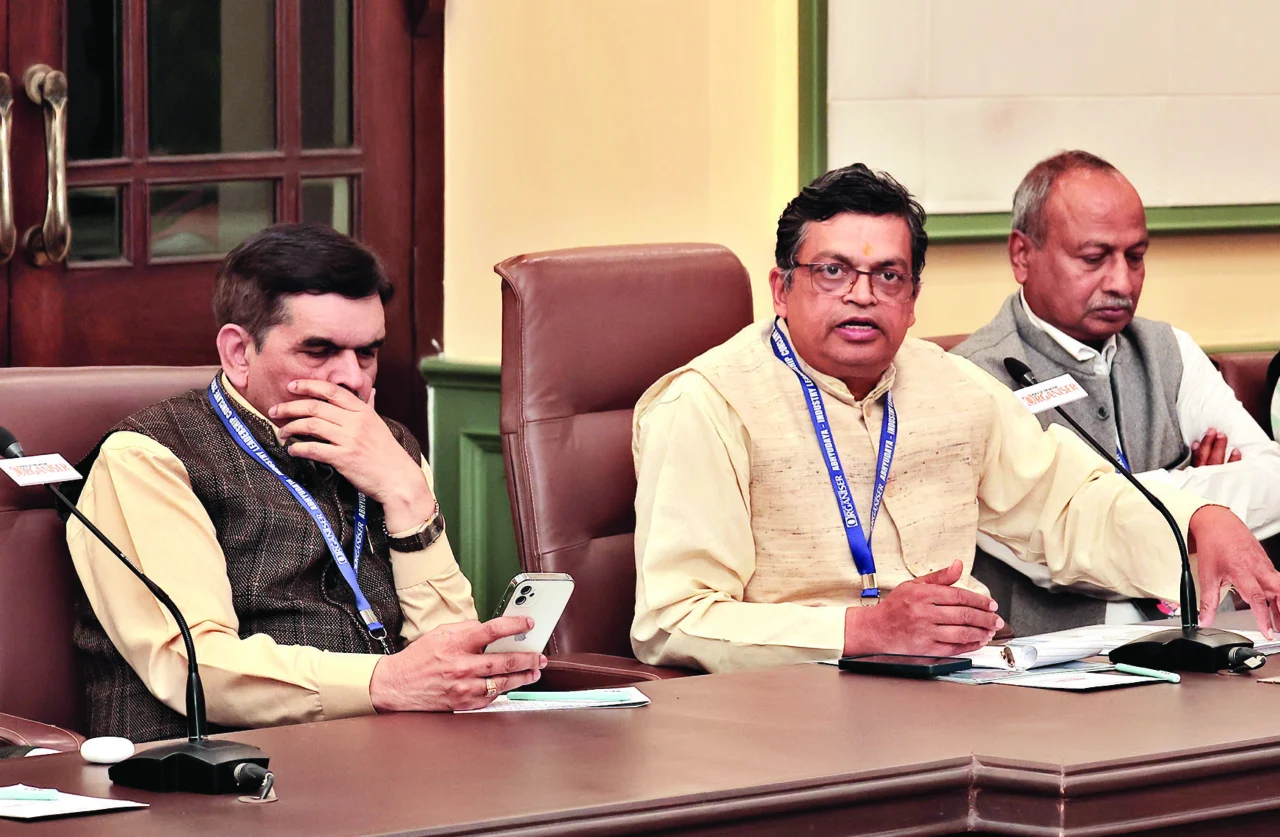
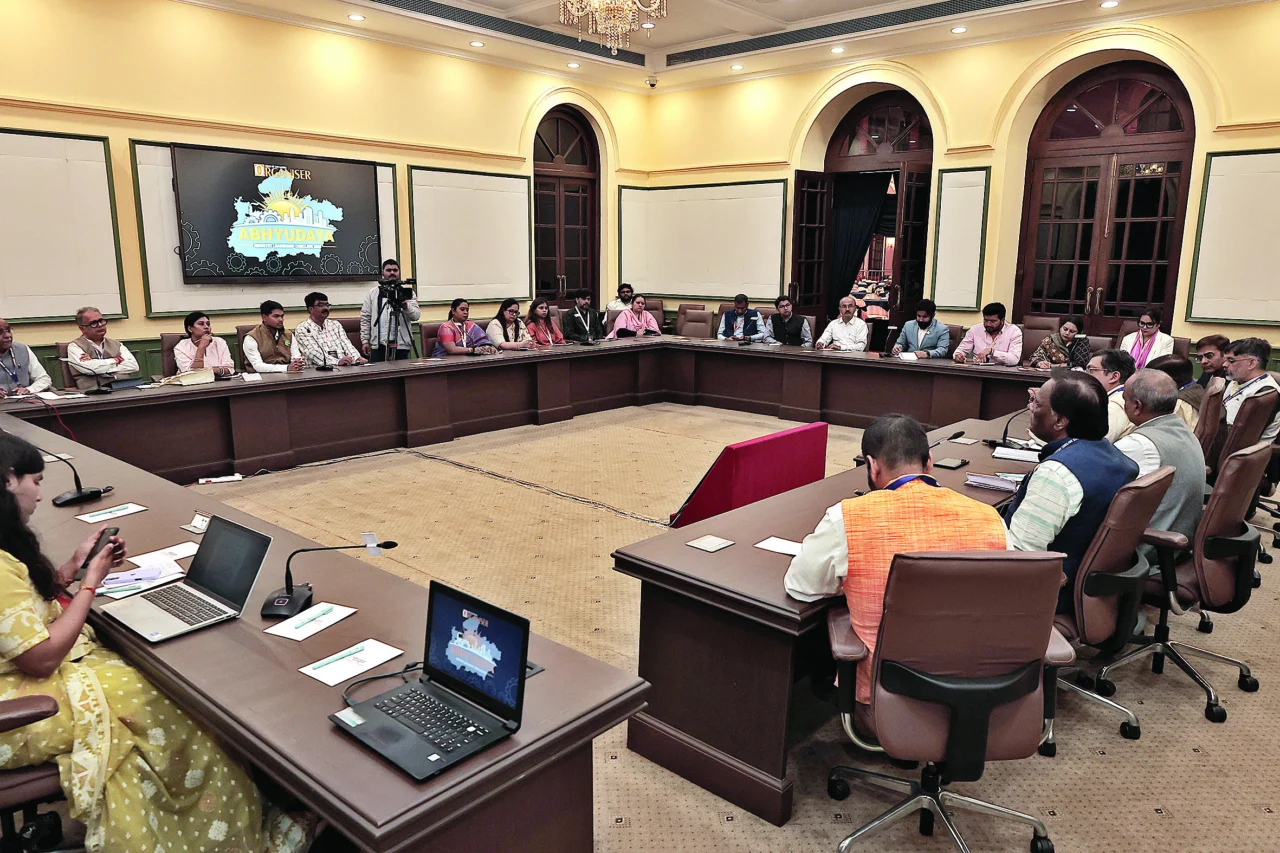
This year’s Budget is extremely significant. With the goal of Viksit Bharat by 2047, it must be seen as a foundational vision document. Across the country, outreach programmes are being conducted, and all suggestions received will be incorporated. We are engaging at the state level as well,” stated Gopal Krishna Agarwal, National Chairperson of the Bharatiya Janata Party Economic Affairs Cell and National Spokesperson of BJP. He was speaking at the MSME Round Table that was convened as part of the ‘Abhyudaya’ event in Bhopal, bringing together policymakers, entrepreneurs and domain experts for a focused and policy-oriented discussion. The conference was chaired by Gopal Krishna Agarwal. In his opening remarks, Agarwal noted that across 11 consecutive Budgets, Bharat has maintained strong macroeconomic fundamentals. High growth rates have been sustained, inflation has been kept under control, and the debt to GDP ratio has been managed prudently.
From cooperative to competitive federalism
On the strength of these fundamentals, the Government is now preparing to accelerate growth further. Agarwal observed that while cooperative federalism has been a defining feature of recent years, the current Budget introduces a new dimension, competitive federalism.
In the past, projects were directly assigned to specific states. However, this time, many schemes have been left open-ended. States are expected to bring forward their own proposals to the Central Government and projects will be sanctioned based on merit rather than pre-allocation.
Six key focus areas have been identified under this approach – Mega Textile Parks, Revival of 200 MSME Legacy Clusters, Development of Iconic Heritage Sites, City Economic Zones with Rs 5,000 crore infrastructure support, Health Services Hubs, and Entrepreneurship Development Hubs. A massive Rs 12.2 lakh crore has been allocated for infrastructure. In addition, states have been provided access to Rs 5 lakh crore through 50-year interest-free bonds to accelerate development.
The conference also discussed future-oriented sunrise sectors that are expected to drive long-term growth. These include global data centres, space technology, nuclear power, power sector expansion, rare earth metals, high-tech tools, AI support systems and the cultural economy.
These sectors are expected to benefit MSMEs directly, particularly within the framework of Free Trade Agreements (FTAs). Just as the Goods and Services Tax (GST) underwent structural reforms, significant changes are anticipated in customs duty structures. Discussions are underway to drastically reduce duties on technology imports, and the government is actively working in this direction.
Licensing Reform And Ease Of Doing Business
Several speakers highlighted the need for systemic reforms in licensing and compliance. Dr RS Goswami, CMD, Hind Pharma pointed out that under the Factory Act, permits and licenses have been extended to a 10-year validity period without annual renewal to enhance ease of doing business.
He observed that 99 per cent of industries manufacture simple and unregulated products. Once the prescribed fee is deposited, a 10-year validity is granted. Yet exploitation persists. In the event of accidents or fire incidents, authorities often question the validity of licenses.
MSME Definition, Incentives And Manufacturing Excellence
At the state level, the investment limit under MSME definitions has been increased. However, if investment exceeds Rs 10 crore, proposals must go before a state-level committee, and incentives are disbursed over seven years. At the district level, incentives are provided over five years.
It was suggested that incentives for manufacturing excellence should be limited to five years to encourage efficiency. For export-oriented units, selecting 5,000 industries across sectors could prepare Bharat for
global competition. Speakers cautioned that once FTAs are operational and imports increase significantly, domestic industries must be prepared to compete effectively. Although MSME is technically a state subject, the MSME Act of 2006 was passed by the Government of India. Uniform nationwide implementation remains incomplete, and reforms may be necessary to ensure consistency.
Startups, Finance And Manufacturing Focus
Participants observed that while startups are emerging rapidly, many are also failing. Technology alone is insufficient; integration with finance and economic viability is essential. Bharat’s comparative advantage has traditionally been in the service sector, but the long-term growth opportunity lies in manufacturing. Credit policy must be straightforward and affordable. With borrowing costs ranging between 15 and 16 per cent, industries struggle to survive. Procurement policy reforms were also discussed. MSME preference should be embedded in modern legislative frameworks. Each state should incorporate domestic preference in procurement policies. Concerns were raised about procurement practices in sectors like railways, where goods and works procurement operate under different frameworks. In the works segment, participation appears concentrated, limiting broader domestic involvement.
Integrating Traditional And Emerging Sectors
Dr Sandhya Chouksey, Executive Director, LNCT Group Bhopal, shared innovative integration models. A large gaushala spanning 25 hectares with a 12,000 cattle capacity is being developed through the municipal corporation. The discussion examined how mechanical students and MSMEs could collaborate in cow-based agriculture and related industries. There was also interest in developing the Narmada Path as an eco-tourism model, linking traditional assets with modern enterprise frameworks.
Sumit Pandey, MD, FALCON India, highlighted interstate investment barriers. For example, if an investor from Maharashtra wishes to invest in Madhya Pradesh, procedural hurdles often arise. A national-level integrated software solution could resolve this. He cited the success of the 181 helpline in grievance redressal and suggested establishing a similar industrial helpline to address compliance-related issues. Strengthening the Udyog Mitra model was also proposed.
The rapid embedding of generative AI into global systems was discussed extensively by Siddhartha Rastogi, Principal Officer, MD and Chief Operating Officer AMBIT Asset Management. However, Bharat currently lacks a clear policy framework for global data warehouses, electricity infrastructure and hardware integration. A single-window clearance mechanism in these sectors would be beneficial.
Karan Khurana, Managing Director of Sage Group, emphasised that to utilise FTAs effectively, beginner-level support must be provided to MSMEs and startups. Approval timelines require reduction, and tracking mechanisms must be established. Bharat needs more R&D hubs and innovation laboratories. For FTA enablement, digital certification, mutual recognition agreements and proactive import-export clearance support are necessary. Strengthening standards and quality certifications is critical. Government involvement in discovery and sales enablement was also discussed.
Compliance integration and entrepreneurship nurturing
Gagan Kumar pointed out the multiplicity of compliances at central, state and municipal levels. An integrated dashboard providing real-time status visibility could ease the burden. New businesses would benefit from structured government handholding during the initial stages. Kamlesh Pratap Singh, MD, Pitambar Cerelacs Pvt Ltd highlighted the struggles of first-generation industrialists who often lack financial and technological knowledge. Establishing Entrepreneurship Development Hubs is crucial. The state could consider participating in capital contribution and loan structures to support emerging manufacturers.
Mitesh K Lokwani, MD, HLBS TECH (P) LTD and President, Laghu Udyog Bharati, Bhopal stressed the strategic importance of processor technology. China has developed its own microprocessors under the CEC Group. Bharat faces a design and core technology gap. Government funding could enable processor design domestically, with fabrication initially undertaken in Taiwan before eventual localisation.
Ashwini Mahajan, Economist and National Co-Convenor, Swadeshi Jagaran Manch concluded by observing that despite initiatives such as Make in India and Atmanirbhar Bharat, manufacturing’s share in the economy has declined over time, disproportionately affecting MSMEs. As global dependency on China reduces, Bharat has a historic opportunity. Entrepreneurs must recognise that domestic manufacturing capacity and integration into global value chains are essential. Unnecessary compliances must be abolished, new technologies adopted, and redundant frameworks dismantled. “The government must facilitate, not administer,” he asserted.
The Round Table Conference in Bhopal emerged as a comprehensive policy brainstorming session, bridging macroeconomic vision with grassroots industrial realities. With competitive federalism, infrastructure expansion, sunrise sector investments and compliance reform forming the core agenda, the deliberations signalled a clear direction: strengthening MSMEs is not merely an economic priority, but a structural necessity for achieving Viksit Bharat by 2047.